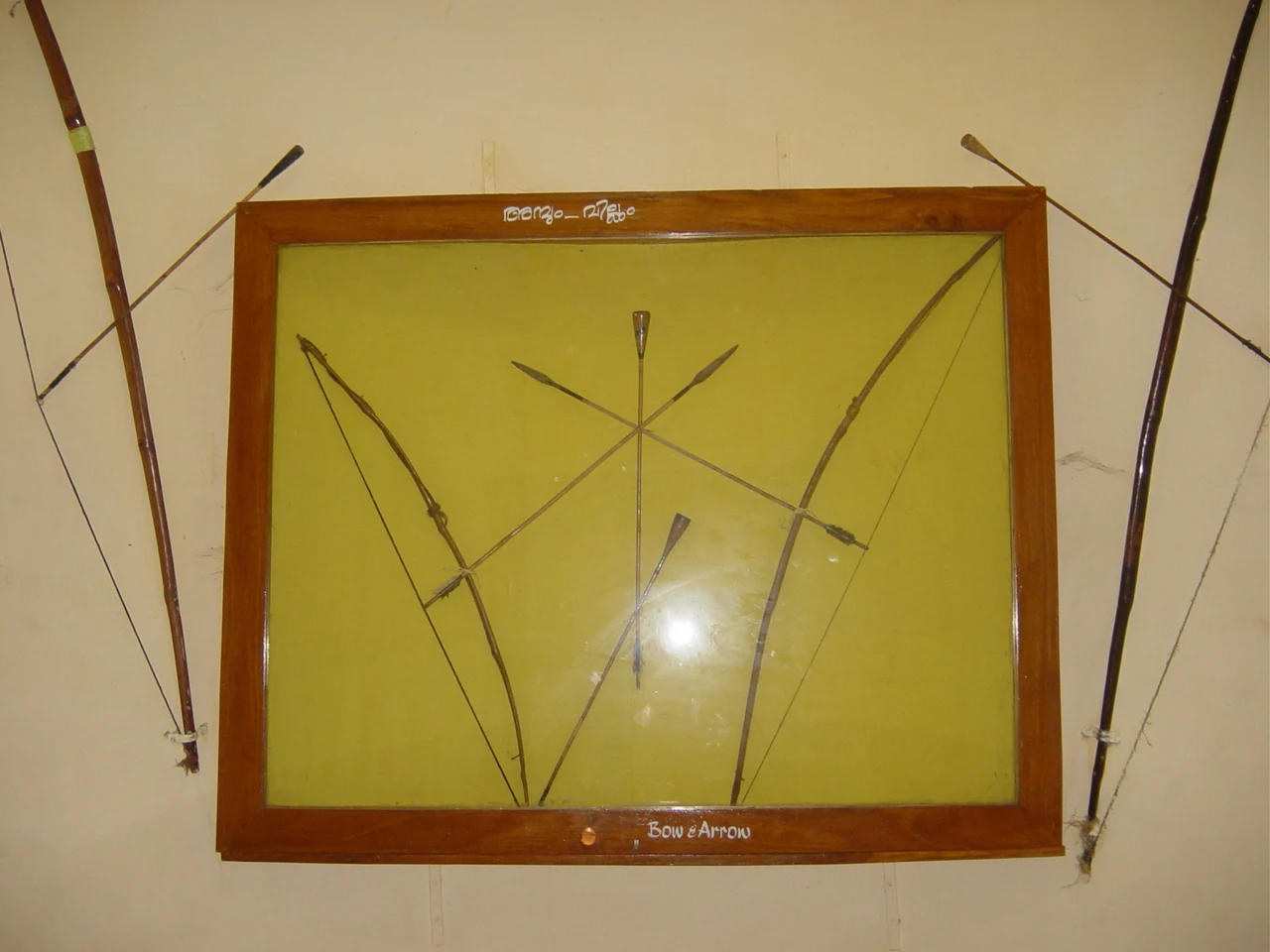
A glass case holds bows and crossed arrows against a plain backing. The label names the objects, while reflections remind the visitor that they are being seen through a museum display. The temptation is to attach them immediately to the most famous person associated with the building. A better first question is what the individual label actually says about their origin and use.
Begin with attribution
Pazhassi’s name gives the Mananthavady museum a clear focus, but it does not turn every exhibit into a personal possession of the ruler. A display may illustrate a community, a technology, an archaeological period or a political event. Those are all worthwhile subjects. Treating them as different forms of evidence gives the collection more depth than a search for celebrated relics alone.
At the weapons display, begin with the label’s material and provenance, then compare it with the object behind the glass. The curvature of a bow and the shape of an arrowhead reveal different parts of its construction. The gallery places these objects within a museum account of Pazhassi’s period, while individual labels distinguish what is known about a particular piece.
Four galleries, four changes of scale
The museum’s official introduction names the Pazhassi, Tribal, Heritage and Coin galleries. The first offers the resistance narrative and associated documents; the others widen the visit into community life, archaeology and currency. That arrangement rewards a complete circuit rather than a brief stop at the weapons.
In the document displays, separate the text’s original date from the date of the copy in front of you. A facsimile can preserve the appearance and wording of an important document without being the original sheet. The distinction does not reduce its usefulness. It tells you what kind of encounter the museum offers: reading a reproduced historical record rather than inspecting the physical paper on which it was first written.
In the Tribal Gallery, an agricultural implement or musical instrument directs attention towards skills and daily life. The important question changes from “what happened in the conflict?” to “how did people work, make and perform?” The communities represented here should remain visible as communities, with cultural lives that extend beyond their relationship to a ruler.
The Heritage Gallery changes the timescale. Archaeological material belongs to histories much older than the resistance commemorated outside. Notice whether a label concerns a burial, a settlement, a religious site or a marked rock surface. These categories are not interchangeable, and recognising the difference makes a small case easier to understand than trying to absorb every date at once.
Coins ask for close comparison. Size, lettering and an emblem may distinguish one issue from another, but identification should follow the label rather than a guess from colour. A coin also carries a question about circulation: whose authority issued it, and in what wider world did it move? Even without specialist knowledge, that question gives a case of small objects a useful structure.
Give each room a different question
A practical way to read the museum is to carry one question into each section. Who wrote this document? What task did this implement perform? What kind of archaeological context does this object come from? Which authority issued this coin? The questions keep the visit specific and reduce the pressure to memorise a long sequence of unfamiliar names.
The outdoor memorial then becomes a point of return. Its single named subject is surrounded by a museum that refuses to fit the district into one biography. Take that wider view back into Mananthavady: the value of the visit is not only in remembering a leader, but in noticing the different kinds of evidence through which a region remembers itself.
Plan the visit: Pazhassi Smarakam in Mananthavady.