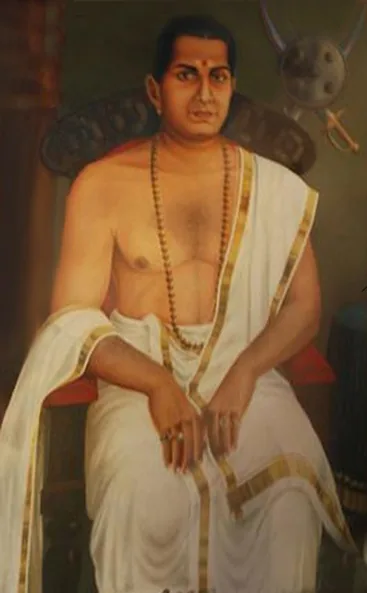
On the bank of the Kabani river in the middle of Mananthavady there is a tomb that marks the spot where a king's body was burned. The king was Kerala Varma Pazhassi Raja of the Kottayam dynasty of North Malabar, and his people still mark his birth anniversary every 3 January. Kerala Tourism remembers him as one of the few Indian leaders to win a military victory over the British. His tomb stands here in Wayanad, far from his own country near Kannur, and the reason lies in the war that drove him into these hills.
Pazhassi Raja fought the British rule fiercely, and when the East India Company pressed him hard, he was forced to take refuge in the Wayanad wilderness. The forest that should have been his hiding place became the base for a new plan instead. Rather than meet the Company's regiments in open battle, he would fight them on ground that only the people of the hills knew well.
Those people were the Kurichiya tribes of Wayanad, and the raja organised them into his fighting force. Their guerrilla warfare caused the British forces great damage and loss, because columns that marched into the forest met an enemy they could not see. The same forest communities still gather each Meenam at Valliyoorkavu Bhagavathy Temple, which is why Kerala Tourism places that grove temple on its Pazhassi Circuit beside the raja's tomb.
The forest war did not end with a surrender. The British won the war against the raja's forces in 1805, but they never captured him alive. The last refuge Kerala Tourism names is the Pulpally cave, and the end came at Mavilanthode near Pulpally, where the King of Kottayam was martyred in 1805. Kerala Tourism's own pages tell that last moment in two ways. One is a death at Mavilanthode, and the other is a king who killed himself in the depth of the forest rather than be taken.
Today Mavilanthode is the site of the Pazhassi Raja Landscape Museum, which keeps that last stand in view. A memorial stone and a statue honour his stand against British rule, and fibre sculptures in an open-air museum tell his life in scenes. The site opens from 9 am to 5.30 pm, according to Kerala Tourism in November 2026, and its park and library are still being built.
From Pulpally the raja's body was brought to Mananthavady and burned beside the Kabani, and the tomb rose on the cremation ground. In March 1996 the Kerala State Archaeology Department turned it into a museum, now known as Pazhassi Smarakam. Its four galleries are the Pazhassi, Tribal, Heritage and Numismatic galleries, so the king's war sits beside the lives of the tribes who fought it.
The objects in those galleries make the war concrete rather than legend. There is Pazhassi Raja's sword, and there are the British orders and letters written to put down the Pazhassi revolt. Next to them lie the tools, utensils, furniture and weapons of the tribal groups. Coins from several Kerala dynasties, stone statues and works by Raja Ravi Varma fill the rest. Kerala Tourism gave the museum hours as 9 am to 5 pm, closed on Mondays, in November 2026. The garden around the tomb is a favourite picnic spot for families from town.
Most visitors join the two places into one day, because they tell the beginning and the end of the same story. The tomb in Mananthavady shows the king remembered. Mavilanthode near Pulpally shows where the war ended, and the drive between them runs through the farm and forest country he fought over. Kerala Tourism's Thalassery Heritage Project lists both among the 21 places on its Pazhassi Circuit, which runs back to his home country in the north.
The raja who never let himself be taken now lies at the heart of the forest country he defended. For the shrine whose festival brought those forest families together every year, and the darker bargain once struck there, read the story of Valliyoorkavu. The oldest pilgrim road in this corner of the district leads to Thirunelli, the Kashi of the South, and for the wider district start at the Wayanad hub.
Frequently asked questions
Who was Pazhassi Raja?
Kerala Varma Pazhassi Raja was a king of the Kottayam dynasty of North Malabar. He fought British rule from the Wayanad forests with the Kurichiya tribes.
Where is Pazhassi Raja's tomb?
It stands on the bank of the Kabani in Mananthavady, on the spot where he was cremated. Since March 1996 it has been a museum run by the Kerala State Archaeology Department.
Where did Pazhassi Raja die?
He died in 1805 at Mavilanthode near Pulpally in Wayanad, where the Pazhassi Raja Landscape Museum now stands.
What can you see at the Pazhassi tomb museum?
His sword and British letters against the revolt. Four galleries also hold tribal tools, old coins and works by Raja Ravi Varma.