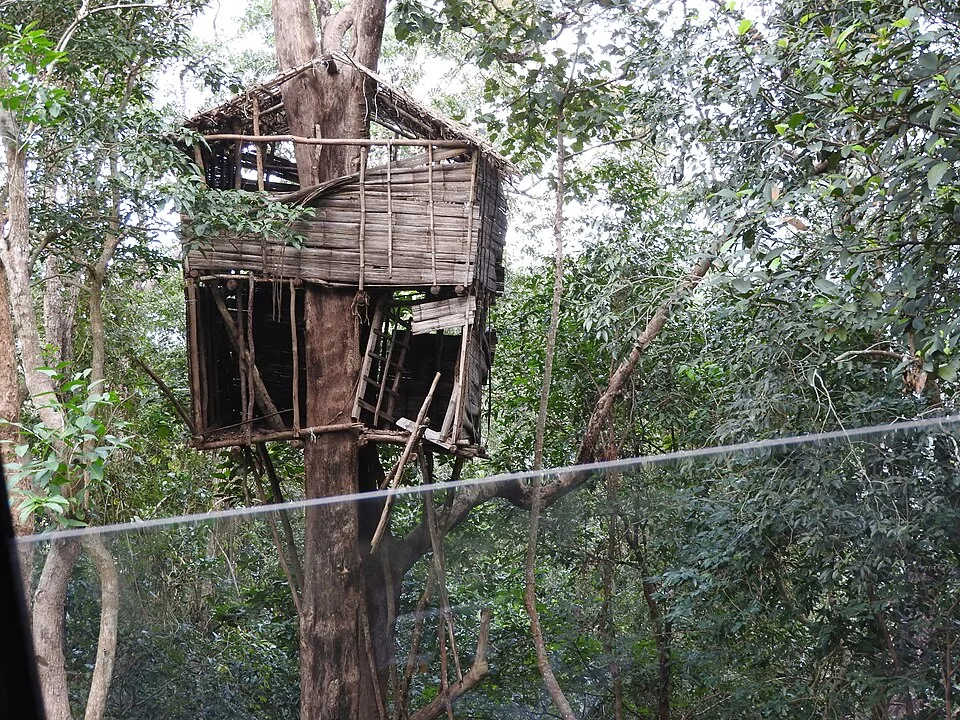
The first thing to understand about walking in Peppara is that you will mostly not see animals. The second is that this is not a failure of the walk.
Sign, not sightings
In closed evergreen forest with sightlines under twenty metres, tracking replaces spotting. What a guide shows you is the record animals leave behind, and once you can read it the forest stops being a wall of green.
Elephant is the easiest to learn. Dung, its moisture telling you roughly how old it is; bamboo pushed over and stripped; mud rubbed onto trunks at shoulder height; a path through undergrowth that is too wide and too clean to be anything else. Elephant sign on these trails is frequent, and reading it is how you know whether to carry on or wait.
Then the subtler things. Scratch marks. Chewed fruit dropped from the canopy, which tells you what was overhead and how recently. And sound above all — a langur alarm call two ridges away means something is moving over there, and a guide will stop and listen to it for a full minute while you wonder why you have stopped.
How to be worth taking
Move at the guide’s pace, which will be slower than yours. Most of what gets missed on these walks is missed because a group is walking at conversational speed.
Be quiet, genuinely. Not whispering-theatrically quiet, but not talking. Every unhabituated animal within a couple of hundred metres has a vote on whether you see anything, and they cast it early.
And do not push for a sighting. Guides get asked to go closer, go faster, go off the route, and the good ones will refuse. Pursuing an animal in unfenced forest is how people get hurt, and it is worst with exactly the species people most want to see up close.
The one long view
There is a break in it. From the higher ground the Peppara reservoir opens out below with the forested ridges of the Agasthyamala foothills behind, and it is the only place on these walks where the eye gets to travel.
It is also the one place where the temptation to go down to the water needs resisting. The drawdown banks — the ground exposed as the reservoir falls through the dry season — are soft and unstable, the water is deep very close in, and the open shoreline is the most heavily used elephant ground in the catchment.
What you actually take away
Two hours of moving slowly through green light, with somebody pointing out things you would have walked straight past, in one of the few pieces of lowland wet evergreen forest in the far south that is still intact enough to hold what it holds.
If a lion-tailed macaque appears, that is a very good morning. If not, you have still spent it inside a rainforest with somebody who can tell you what it is doing — which is the part that survives the drive home.
Frequently asked questions
What will a guide actually show me?
Mostly sign rather than animals: elephant dung and its freshness, pushed-over and stripped bamboo, mud rubbed on trunks, scratch marks, chewed fruit dropped from the canopy, and alarm calls. In forest with twenty-metre sightlines, tracking replaces spotting.
How should I behave on the walk?
Move at the guide’s pace, which will be slower than you would choose, and do not talk. Unhabituated animals hear a conversational group from a long way off. Never push a guide to go closer, faster, or off the route.
Is there anywhere with a long view?
Yes — from the higher ground the Peppara reservoir opens out with the Agasthyamala foothills behind it. It is the only long sightline on these walks, and it is also where you should stay up rather than going down to the water.
Why should I not go down to the reservoir?
The drawdown zone exposed as the water falls is soft, unstable ground that can hold and then give way, the water deepens sharply just off it, and the open shoreline is the most heavily used elephant ground in the catchment. It is the wrong surface in the wrong place.
How fit do I need to be?
Reasonably, but no more. Routes here are measured in hours rather than days with modest height gain; the difficulty is underfoot — wet rock, roots, mud and leeches — rather than anything steep or exposed. Footwear with grip matters more than fitness.