The animals remain on their own ground
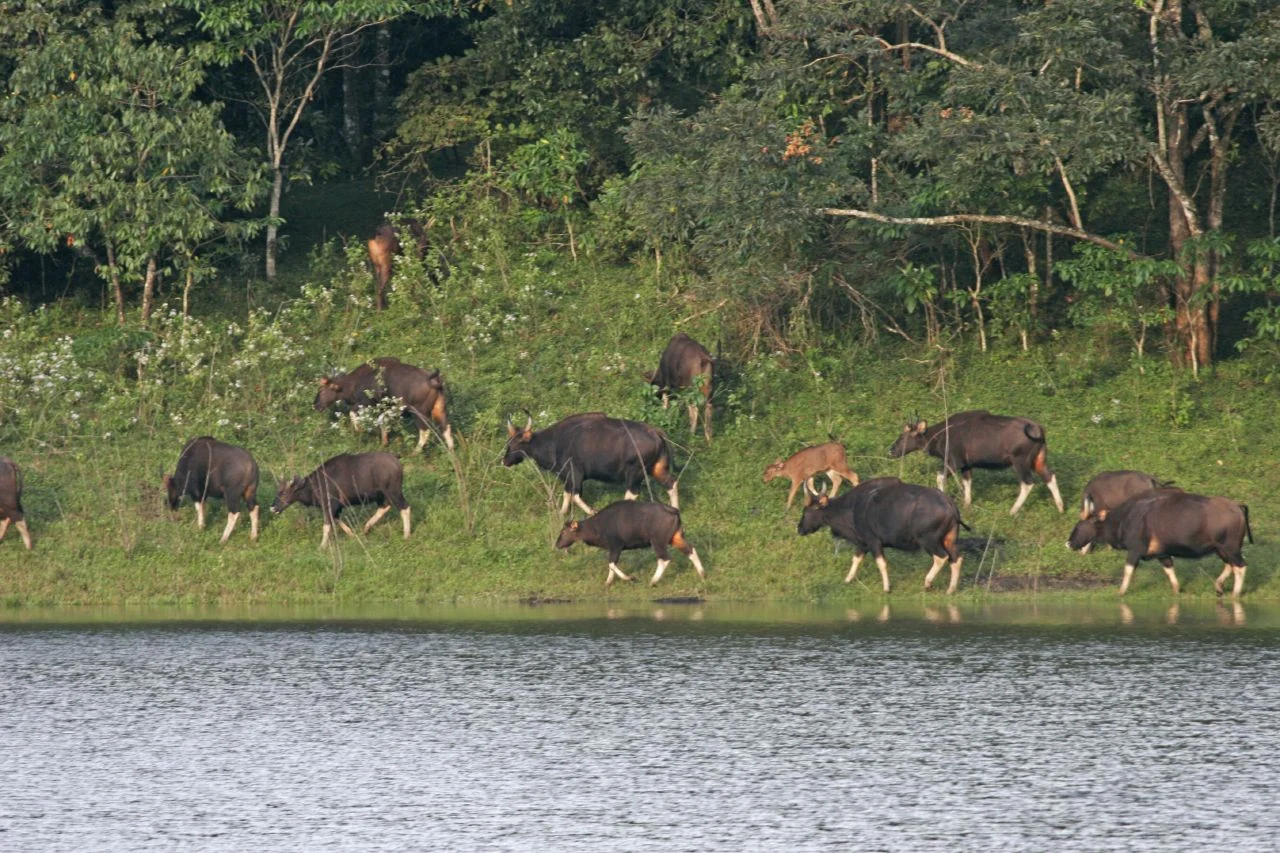
The photograph shows gaur on a grassy bank across the water. The group is visible within a much larger landscape, with the shoreline and vegetation occupying most of the setting. That scale is a useful starting point for the Periyar boat journey: wildlife is observed at a distance, in habitat, rather than presented beside the passenger deck.
The reserve’s boating programme offers a scheduled journey on the lake. It does not offer an appointment with an elephant herd. An animal may be visible briefly, remain partly concealed or never appear during a particular departure. A photograph records a sighting that happened, not a promise attached to a ticket.
Read the shoreline patiently
Begin with the boundary between the water and vegetation. A change in outline or movement may become easier to understand when watched for a moment than when immediately photographed. A dark patch can be an animal, a trunk or shadow; allow the actual shape and behaviour to establish the observation.
On a distant slope, a group of gaur may occupy only a small part of the view. First find the bank with the naked eye, then use binoculars or a camera’s zoom from your seat. Keep the broader shoreline in mind: it helps you relocate the animals as the boat moves and explains their position within the forest landscape.
If a sighting draws attention, remain within the crew’s seating and movement directions. Crowding one side, standing on a seat or calling towards an animal does not improve observation responsibly. The boat remains a shared passenger space even when the far bank becomes interesting.
Keep more than one scale of attention
Large mammals are only one scale at which to watch the lake. Bare trunks, branches above water and the meeting of forest and reservoir offer other points of interest. Research in Periyar has documented waterbirds using standing dead trees, although the study area extends beyond what a passenger journey necessarily reveals.
That wider attention helps avoid a common disappointment: treating every minute without an elephant as empty time. The boat is moving through a reservoir with changing banks and water arms. Notice how the visible shore changes, how light reaches a slope and which birds or animals are actually present, rather than filling the view with an expected list.
A useful photograph can preserve that context. Keep enough of the bank and water to show the animal’s position and distance. Identify the species only when the visible features support it, and describe the action seen rather than inventing a story about where the animal came from or what it will do next.
At the end of the journey, a short, accurate account is more valuable than an inflated one: the group seen on a particular bank, a brief movement into cover, or a lake journey whose strongest memory was its forested setting. Periyar’s wildlife remains the subject of observation, not a performance controlled by the visitor.
Sources: Periyar Tiger Reserve official booking and programmes and Periyar waterbird research.
Plan the visit: Periyar Boat Safari.