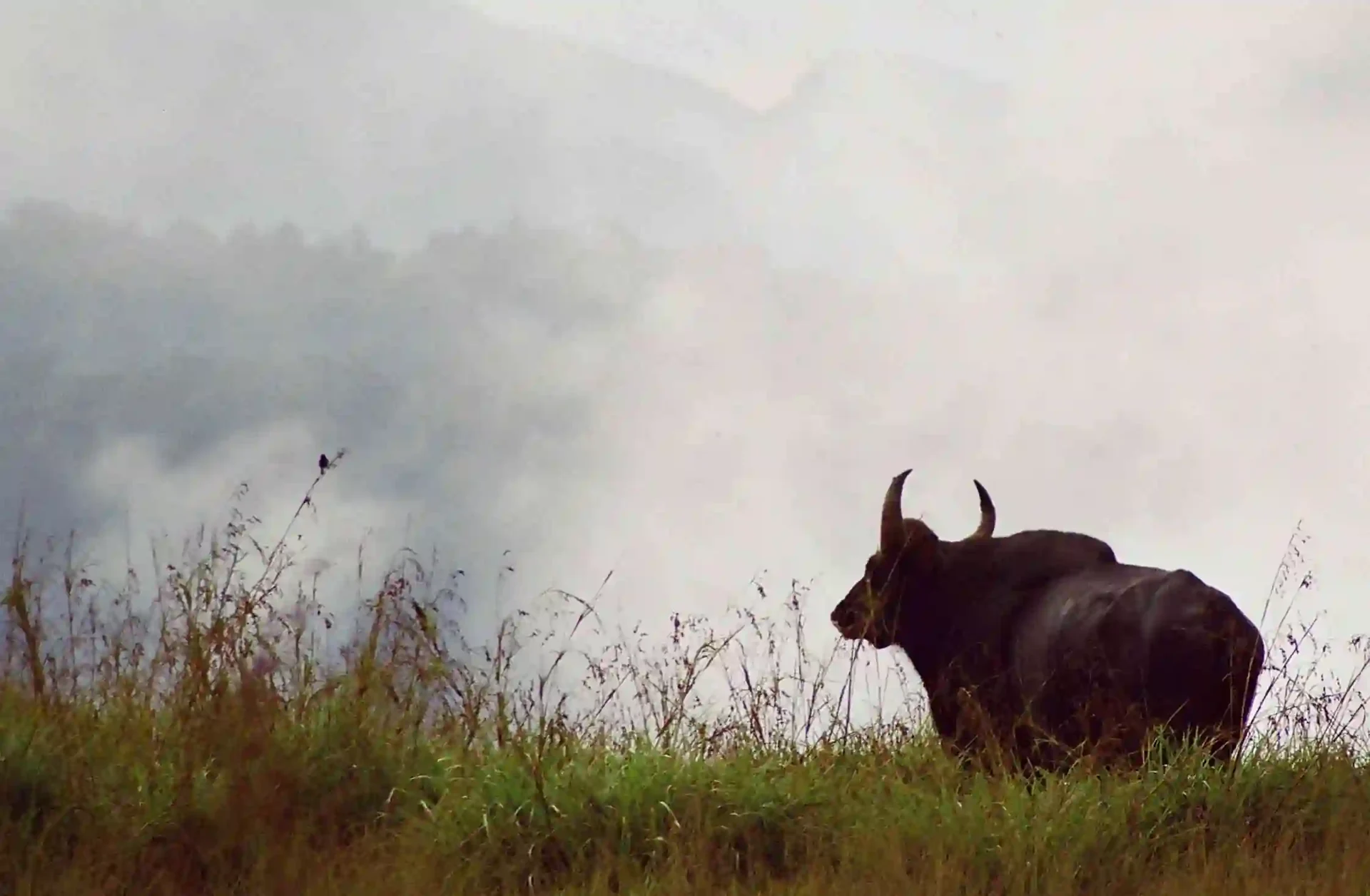
A gaur stands in misty grass in one of the reserve’s Border Hiking images. Much of the surrounding landscape has faded, leaving the animal and a small area of foreground more prominent. It is an arresting scene because of the conditions in that moment, not because a particular ridge offers a repeatable wildlife appointment.
Visibility is part of the encounter
Open ground can make a large animal easier to distinguish than dense woodland does. Yet long grass, folds in the slope and mist can conceal much of the scene. What a visitor sees from one position may be only a portion of the animals or terrain present beyond it.
Follow the guide’s first instruction before trying to improve the view. The team may ask people to remain still, move back or continue quietly. Those choices take account of information that is not necessarily visible to every participant. A clear photograph is not the measure by which the decision should be judged.
Use binoculars from the allowed position if the guide considers that appropriate. Establish where the animal is with the naked eye first, then bring the binoculars up without walking forward. This keeps observation separate from approach and gives the group a way to share a distant sighting calmly.
Keep grassland and cover in the frame
The reserve’s programme photographs show both open slopes and wooded folds. The edge between them is worth watching even when no large animal is present. A shape may disappear into cover without travelling far, and a quiet-looking opening can change while the group pauses.
Do not interpret an animal entering the trees as an invitation to follow. The assigned route remains the route. Tracking a subject independently would separate a visitor from the guiding team and turn a controlled observation into a different, unplanned activity.
The same restraint improves the experience for other walkers. Calling, pointing repeatedly or moving across the front of the group can make it harder for everyone to observe. A short, quiet description of the position is usually more useful than a burst of excitement directed at the whole hillside.
An animal-free stretch still belongs to the hike
Border Hiking offers time in a specific high-ground landscape, with interpretation and protection staff accompanying the group. It does not promise that every open slope will contain gaur, elephants or deer. Long stretches of walking can be valuable for noticing vegetation, landforms and changes in the weather.
If the animal moves away, let the encounter finish. Ask the guide about the visible setting or the decision to pause, then continue with the group. A brief observation that respects the animal’s movement is a complete experience.
The reserve’s Border Hiking programme describes wildlife possibilities alongside the terrain. Keep those possibilities open, and let the actual day determine which of them becomes part of the walk.
Plan the visit: Periyar Border Hiking.