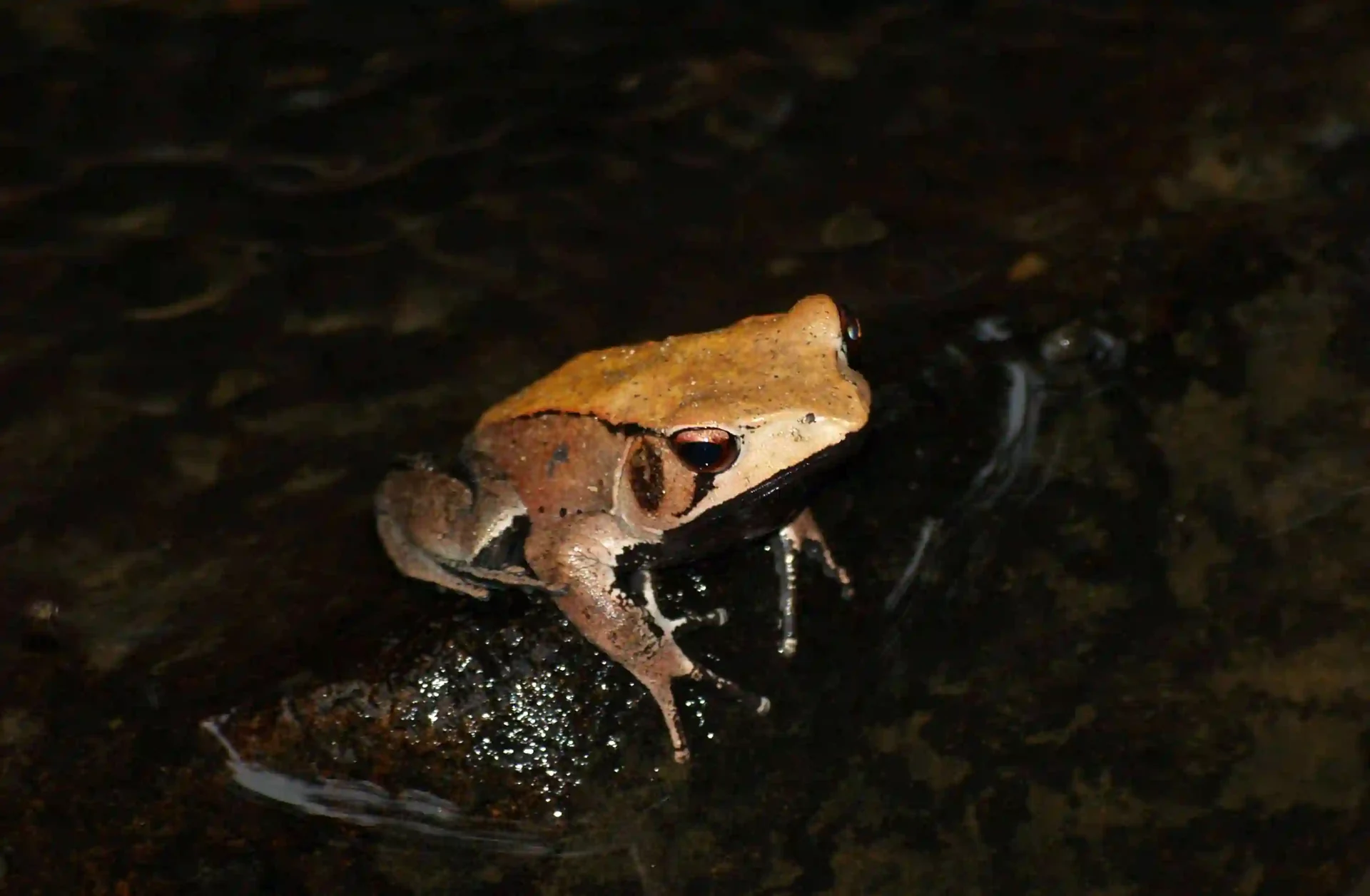
A frog occupies a small patch of the reserve’s night-walk imagery. It offers a useful change of scale from the large mammals often used to advertise a forest trip. Jungle Patrol can make a modest subject conspicuous because a torch isolates it from the surrounding darkness, turning a few centimetres of habitat into the whole visible scene.
Look at the subject in its setting
Start with what can actually be seen: the animal’s position, the surface beneath it and the nearby vegetation. These observations are useful even when a species name is uncertain. A guide may be able to explain more, but a confident label should not be improvised from colour alone.
The narrow lit area can also hide important context. Water, a drop or another animal may lie outside the beam. Keep your feet on the permitted walking line while looking, and resist the impulse to step sideways simply because the subject appears close.
A small animal is not a prop to be moved into better light. Leave it where it is and let the guide decide whether the group can stop. Handling, surrounding or repeatedly repositioning around it would change an observation into a disturbance.
Let darkness remain part of the experience
The attraction of a night walk lies partly in the difference from daytime vision. The group sees selected details rather than a continuous panorama. A sound may remain unidentified, and something visible for a moment may disappear before every camera is ready.
Accepting those limits can make the outing more attentive. Listen when the guide pauses and allow an explanation to finish before moving a light towards a new object. The aim is to understand the patch of forest being encountered, not to sweep every surface as quickly as possible.
Follow the team’s lighting instructions around wildlife. More light is not automatically more useful, especially when several participants aim at the same subject. A short view shared calmly can be more informative than a long, unsettled attempt to obtain a perfect close-up.
A night walk is not a mammal checklist
Periyar’s Jungle Scout imagery includes a range of nocturnal scenes. Their diversity is a reminder that the experience need not be judged solely by whether a large animal appears. A frog, an invertebrate or a change in the forest sound can provide a precise memory of the route.
If a subject cannot be photographed from the allowed position, the observation still has value. Remember the setting and the guide’s explanation. Recording everything is not a requirement for having seen it well.
The reserve’s Jungle Scout programme describes an accompanied outing after dark. Bring the willingness to notice small things and to leave them undisturbed; the forest supplies the subjects that are present on the night.
Plan the visit: Periyar Jungle Patrol.