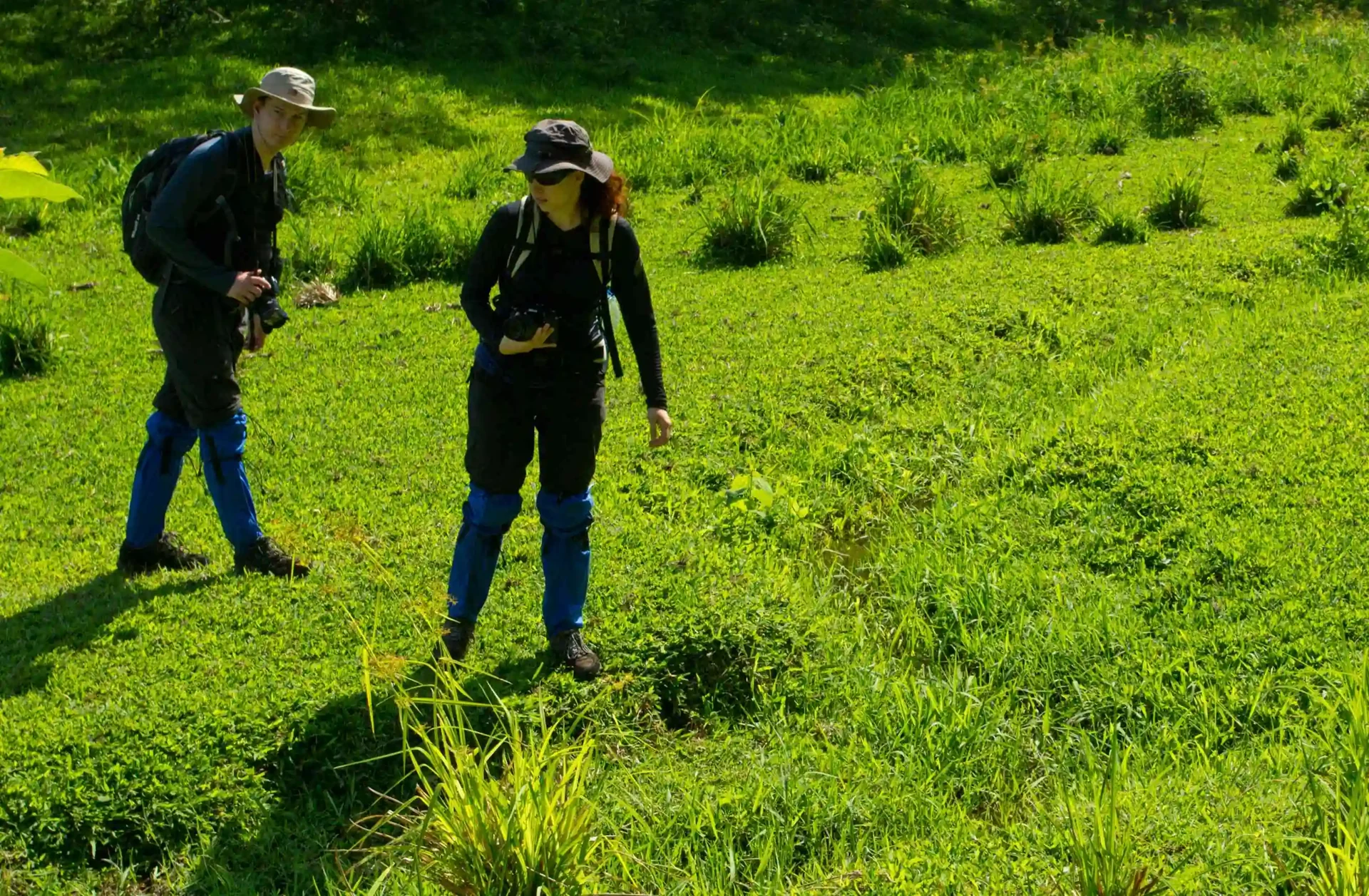
Two walkers pause in sunlit grass, wearing hats, backpacks and the blue leech socks used on Periyar’s forest outings. The scene says little about how far they have already walked. That is the first useful distinction when choosing an activity here: a photograph of people in green surroundings cannot tell you whether the booking is a short interpretation walk or a day-long hike.
Choose the shape of the day
Nature Walk is the shorter commitment. The reserve describes an outing of about four to five kilometres over two and a half hours. Its purpose is interpretation: moving with a guide, stopping to notice forest detail and learning how to look. The distance still asks for ordinary walking endurance; shorter does not mean a paved garden circuit.
Border Hiking occupies the main daylight period and passes through undulating high ground. Its description brings ridges, escarpments and watersheds into the plan. Someone who enjoys repeated ascents and descents may welcome that scale. Someone who wants a first introduction to the forest before an afternoon in town may find Nature Walk the more comfortable match.
Think about the participant who will find the ground hardest, rather than the fastest walker in the group. The length of a hike becomes meaningful when combined with gradient, humidity, pauses and the return. Choosing a shorter programme that everyone can follow is more useful than expecting a long route to be abbreviated after departure.
A stop is part of the activity
On Nature Walk, the guide may hold the group at a piece of dead wood or a sound above the canopy. Those pauses are not lost time between wildlife encounters. They are a central part of the programme, allowing a small group to notice something that would be passed in seconds on an independent march.
The longer hike can also contain extended observation stops. Its additional hours do not promise a proportionate increase in animal sightings. They provide more time moving through the assigned landscape. A visitor who judges both programmes only by the number of mammals seen has chosen a measure that neither operator nor guide can control.
A useful personal question is whether the forest itself would hold your attention if large animals stayed out of sight. If the answer is yes, both activities have something to offer. Then the choice can be made through time and terrain, rather than an imagined ladder of better and worse safari results.
Keep the reporting point attached to the booking
Nature Walk reports at Boat Landing. Border Hiking has separate Brandipara and Thondiyar products, using the Forest Check Post Ex Vayana office and the Tribal Trackers office near Bamboo Grove respectively. These are meaningful differences within the same Thekkady–Kumily visitor area.
Keep that office name in the transport arrangement. A driver told only “Periyar trekking” may reasonably understand a different programme. The right activity choice is not complete until the group also knows where its morning begins.
Read the Nature Walk programme alongside the reserve’s Brandipara and Thondiyar descriptions. Match the walking demand first, then reserve the actual departure that fits the stay.
Plan the visit: Periyar Nature Walk.