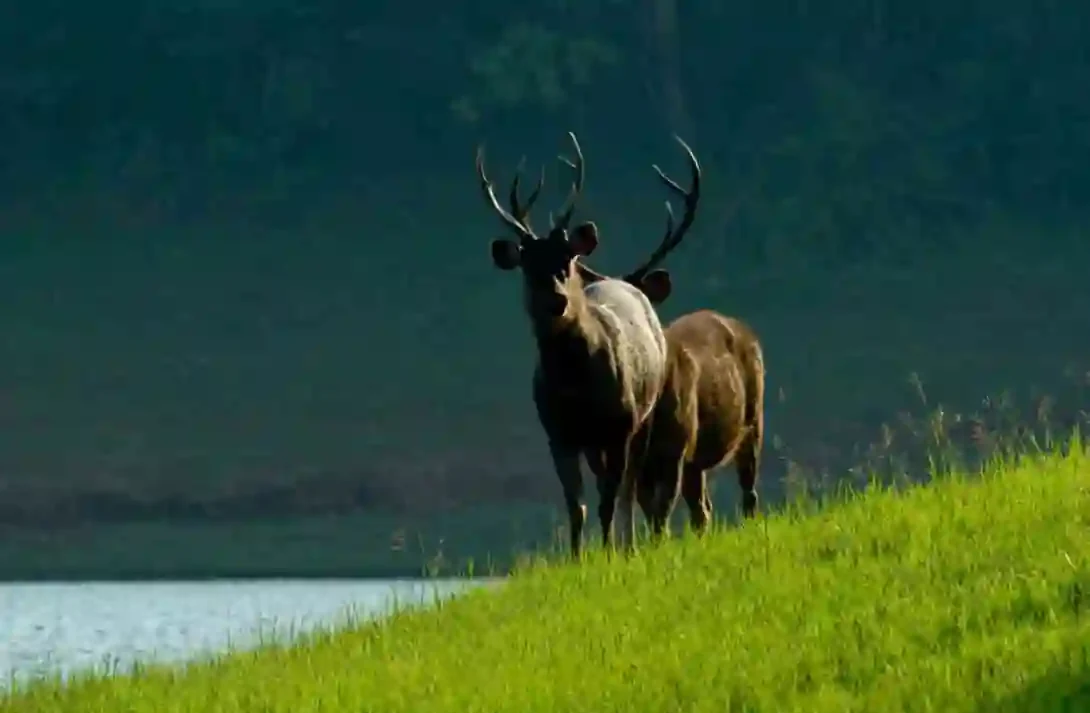
An antlered sambar stands on a green slope with Periyar Lake behind it. The open water makes the animal’s outline easier to see than it would be beneath trees. Yet the photograph is a record of one position at one moment. On a Nature Walk, learning to read the edge between cover and an opening is more useful than expecting the same animal to be waiting there.
Cover changes what the eye can find
Inside the forest, trunks and overlapping leaves break up a view. Near an opening, the eye can travel farther, but distance introduces its own difficulty. A stationary shape can merge with grass, shadow or a darker patch of ground until it moves. The guide may notice a change well before it becomes obvious to every visitor.
Follow the guide’s indication carefully rather than immediately raising a camera towards the whole hillside. Establish the position with your own eyes first. If binoculars are being shared, make room for others and pass on a simple location description. That keeps the group’s attention on the scene without a series of loud attempts to direct everyone.
An animal’s partial appearance still counts as an observation. A head above grass or a brief movement into cover may be all that the permitted position offers. The response should not be to walk closer until the composition becomes clearer.
The edge belongs to the animal
Periyar’s programme photographs include sambar and elephants in open grassy settings. Their presence in the reserve does not make a particular bank a scheduled wildlife stop. Animals move in response to their own needs and to conditions visitors cannot fully see. A guided group must make room for those movements.
The guide may ask people to wait, move back or continue along the route. Those choices can reduce a photographic opportunity while improving the encounter for the animal and the group. A visitor does not need to interpret every decision independently; following it promptly is part of responsible participation.
Avoid calling, feeding or trying to provoke a glance towards the camera. A natural observation is interesting because the animal is continuing its own activity. Altering that activity to obtain a response changes the encounter into something less informative as well as more intrusive.
Keep the landscape in the experience
When no mammal is visible, the lake edge still offers a distinct view. Grass, exposed bank, water and the wooded slope behind it occupy different layers. Standing trunks can create depth across the water, while a shift in cloud or light changes how far the eye travels. These are subjects in their own right.
The short walking programme cannot sample every part of that landscape in every condition. Its value lies in the assigned route and the guide’s interpretation of what is present. An animal-free opening may lead to a discussion of cover or visibility that makes the next observation more meaningful.
Use the reserve’s Nature Walk page to understand the accompanied activity. Let photographs introduce possibilities, and let the actual forest decide the day’s view.
Plan the visit: Periyar Nature Walk.