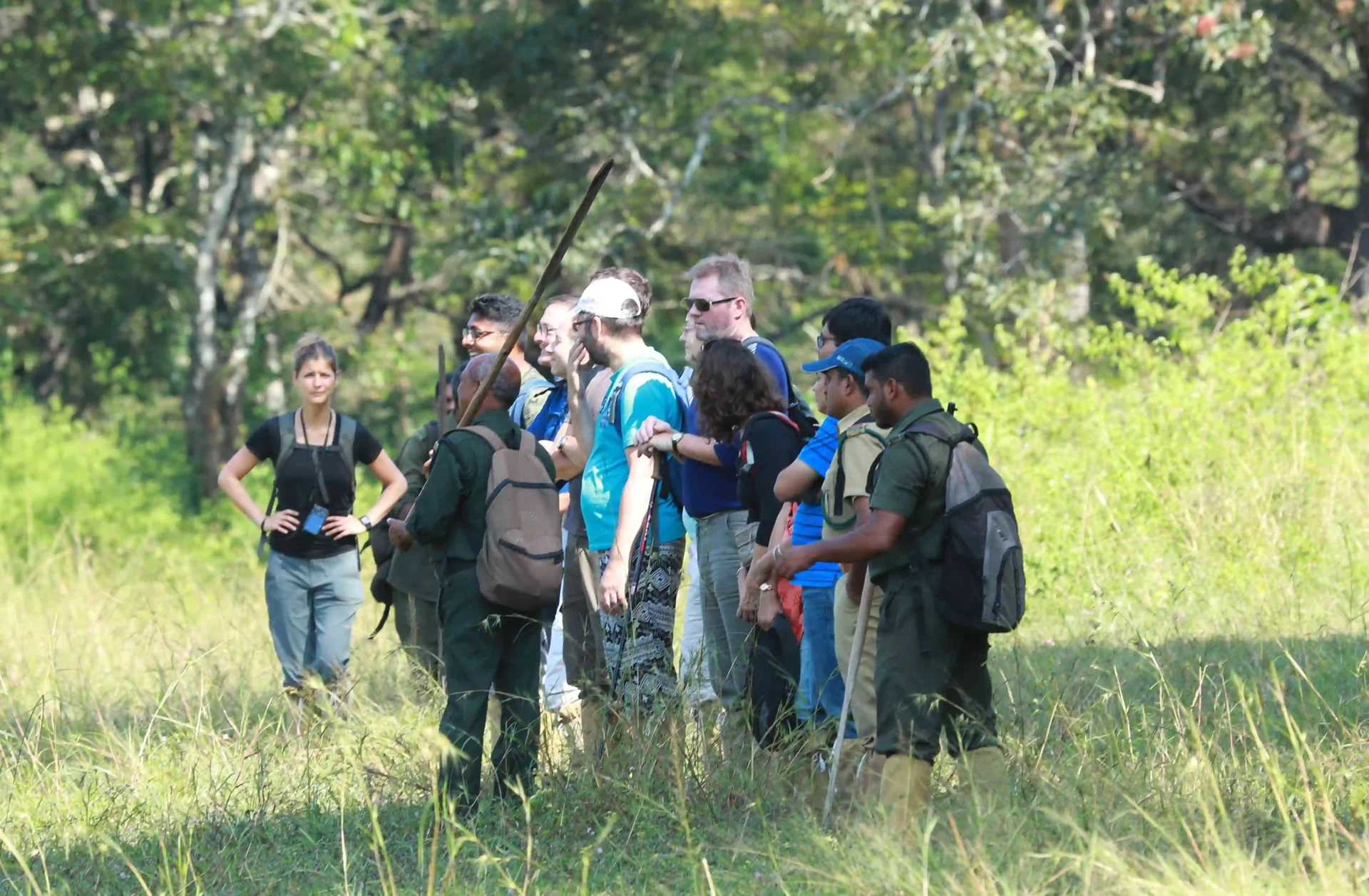
The people accompanying a Tiger Trail group are central to the programme’s identity. Their work involves knowing the forest, organising the walk and supporting a stay away from town facilities. Behind that present-day role lies a particular conservation experiment at Periyar, described in the Government of India’s 2005 Tiger Task Force report.
A livelihood problem became a conservation question
The report describes a group formed in 1997 with 22 men who had previously been involved in poaching and collecting cinnamon bark. An agreement brought their forest knowledge into protection work. The account makes clear that a change of role also needed an answer to the question of regular income.
Guiding visitors provided one route towards that answer. Tourism could make knowledge of the forest valuable through lawful employment, while a working relationship with protection staff offered a different place in the reserve’s social world. The story is more specific than the general claim that tourism helps local people: it concerns an organised transition with named livelihood and conservation aims.
Those numbers and circumstances belong to the historical report. They should not be used as a present-day staff count or as a claim about every person now working on Tiger Trail. A photograph of a current guide does not establish an individual’s past, and visitors should not attach that history to somebody without their own account.
Knowledge has value beyond finding animals
A guide’s contribution can be visible in small decisions: where the group pauses, how a crossing is managed or when a route should be adjusted. Those choices draw on familiarity with terrain and the needs of an accompanied party. Their usefulness is not limited to producing a tiger sighting.
The programme name can make wildlife expectation dominate the conversation. It is more revealing to ask, when appropriate, about the landscape being crossed or the work involved in supporting a camp. Such questions recognise expertise without demanding that a person retell a difficult personal history for visitors.
The report also discusses social respect as part of the transition. That dimension matters because employment is not only a transaction at a ticket counter. A visitor’s conduct can acknowledge the guide as a professional responsible for the group, rather than as a character in an adventure story.
Join the programme as it operates today
Current Tiger Trail arrangements belong to the reserve’s published overnight products, with a guiding team and an armed official accompanying visitors. The practical terms should be read from those current listings; the 2005 report is a historical source, not a booking manual.
Read the Tiger Task Force report, especially its Periyar discussion, alongside the reserve’s one-night Tiger Trail programme. Together they explain why this is an organised conservation-linked outing with a human history, not simply a tent pitched in a scenic place.
Plan the visit: Periyar Tiger Trail.