A waterfall and a power scheme share the river
KSEB’s 2012 consultation document describes Perunthenaruvi as a run-of-river small hydroelectric scheme on the Pamba. The Kerala State Planning Board’s Economic Review 2017 subsequently records the commissioning of the six-megawatt project in October 2017. The proposal and the later commissioning record together establish its place in the river landscape.
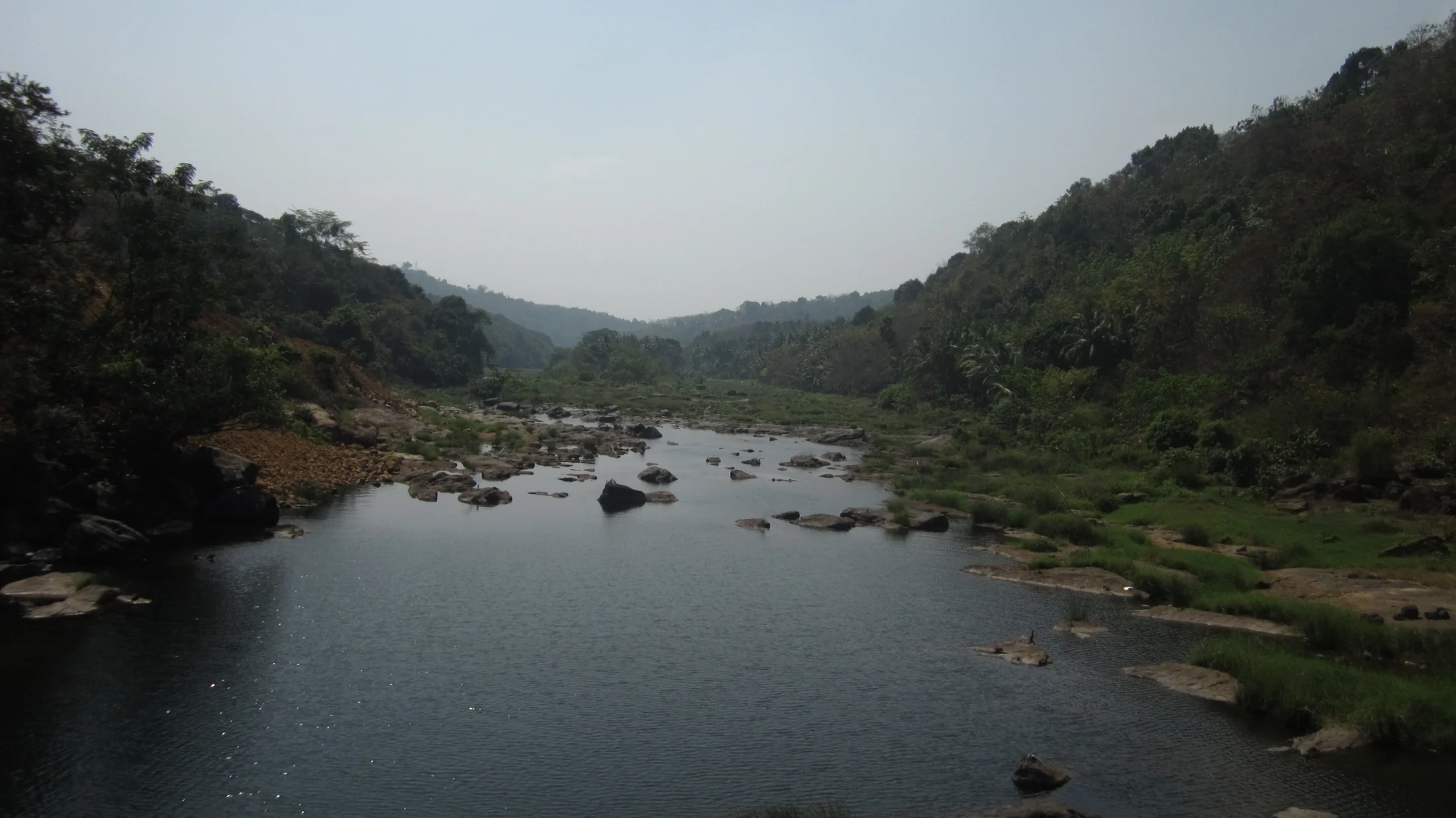
The photograph with this story shows the rocky river reach, not the generating machinery. It provides the landscape context for understanding why an engineering scheme could use the difference in level here.
The 2012 design followed a specific water route
The design placed a diversion weir about 460 metres upstream of the falls and a powerhouse on the left bank below them. Between those points, it specified a power channel, a forebay, two penstocks and two tubular turbine-generator units. A tailrace would return water to the parent river.
This sequence explains the basic arrangement. The weir diverts water into the conveyance system; the channel leads towards the forebay; the penstocks deliver it to the turbines; and the tailrace carries it back to the river. It is a planned route through infrastructure, separate from the visitor’s movement around the waterfall.
The document gives a design net head of 18 metres and a catchment of 442 square kilometres involving the Pamba and Azhutha. Those are engineering parameters from the published project design. They should not be confused with a tourist waterfall-height claim or a measurement made from a scenic photograph.
Run-of-river is a project type, not an access permission
The term describes the scheme’s relationship with river flow. It does not mean the weir, channel or powerhouse is a public attraction, nor does it establish that any particular downstream rock is safe to stand on. The visitor area and the generating infrastructure have different purposes.
Use the permitted waterfall approach and follow any current restrictions. A distant view of a structure is sufficient to connect it with the engineering story; there is no need to approach an intake or operating installation to understand the water route.
Keep the dates with the facts
The detailed arrangement above comes from the 2012 design consultation. The 2017 Economic Review confirms that the six-megawatt scheme was commissioned, but it does not turn every design dimension into a new field measurement of the present installation.
That distinction preserves the useful lesson of the documents: Perunthenaruvi belongs simultaneously to the Pamba’s visible waterfall landscape and to a carefully arranged small-hydel water route. Seeing both gives the place more depth while keeping the visitor’s actual access clear.
Sources: KSEB, Perunthenaruvi Small Hydro Electric Project stakeholder consultation, 2012; Kerala State Planning Board, Economic Review 2017, energy.
Plan the visit: Perunthenaruvi Waterfalls.