The signboard is the story. It stands at the enclosures on the reservoir shore at Peruvannamuzhi, painted red and green in the manner of Kerala government boards everywhere, and it is headed — in Malayalam — "Government Crocodile Breeding Centre, Peruvannamuzhi". Below that, one line that no travel article about this place has ever bothered to quote: സ്ഥാപിതം 7-1-1977. Established 7 January 1977. Not "the 1970s". Not "some decades ago". A date.
Almost everything written about Peruvannamuzhi calls this a crocodile farm, and the word does real damage. A visitor who reads "farm" reasonably assumes what a farm is for. India had a crocodile-skin industry, it was legal and it was substantial, and it ran until the Wildlife (Protection) Act of 1972 shut it down. So "crocodile farm beside a 1970s dam" reads as a relic of that trade — a leather operation that outlived its market and became a picnic attraction.
It is the exact opposite. This place exists because the skin trade ended.
What the Act started
When the 1972 Act closed the trade, India’s crocodilians were in serious trouble — decades of hunting had left the mugger, the gharial and the saltwater crocodile depleted across their ranges. The response, developed with the United Nations Development Programme and the Food and Agriculture Organization, was a national crocodile breeding and management project: collect eggs from the wild, hatch and rear the young in protected captivity past the age at which almost all of them would otherwise die, and put them back into protected areas as sub-adults capable of surviving.
Kerala got two centres, and both opened in 1977. One was at Neyyar, in the far south of the state. The other was here, at Peruvannamuzhi, in Malabar — a new reservoir, four years old, with a Forest Department presence already on site and a large body of still water in a valley that had just been flooded.
The board, in full
What makes this signboard unusually good is that it is not promotional. It is a species information panel of the kind forest departments put up when they expect the public to stand and read, and its content is straightforwardly factual. It records the centre’s stock: six crocodiles — three male, two female, one juvenile. It names the animal as the mugger, and gives its range as India, Iran, Nepal and Sri Lanka; its habitat as marshes and lakes; its colour as dark grey.
Then the natural history, in the flat register of a government board. Hatchlings measure 25 to 27 centimetres. Full growth is about four metres. The egg is white and measures 75 by 53 millimetres. The diet is freshwater fish and meat. The lifespan is about a hundred years. The temperament is listed, without elaboration, as aggressive. Mating season November to December; egg-laying February to March. At the foot, in its own box, the line that gives the board its authority: harming crocodiles is punishable under the Wildlife Protection Act.
Six animals is a small number, and it is worth sitting with. Neyyar’s centre still holds something in the region of forty-four. Peruvannamuzhi’s board records six.
The programme that closed
Between 1978 and 1992, the Indian crocodile programme released roughly 1,193 captive-bred muggers into 28 protected areas across the country. By any measure that is a success — the mugger did not disappear, and the technique of head-starting reptiles through their most vulnerable years was proved at scale.
And then, in 1994, the Government of India stopped producing captive-bred crocodiles for release. The reasoning was not that the animals had failed but that the habitat had run out: there was little point manufacturing more crocodiles when there were not enough secure, undisturbed waters left to receive them. The bottleneck had moved from the animal to the land.
Which leaves the enclosure at Peruvannamuzhi in a strange position. It is not a zoo, and it is not a farm, and it is no longer, in any active sense, a breeding centre for release. It is the last room of a programme that ended three decades ago. The animals are still here because muggers live a very long time — that hundred-year figure on the board is not a figure of speech — and because a species listed on Schedule I of the Wildlife (Protection) Act and Appendix I of CITES cannot simply be dispersed.
What you are actually looking at
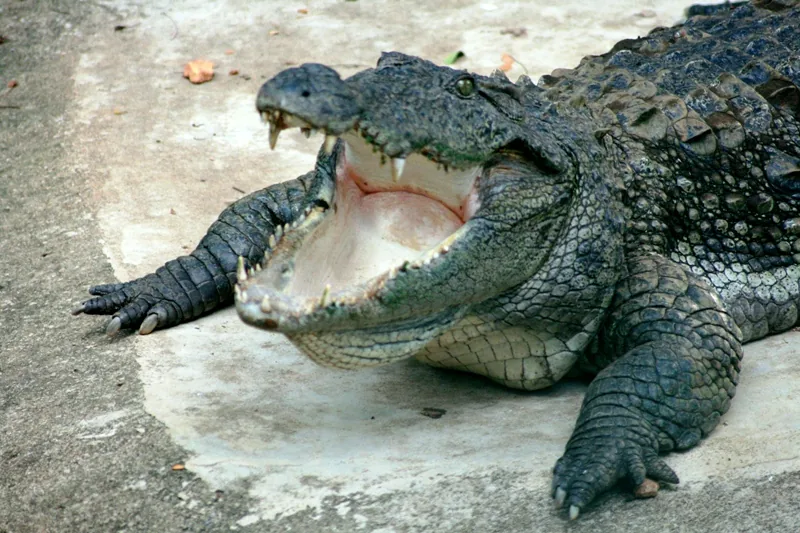
Low concrete-walled pens on the reservoir shore. Bare concrete, a pool, and one or two large grey-brown animals hauled out with their jaws held wide open. That gape reliably reads as a threat display to visitors and it is nothing of the kind — it is thermoregulation. A crocodile has no sweat glands, and holding the mouth open lets heat off through the moist lining. An animal lying still with its mouth open is an animal cooling down.
The mugger itself — Crocodylus palustris — has been listed as Vulnerable on the IUCN Red List since 1982. Estimates around 2013 put fewer than 8,700 mature individuals in the wild, with no single population above a thousand. It nests between February and June, laying somewhere between eight and forty-six eggs, and incubation runs about two months. The board’s "mating November to December, laying February to March" is that cycle, localised.
Why it is worth five minutes
Peruvannamuzhi is a boating day out, and most people give the crocodiles the ninety seconds it takes to photograph one. But this is one of the few places in Kerala where you can stand in front of a piece of conservation policy and read its founding date off the wall. The dam behind you was finished in 1973; the Act that made this enclosure necessary was passed in 1972; the centre opened on 7 January 1977; the programme it belonged to stopped in 1994.
Four dates, one small concrete pen, and six animals that were bred for a purpose the country has since decided it cannot use. Call it a farm if you like, but the board disagrees, and the board was there first.
Frequently asked questions
When was the Peruvannamuzhi crocodile centre established?
On 7 January 1977, according to the centre’s own government signboard, which is the primary source for the date. It was one of two crocodile breeding centres opened in Kerala that year, the other being at Neyyar.
Is it a crocodile farm?
No, despite the name almost every source uses. It is a Government Crocodile Breeding Centre run by the Kerala Forest Department, set up after the Wildlife (Protection) Act 1972 ended India’s crocodile-skin trade, to breed muggers in captivity and release them into protected areas.
How many crocodiles are there?
The centre’s board records six — three male, two female and one juvenile. Numbers on a painted board should be treated as a record of when it was written rather than a live count, so confirm on site.
Why do the crocodiles lie with their mouths open?
It is thermoregulation, not aggression. Crocodiles cannot sweat, so holding the jaws open sheds heat through the moist lining of the mouth.
Are captive-bred crocodiles still being released in India?
No. Between 1978 and 1992 roughly 1,193 captive-bred muggers were released into 28 protected areas, but the Government of India halted new production for release in 1994 — largely because suitable secure habitat, rather than the supply of animals, had become the limiting factor.