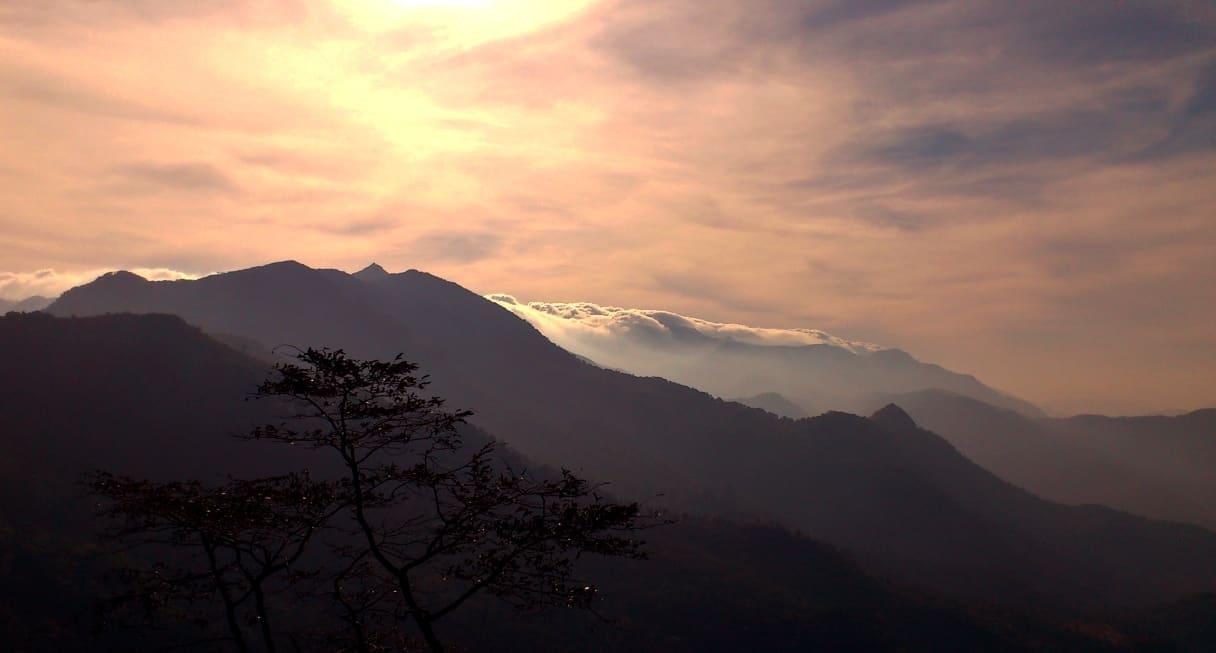
Stand at a Ponmudi viewpoint and look north-east, past the tea and grassland, to where the ridges pile up into blue distance. That is the edge of the Agasthyamala Biosphere Reserve — one of the most botanically rich corners of the entire Western Ghats, and the wild engine that gives this whole landscape its cool, misted, endlessly green character. Ponmudi is the doorstep; behind it lies a mountain kingdom of endemic plants, ancient forest and a peak named for a sage.
A UNESCO treasury in the southern Ghats
The Agasthyamala Biosphere Reserve spans roughly 3,500 square kilometres across the southern tip of the Western Ghats, straddling Kerala and Tamil Nadu. It was constituted as a biosphere reserve in 2001 and added to UNESCO’s World Network of Biosphere Reserves in 2016 — recognition of a landscape whose steep rainfall gradients and long isolation have made it a factory for species found nowhere else. Peppara Wildlife Sanctuary, on Ponmudi’s own flank, forms part of this larger protected mosaic.
The reserve sits within the broader Western Ghats, itself a UNESCO World Heritage Site and one of the world’s recognised biodiversity hotspots. The Ghats are older than the Himalaya and intercept the south-west monsoon head-on; the water they wring from the sky is exactly what feeds the Kallar river and keeps Ponmudi’s slopes wet and cool.
A cradle of endemic plants
The numbers tell the story. The reserve is home to something on the order of 2,254 species of higher plants, of which around 405 are endemic — species that exist here and, in many cases, nowhere else on the planet. Orchids, medicinal herbs, wild relatives of cultivated crops and ancient lineages of tree crowd its shola forests and high grasslands. For botanists it is less a forest than a living archive.
Arogyapacha, the herb of the Kani
One plant made the reserve globally famous. Arogyapacha — the creeping herb Trichopus zeylanicus, sometimes called the ginseng of Kerala — has long been used by the indigenous Kani people to fight fatigue and restore energy. In 1987, Kani guides including the forest elder Kuttimathan pointed the plant out to visiting scientists from the Tropical Botanic Garden and Research Institute (TBGRI), who went on to develop an anti-fatigue formulation named Jeevani from the traditional knowledge.
What followed was hailed, at the time, as a world-first: in 1995 the institute licensed the formulation to a pharmacy and arranged for a share of the fee and royalties to flow back to the Kani community through a dedicated trust — an early attempt at biodiversity benefit-sharing before such ideas were widely codified. The reality proved messier than the headlines. Critics have questioned whether the community’s consent was properly informed and whether the money genuinely reached those who held the knowledge, and later accounts record the trust struggling and some of its promised benefits falling away. It endures as both a landmark and a cautionary tale about who owns the wisdom of the forest.
Agasthyarkoodam: the peak and the pilgrimage
The reserve is crowned by Agasthyarkoodam, also written Agastya Mala, a peak rising to about 1,868 metres. In Hindu tradition — told here as living legend rather than record — the mountain is the abode of the sage Agastya, and it is revered as a sacred summit; the hills and the biosphere both take their name from him. The mountain is said to bristle with medicinal plants, a botanical reputation that folds neatly into its spiritual one.
For a short window each year the forest department opens a seasonal trek to the summit, generally spanning parts of January and February, on a route of roughly 24 to 28 kilometres that starts from Bonacaud and climbs through forest, grassland and rocky ground. It is a demanding, tightly regulated walk: numbers are capped, permits must be booked through the official Kerala Forest Department portal, and a recent medical fitness certificate is required. Access for women trekkers was historically restricted but was opened following a High Court intervention; confirm the latest guidance, as the exact dates, quotas and conditions change from year to year.
- Status: UNESCO Biosphere Reserve since 2016 (constituted 2001), within the Western Ghats World Heritage landscape.
- Size: roughly 3,500 sq km across Kerala and Tamil Nadu.
- Flora: around 2,254 higher-plant species, about 405 of them endemic.
- Peak: Agasthyarkoodam, about 1,868 m; seasonal trek from Bonacaud, permits via the Kerala Forest Department.
Frequently asked questions
What is the Agasthyamala Biosphere Reserve?
It is a UNESCO-recognised biosphere reserve of roughly 3,500 square kilometres in the southern Western Ghats, spanning Kerala and Tamil Nadu, celebrated for exceptionally high plant endemism. Ponmudi sits on its doorstep.
What is Arogyapacha and why is it famous?
Arogyapacha (Trichopus zeylanicus) is a herb used by the Kani people to combat fatigue. Scientists developed a formulation named Jeevani from that knowledge in the 1990s, in an early and much-debated attempt at sharing benefits with an indigenous community.
Can anyone trek Agasthyarkoodam?
The forest department runs a capped seasonal trek, generally over parts of January and February, from Bonacaud. Permits must be booked through the official Kerala Forest Department portal and a recent medical certificate is required. Confirm the current season’s dates and rules, as they change yearly.
How is Agasthyarkoodam connected to Ponmudi?
Ponmudi lies on the edge of the same protected landscape and shares its cool, wet, forest-fed climate. The peak and the wider biosphere both take their name from the sage Agastya of Hindu tradition.