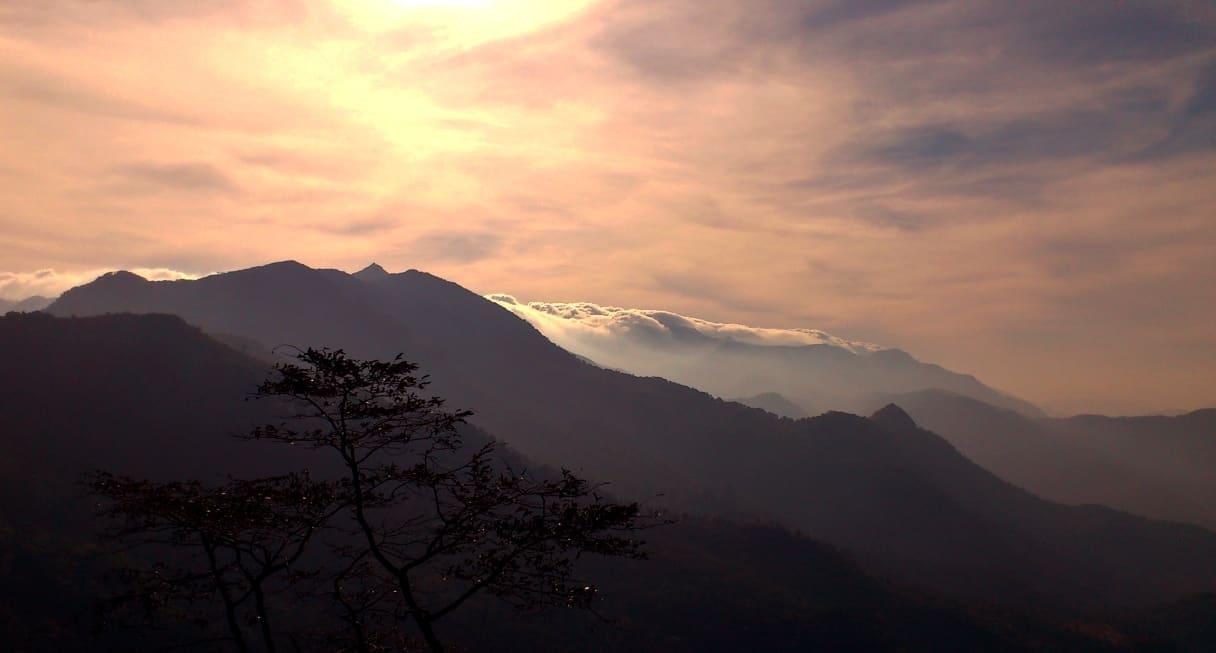
At first light the ridge does exactly what its name promises. Sun slides across a sea of tea and grassland roughly 1,100 metres above the coastal plain, the mist burns off in slow gold, and for a few minutes Ponmudi looks less like a place than a coin held up to the morning. The Malayalam name means, quite simply, the Golden Peak — and for the people of Thiruvananthapuram, an hour or two down the ghat, it has long been the nearest thing to a mountain of their own.
What is in a name
Pon means gold; mudi means crown, peak or summit. Together they give Ponmudi its gentle, literal poetry — the golden crown of the hills. The reading is usually tied to the light: the honeyed glow that pools on the slopes at sunrise and sunset, when the grasslands catch fire and the tea gardens run copper. It is an unusually apt piece of naming for a hill that, more than most, is defined by the hour you happen to catch it.
The ridge sits in Peringamala, in the north-east of Thiruvananthapuram district, on the flank of the southern Western Ghats. Depending on where you start counting in the sprawling capital, it lies roughly 53 to 61 kilometres from the city centre — close enough to be a day trip, high enough to feel like an escape.
A cool ridge above a warm coast
Thiruvananthapuram is a hot, humid, sea-level city, and the appeal of a place like Ponmudi is written into that contrast. Where the coast sweats, the peak keeps a normal range of about 14 to 25°C, dropping into the low teens on winter nights, with readings as low as 8°C recorded. A settlement that stays fresh through the summer, within reach of the plains, was always going to be prized — first as a working estate, later as a retreat.
Discovery in the age of Travancore
Like many of the southern hill stations, Ponmudi owes its modern shape to the plantation era. The estate was reportedly bought by a British planter, Richard Arther Moore, from the King of Travancore in 1860, when these slopes were being opened up for commercial agriculture in the princely state. The first crop was coffee — but leaf-rust disease swept the region from the 1860s and ruined the early plantings, pushing planters across the Ghats towards a hardier alternative.
That alternative was tea. Records place the first tea in Ponmudi around 1884, on slopes soaked by close to 160 inches of annual rain — punishing for people, ideal for the bush. In 1900 the holdings were consolidated as the Ponmudi Tea and Rubber Company Ltd, drawing together three estates — Ponmudi, Bon-Accord and Braemore — across some 3,276 acres. Neighbouring Bonacaud grew into a full plantation township, and the labour that worked these gardens was drawn from Malabar, southern Travancore and the Tinnevelly country to the east.
From working estate to weekend hill
The bungalows the planters left behind, the tea that still clothes the lower slopes, and the ghat road that climbs to them are the estate era’s most visible bequest. Over the twentieth century, as tourism overtook planting as the hill’s main business, Ponmudi settled into its present role: a retreat for the capital rather than a producer for the empire. The state’s Kerala Tourism Development Corporation runs the hilltop Golden Peak property, its name a straight translation of the peak it sits on.
Why the peak still draws people up
Ponmudi endures because it packs a great deal into a short climb. It is a genuine biodiversity pocket — one much-quoted figure counts 283 bird species here, said to be around 59 per cent of all the birds recorded in Kerala, alongside a large share of the Western Ghats’ butterflies. It is a trailhead into deeper wild country. And it remains, above all, the answer to a very old local question: where does a citizen of the hot coast go to stand in cool cloud? For close to two centuries, the reply has been the same — up the golden crown of the hills.
- Name: Ponmudi means Golden Peak in Malayalam (pon, gold; mudi, crown or summit).
- Elevation: around 1,100 metres in the southern Western Ghats.
- Location: Peringamala, Thiruvananthapuram district, roughly 53 to 61 km from the city.
- Estate era: bought from Travancore reportedly in 1860; tea planted around 1884; consolidated as the Ponmudi Tea and Rubber Company in 1900.
Frequently asked questions
What does the name Ponmudi mean?
It is Malayalam for the Golden Peak — pon meaning gold, and mudi meaning crown, peak or summit. The name is usually linked to the golden light that washes the slopes at sunrise and sunset.
How high is Ponmudi?
The hill station sits at roughly 1,100 metres (about 3,600 feet) in the southern Western Ghats, which keeps its temperatures far cooler than the coast below.
Why did tea take over from coffee here?
Coffee was the first plantation crop, but leaf-rust disease devastated the early plantings across the region from the 1860s. Planters switched to hardier tea, first grown in Ponmudi around 1884.
Is Ponmudi still a tea-growing area?
Tea still clothes the lower slopes and shaped the landscape you see today, but the hill’s main business is now tourism rather than planting, with the estate-era bungalows and ghat road as its most visible legacy.