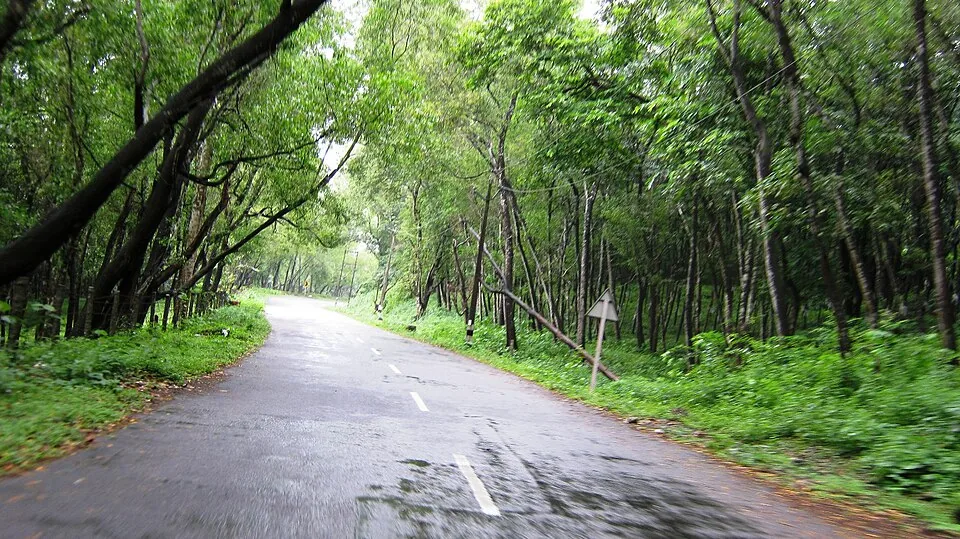
There is a mismatch between why people come to Ponmudi and what they get, and it is worth naming before you book a walk. The photographs that bring visitors here are all taken on the bald grass shoulder at the summit. The walking is nearly all several hundred metres below it, in closed wet evergreen forest. Most trekkers on this hill never set foot on the grassland at all.
This is usually presented, when it is mentioned, as a disappointment to be managed. It is the wrong way round. The forest is the richer half of the mountain and it is not close.
What the counts say
Ponmudi is exceptionally birdy by any standard and startlingly so for a hill this accessible. Published counts put some 283 bird species on the hill. Of the sixteen bird species endemic to the Western Ghats — found in this mountain range and nowhere else — fifteen occur here. That is very nearly the complete set, on a hill you can reach from the state capital before breakfast.
The butterflies tell the same story. Of the 332 butterfly species recorded across the Western Ghats, 195 are found at Ponmudi. Again: well over half the range total, concentrated on one modest massif in the far south.
Almost none of that lives on the grass. Endemic Ghats birds are overwhelmingly forest species — canopy feeders, understorey skulkers, birds of the dense wet interior. The open summit is a thin, exposed, heavily walked cap. The biodiversity is downstairs.
Learning to see it
Closed evergreen forest is difficult to watch in. Sightlines are short, the light is poor and green, and much of what is present is directly above you behind several layers of leaf. The instinct is to look ahead along the trail, which is the least productive direction available.
Look up instead. Malabar giant squirrel is the easiest large animal here and it is almost always overhead — a rust-and-cream animal the length of your forearm, moving in long horizontal bounds between branches, usually announced by a shower of chewed fruit before you see it. Hornbills are the other reliable canopy sighting, and you will nearly always hear the wingbeats before anything else; the sound carries much further than the bird is visible.
Langurs work the middle storey and give the game away for everything else, because an alarm call two ridges over means something is moving there. Guides stop and listen to these for a full minute while visitors wonder why the walk has paused.
And the ground floor is bamboo, buttressed trunks and a permanent green half-light, with elephant sign more common than most walkers expect. Dung, bamboo pushed over and stripped, mud rubbed onto trunks at shoulder height, a path through undergrowth too wide and too clean to be anything else. Seeing the sign and not the animal is the outcome to hope for, and it is the main reason a guide is required on most routes.
How to be a good visitor to a forest like this
Walk at the guide’s pace, which will be slower than yours and slower than feels reasonable. Nearly everything missed on these walks is missed at conversational speed.
Be actually quiet rather than theatrically quiet. Every unhabituated animal within a couple of hundred metres decides early whether you are going to see anything.
And go early. The first two hours after light are worth the rest of the day put together, particularly for birds, and the check-posts want walkers out of the forest well before dusk in any case.
The honest expectation
You will probably not see the grassland. You may well not see a large mammal. What you will get, on a good morning between October and March, is a few hours inside one of the richest and least-visited pieces of forest in southern Kerala, with a very high chance of hornbills and giant squirrel and a real chance of something better.
If the open summit is specifically what you came for, drive up to the viewpoint afterwards — the road passes the trailheads anyway. Do both in the right order and the day makes sense: forest on foot in the morning while the birds are working, grass under the wheels afterwards when the cloud has burned off the view.