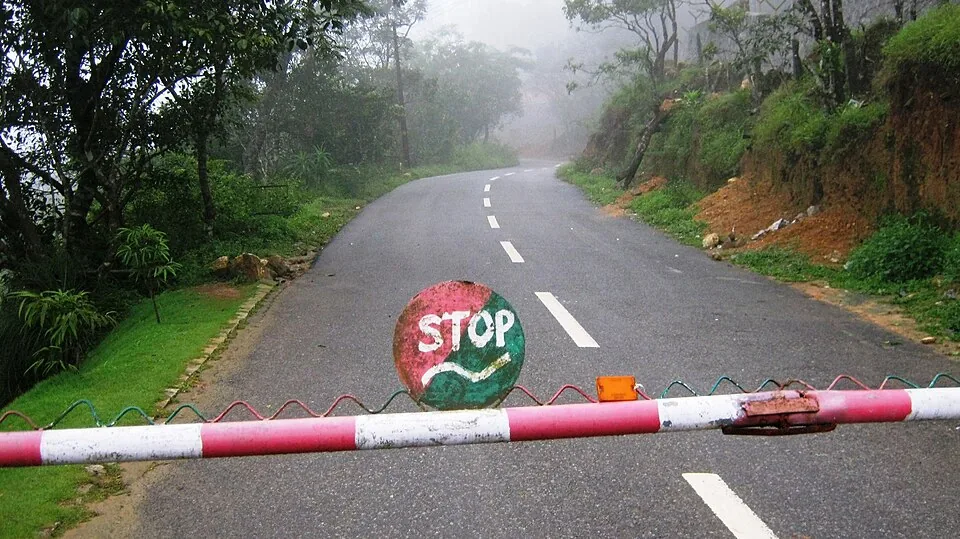
Almost every published description of Ponmudi tells you the timings and the entry charge. Very few tell you the thing that actually determines whether your day happens, which is that the hill is closed to visitors fairly often, sometimes decided that morning, and that there is no alternative route to argue your way onto.
The geography of a single gate
Above the forest check-post at Kallar there is one road up this mountain. No loop, no back way, no second approach from another valley. Everything — cars, buses, motorbikes, walkers heading for the trailheads — passes that barrier.
That makes management unusually simple and unusually absolute. One decision at one post closes the entire hill, and when it is closed it is closed for everyone.
Reason one: the ghat section slides
The road above Kallar climbs through twenty-two hairpin bends over roughly its last eighteen kilometres, cut into steep, deeply weathered, very wet slopes. That is textbook landslide ground, and in heavy rain the Forest Department suspends entry outright — sometimes for a day, sometimes until further notice, and sometimes in the middle of what a visitor would reasonably consider the season.
This is not a formality. A slip on a single-lane hairpin with no verge does not merely inconvenience people; it strands everyone above it. Closing at the bottom is the only safe way to manage a road shaped like this one, which is exactly why the decision is taken at the gate rather than on the hill.
Reason two: too many cars for the top
The second constraint is carrying capacity, and it is a genuinely hard problem. Ponmudi is close enough to Thiruvananthapuram to be a casual day trip, which is why it is busy; and the ground everyone drives up to see is thin-soiled high grassland that does not recover quickly from being parked on, trampled or burned.
So vehicle numbers going up are now managed rather than simply admitted. On peak weekends cars may be held below the post, or visitors moved onto a shuttle arrangement instead of driving to the summit themselves. Alcohol, dropped plastic and drone flying are all prohibited inside the eco-sensitive area, and the plastic rule in particular is enforced at the barrier rather than merely signposted.
Arrangements here have been tightened and relaxed more than once over the years, which is why we do not publish a fixed set of rules on this site and why you should distrust anything that does. The direction of travel, though, has been consistently towards more control.
Planning a day that survives the answer
The practical response is to stop treating the summit as the plan and start treating it as the upside.
Check before you leave. The Forest Department is the authority, not a listings page, and closures are announced at short notice. If it has been raining hard for a couple of days, assume the answer is no and be pleased to be wrong.
Arrive at the post when it opens rather than mid-morning. Both the vehicle count and the weather work against you as the day goes on, and the view from the top is only reliably clear early anyway.
Ask specifically which routes are running, because the answer is not binary. The upper walks towards the ridge are the first closed and the last reopened; the riverside trail at Kallar is the most likely to be available on a marginal day. Build the day around the trail that is open rather than the one you had in mind.
And carry cash. Fees and guide charges are collected at the post, and this is not a place to discover that you cannot pay.
Why this is the right trade
It is easy to read all of this as bureaucracy, and irritating to drive an hour and a half to be turned round. But the alternative is visible in the photographs of this hill from a decade ago: unregulated parking on the grass, litter across the summit, and a habitat that is measured in a few hectares taking the weight of a city’s weekends.
A single controlled gate is a blunt instrument, and it is also the only one the geography offers. Go early, go in the dry months, have a second plan, and treat an open barrier as good luck rather than an entitlement.