Almost everything written about Poruvazhy Peruviruthy Malanada leads with the same line: India’s only Duryodhana temple. It is a good line. It is also doing more work than it can support, and the evidence against it is five kilometres up the road.
The claim disagrees with itself first
Before going anywhere, notice that the sources do not agree among themselves. English Wikipedia says this is India’s only Duryodhana temple. The temple’s own website says it is the one and only Duryodhana temple in South India.
Those are different claims, and the second is considerably smaller than the first. When an institution’s own description of itself is more modest than the encyclopaedia’s, that asymmetry is usually worth following.
Ennasheri
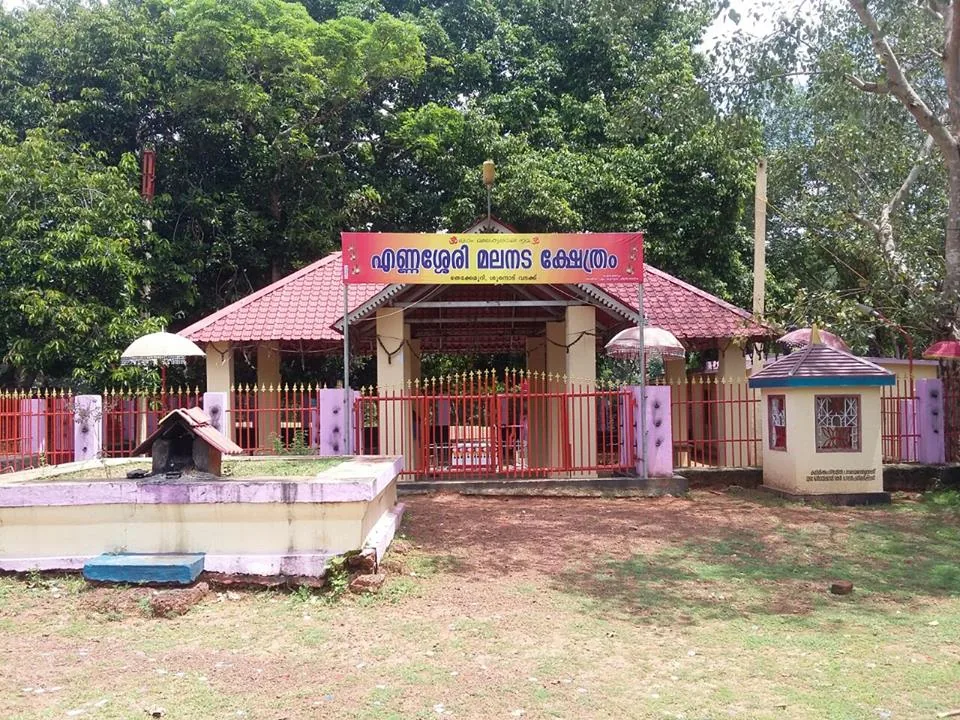
At Sooranad North, in the same Kunnathoor taluk, about five kilometres from Poruvazhy, stands Ennasheri Malanada.
It is dedicated to Dussasana — Duryodhana’s brother, the Kaurava who drags Draupadi into the assembly hall, which is to say a figure with even less claim on ordinary piety than Duryodhana has.
And it is built to the same pattern, point for point. No sreekovil. No idol. A raised althara under an open roof. Worship by sankalpam. Its administration vests in a committee elected by the members of seven karas, with a Kurava family body and an Ezhava family body holding recognised standing in it.
So the narrow claim may hold: this may well be the only temple where Duryodhana specifically is the presiding form. But the impression that line creates — a unique, isolated, inexplicable idol-less shrine to a Mahabharata villain — does not survive at all. There is a second one, of the same design, to another Kaurava, in the same taluk.
And the legend said so all along
Here is the part that turns a correction into something better than a correction.
The Poruvazhy legend does not describe a single miraculous event at a single spot. It says that after Duryodhana accepted toddy from the Kurava woman and granted his land, he ensured that further places of worship were established nearby — and that members of the Kurava caste would serve as priests in them.
The cluster is in the tradition. It was never supposed to be one temple. Every account that leads with "the only one" is quietly contradicting the story it goes on to tell three paragraphs later.
What exists in Kunnathoor taluk, then, is not an anomaly but a small religious landscape with its own internal logic: a family of shrines to the losing side of the Mahabharata, sharing a form of worship that dispenses with images, and a priesthood drawn from a community that Brahminical temple practice excluded.
Why that reframing matters
A single strange temple is a curiosity. You visit it, take a photograph, and file it under things that are odd about Kerala.
A cluster of related shrines is a tradition, and traditions have reasons. The reason on offer here is legible: these are shrines where the excluded do the officiating, organised around a story in which a high-born traveller accepts food from an untouchable woman and is not diminished by it. That the god at the centre is the Mahabharata’s villain is not despite the argument. It is the argument. If Duryodhana can be honoured, the ranking of persons that the temple system otherwise enforces is not the last word.
We are not claiming this is what any particular worshipper believes; we cannot know that, and religious practice rarely reduces to a thesis. But the shape of the institution — who officiates, what is offered, what is absent from the sanctum — is not accidental, and it repeats across more than one site.
A word on how solid any of this is
We would rather state the sourcing position than bury it. English Wikipedia’s article on Poruvazhy has carried a flag since August 2012 saying it relies excessively on primary sources, and a great deal of what circulates — the legend, the land grant, the tax levied in Duryodhana’s name, the ritual counts — traces back to the temple’s own website.
That does not make it false. A temple is a perfectly reasonable authority on its own ritual calendar and its own traditions. But it means this is largely an institution’s account of itself, and claims that would need an outside record — the revenue entry in particular — are given on this site as reported rather than verified.
The Ennasheri comparison is useful partly because it is independent of that. It is a different temple, described by different people, and it happens to corroborate the one part of Poruvazhy’s story that the headline version leaves out.
Frequently asked questions
Is Poruvazhy the only Duryodhana temple in India?
The sources disagree — English Wikipedia says India’s only, the temple’s own site says the only one in South India. The narrow claim about Duryodhana specifically may hold, but the impression of an isolated idol-less Kaurava shrine does not: Ennasheri Malanada, five kilometres away in the same taluk, is dedicated to Dussasana and is built to the same pattern.
What is Ennasheri Malanada?
A temple at Sooranad North in Kunnathoor taluk dedicated to Dussasana, Duryodhana’s brother. Like Poruvazhy it has no sreekovil and no idol, only an althara, with worship by sankalpam; its administration vests in a committee elected by members of seven karas, with Kurava and Ezhava family bodies holding recognised standing.
Does the legend mention other shrines?
Yes, and that is the point. The Poruvazhy legend says Duryodhana ensured further places of worship were established nearby, with members of the Kurava caste serving as priests in them. The cluster is part of the tradition, not a complication to it.
How reliable is the information about this temple?
Much of it comes from the temple itself. English Wikipedia’s article has been flagged since August 2012 as relying excessively on primary sources. We treat the temple as a good authority on its own ritual and calendar, and give claims needing an outside record — such as the land tax levied in Duryodhana’s name — as reported rather than verified.
Can you visit both?
They are about five kilometres apart in the same taluk, so yes. Seeing the two together is the clearest way to understand that this is a shared local form rather than a one-off.