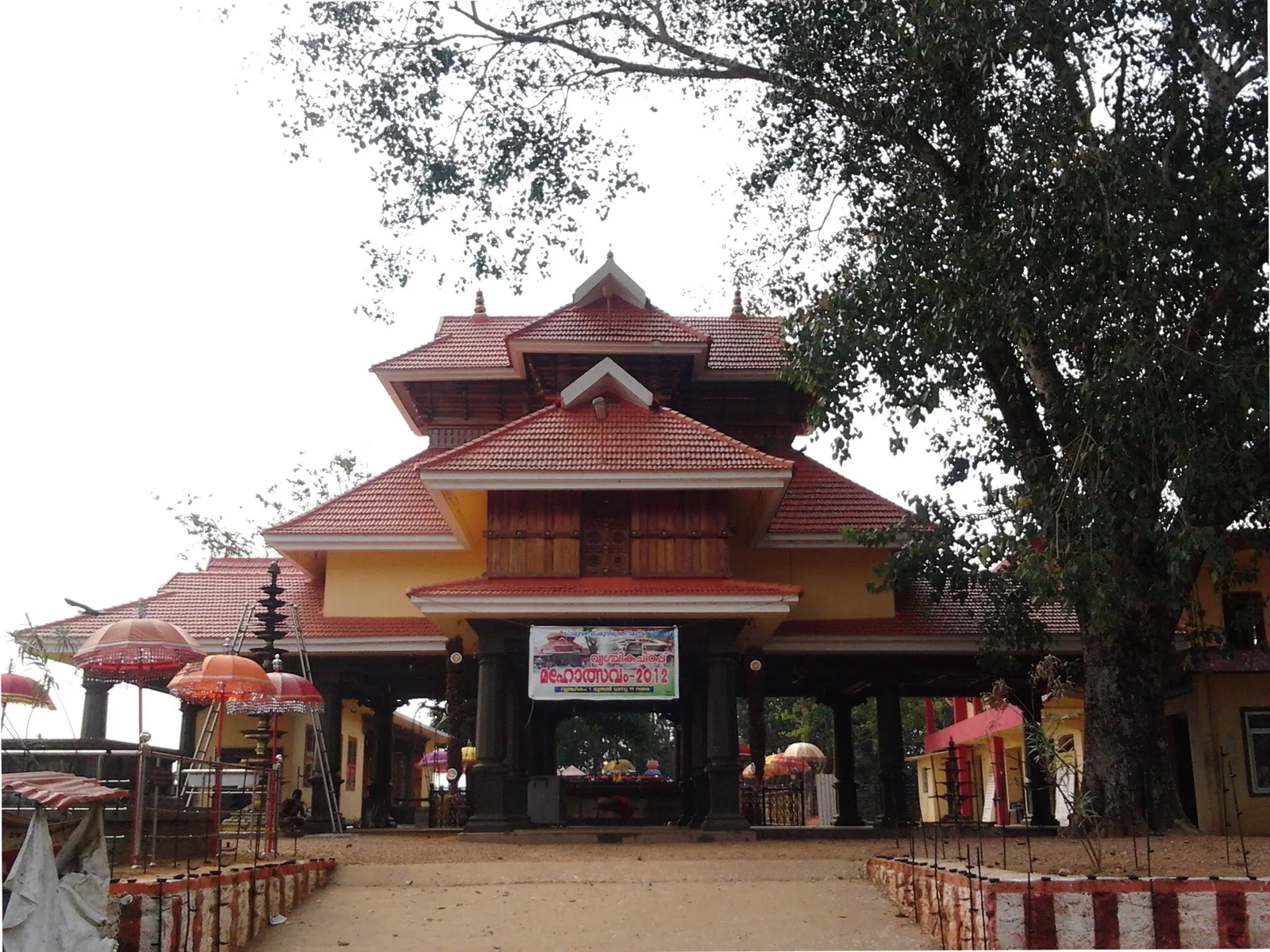
Most Kerala temple festivals are named for a deity, a month, or a rite. Malanada’s is named after a piece of equipment.
Malakkuda
Mala is the hill and the temple on it. Kuda is the ornamental ceremonial umbrella carried by the Oorali, the priest, on ceremonial occasions. Malakkuda — the hill’s umbrella — is the annual festival.
Consider what that tells you about where authority sits here. Not in an image, because there is none. Not in a Brahmin priesthood, because there is none. The festival takes its name from the object the Oorali carries, which is to say from the officiant himself and the visible sign of his office.
It falls in the second half of March, on the second Friday of the Malayalam month of Meenam. There is kettukazhcha — the enormous built pageantry-effigies that Kerala’s central belt does better than anywhere else — and Kathakali, traditionally including Nizhalkuthu, which is itself a Kaurava story. A temple to Duryodhana staging Kathakali about the Kauravas is not an accident of programming.
We are deliberately not printing a date for the next one. One widely copied source still carries a "next festival" line naming a day in a year that has already gone by — a date captured once and left to rot, which is a failure mode we have run into elsewhere and would rather not reproduce. The rule is durable; the specific day is not. Check a current Malayalam calendar, or ask on site.
And then, once every twelve years
Pallipaana is the great rite here, and it comes round only once in twelve years: eleven days, eighteen ceremonial acts.
The last was held from 24 February to 7 March 2023. The next is due in 2035.
That is worth writing down somewhere you will find it again. A twelve-year cycle means most people who visit this temple will never see one, and someone who catches the 2035 rite and misses it thereafter waits until 2047. If you are the sort of traveller who plans around a once-in-a-decade event, this is one.
The temple also keeps a Swarna Kodi, a gold flag held under lock as a symbol of authority and brought out only on auspicious occasions. Do not expect to see it, and do not build a visit around the hope.
The strangest detail is bureaucratic
Of everything told about this temple, the claim that has stayed with us longest is not about ritual at all.
The legend has Duryodhana granting hundreds of acres of paddy and garden land in freehold to the devasthanam. And it is consistently reported that the land tax on that property is levied, to this day, in the name of Duryodhanan.
If that is accurate, it is a genuinely remarkable piece of administrative continuity: a figure from the Mahabharata holding a live entry in a modern Indian land-revenue system, generating a demand every year, in the name of a man from an epic.
We give it as reported rather than as verified, and we want to be explicit about why. We have not seen the revenue record. No source we found quotes its exact wording or produces a document number. The claim traces, like most of the detail about this temple, to the institution’s own account of itself.
That is not a reason to dismiss it — temples are reasonable authorities on their own affairs, and a claim this specific and this checkable is not the kind that usually gets invented. It is a reason to mark it clearly as a report, which is what we have done everywhere it appears on this site.
What a visit is actually like
Outside festival days, quiet and quick. There is no sanctum queue, because there is no sanctum; the mandapam is open on all sides and the althara is the focus. Half an hour to an hour covers it.
We could not find verifiable published timings, and we are not going to invent a schedule. With no chamber to open or close, the usual Kerala morning-and-evening pattern applies loosely at best. Traditional temple dress is expected, as it is across Kerala.
Poruvazhy sits on the northern edge of Kollam district in Kunnathoor taluk, inland from NH66 near Ochira, with Kayamkulam as the practical railhead and Sasthamcotta the nearest town of any size. One navigational warning: there is a second, similarly named point about 940 metres north-east of the temple in the mapping data, so aim at the temple rather than at the name.
And if you have the time, pair it with Oachira, thirty-odd kilometres west — the other great Kerala shrine that does without an image and without a roof over its deity. Two temples, one district, two different ways of arriving at the same refusal.
Frequently asked questions
When is the Malakkuda festival?
On the second Friday of the Malayalam month of Meenam, in the second half of March. We deliberately do not print a specific next date — one widely copied source still gives a day from a year already past. Check a current Malayalam calendar, or ask on site.
What does "Malakkuda" mean?
Mala is the hill and its temple; kuda is the ornamental ceremonial umbrella carried by the Oorali, the priest. The festival is named after the priest’s umbrella — which says a good deal about where authority sits at a temple with no image and no Brahmin priesthood.
What is Pallipaana and when is the next one?
The temple’s great rite, held once every twelve years over eleven days and comprising eighteen ceremonial acts. The last ran from 24 February to 7 March 2023; the next is due in 2035, and the one after that would fall in 2047.
Is the land really taxed in Duryodhana’s name?
It is consistently reported that the land tax on the property said to have been granted by Duryodhana is levied in his name to this day. We give it as reported, not verified: we have not seen the revenue record, and no source we found quotes its wording or cites a document.
What is the Swarna Kodi?
A gold flag kept as a symbol of authority, held under lock and displayed only on auspicious occasions. It is not something to expect to see on an ordinary visit.
How long does a visit take?
Half an hour to an hour outside festival days. There is no sanctum and therefore no queue — the mandapam is open on all sides and the raised althara is the focus. Allow most of a day for Malakkuda.