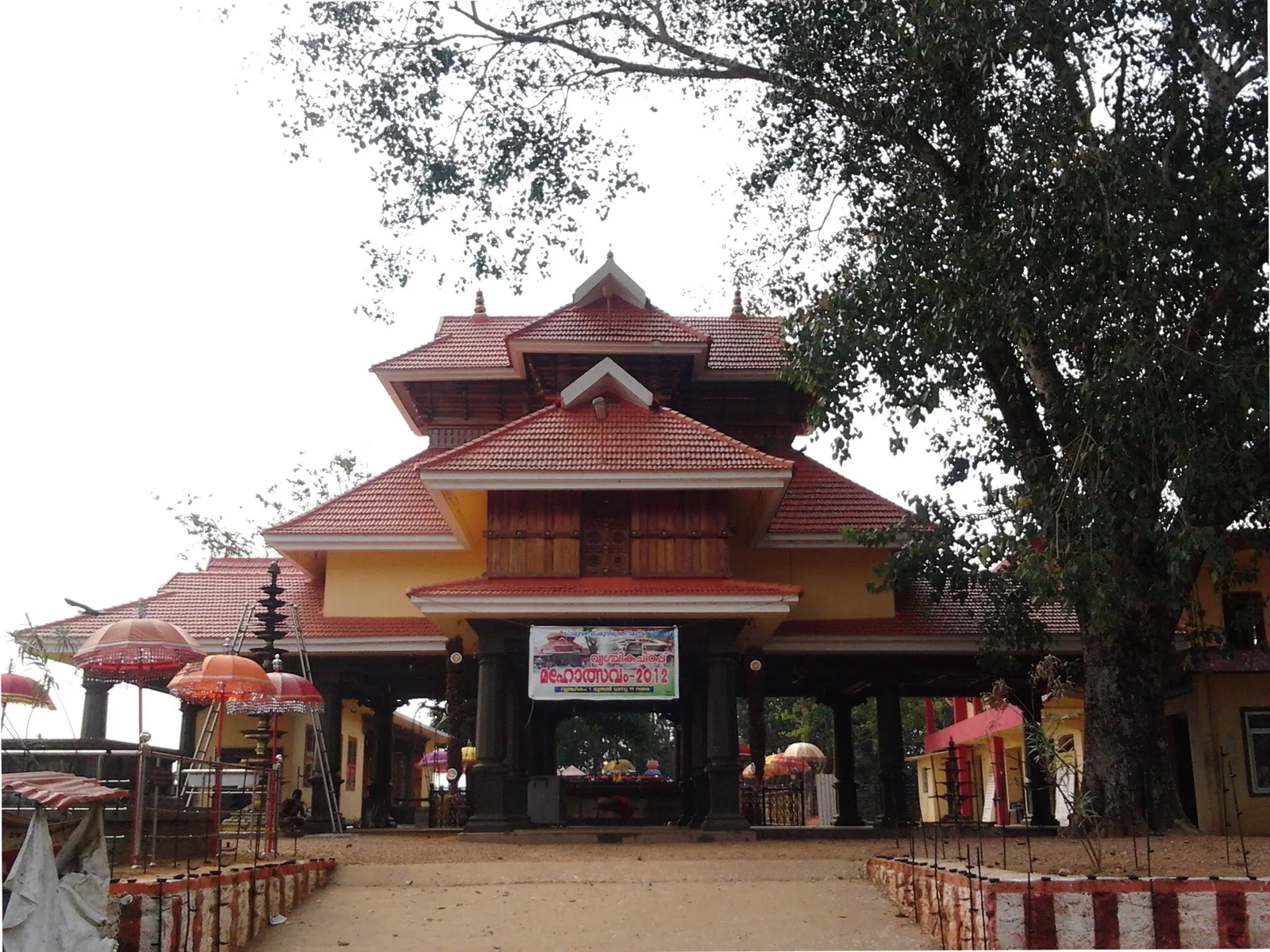
The photograph gives it away before you have read a word about the place. There is a fine tiered roof on granite pillars, deep eaves, the whole thing solid and well made — and you can see straight through it to the trees on the other side.
Where a Kerala temple would have its sreekovil, the dark chamber holding the image, Malanada has an althara: a raised platform, open on every side. There is no idol. There is nothing to be shown.
That is the point, not a shortfall
Worship here is by sankalpam — the deliberate holding of the divine form in the mind, in the absence of anything to look at. The worshipper does the work that an image would otherwise do.
It is worth resisting the instinct to treat this as a temple that is missing something. Kerala has a small and remarkable set of shrines built on this principle, and they are not impoverished versions of image-worship — they are a deliberate alternative to it. About thirty kilometres west, the Oachira Parabrahma temple does something related: devotion directed at the formless, Parabrahma, under carefully tended old trees, with no roofed sanctum over the deity at all. If you visit one, visit the other; the comparison teaches more than either does alone.
The practical consequence is worth flagging because it catches people out. There is no queue and nothing to glimpse. Visitors who arrive expecting a shrine interior sometimes decide the temple must be closed.
And now who the platform is for
The presiding figure is Mala Appooppan — the grandfather of the hill. And the form in which that presence is held, the sankalpa moorthy, is Duryodhana.
Duryodhana is the antagonist of the Mahabharata: the eldest of the hundred Kauravas, the man whose refusal to concede five villages brings on a war that empties the world. This is very widely described as India’s only temple to him.
Keep the local formulation, though, because it is more precise than the headline and it explains something the headline cannot. A hill deity, understood as Duryodhana. Not Duryodhana imported and installed as a god, but a presence already in the landscape, recognised in a particular form. That is how a Mahabharata villain ends up with an althara in Kollam district.
Kerala’s own classical stage had already made room for him, incidentally. In Kathakali, Duryodhana is a kathi role — the knife — green-faced with an upturned moustache and a knife-shaped mark, the make-up reserved for the grand villain, magnificent rather than merely wicked. The register in which he is taken seriously here is not foreign to the culture around it.
Toddy, and a woman at the roadside
The founding story is short and it turns on a single decision.
Duryodhana came through this country looking for the Pandavas, who were somewhere in exile. He was thirsty and asked an elderly woman for water. She gave him toddy instead — as a mark of respect, that being what there was and what was offered to someone honoured.
He drank. Only afterwards did he take in her dress and her ornaments and understand that she belonged to the Kurava caste, then held to be untouchable.
And then he did nothing about it. He did not recoil, purify himself, or punish anyone. He worshipped Shiva on that spot and granted hundreds of acres of paddy and garden land in freehold to the devasthanam.
Toddy remains the traditional offering here, for exactly that reason. It is not a folkloric curiosity. It is the specific thing the story is about.
The proof that the story was meant seriously
Founding legends are cheap. What makes this one worth attending to is that the temple is still organised around it.
The priest here is not a Brahmin. He is the Oorali, and members of the Kurava caste serve as poojaris — the same community as the woman in the story. The hook-swinging tradition of Thookkam is reserved to a named family. Administration runs through taluk-level community bodies rather than a single lineage.
A shrine whose founding story turns on a caste boundary being disregarded, and which is staffed in perpetuity by the community on the wrong side of that boundary, is making an argument. It is not telling an anecdote about a strange god.
Which is why we would push back on the framing this temple usually gets — Kerala’s weird temple to the bad guy. The story is about caste. The priesthood is the evidence that it always was.
Frequently asked questions
Why is there no idol at Malanada?
By design. In place of a sreekovil and an image there is an althara — a raised platform under an open pillared mandapam — and worship is by sankalpam, holding the divine form in the mind. It is a deliberate alternative to image-worship rather than a lack, and there is nothing to queue for or glimpse.
Who is the deity?
Mala Appooppan, the grandfather of the hill, conceived in the form of Duryodhana — the sankalpa moorthy. "A Duryodhana temple" is serviceable shorthand but it inverts the structure: a hill deity understood as Duryodhana, not Duryodhana installed as a god.
Why is toddy offered?
Because of the founding story. An elderly woman gave Duryodhana toddy when he asked for water, as a mark of respect; he drank it, then realised she was of the Kurava caste, then held untouchable, and accepted it regardless. Toddy is the specific thing the legend is about.
Who are the priests here?
The officiant is the Oorali, not a Brahmin, and Kurava-caste poojaris serve — the same community as the woman in the legend. Thookkam is reserved to the Gurukkalsserial family. Note that "Oorali" here is a priestly office; elsewhere in Kerala the word names a tribal community.
What else in Kerala is like this?
The Oachira Parabrahma temple, about 30 km west, where devotion is directed at the formless Parabrahma under old trees with no roofed sanctum. And Ennasheri Malanada, five kilometres away in the same taluk, which is dedicated to Duryodhana’s brother Dussasana and built to the same pattern.