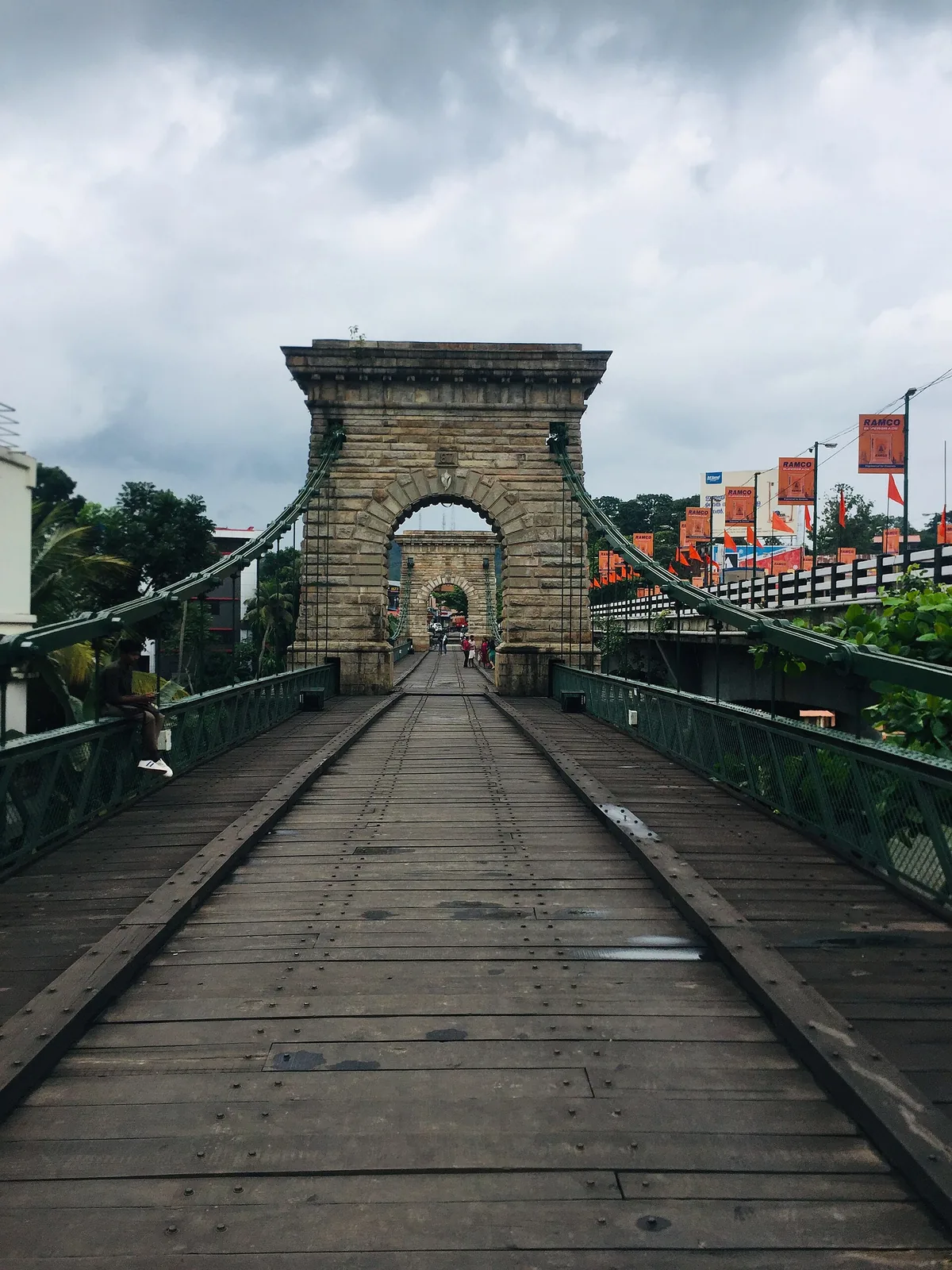
Walk out onto the Punalur bridge and it moves. Not alarmingly — a slow give underfoot, more noticeable when somebody else is walking too. Everyone who crosses it notices, and everyone is told the same thing about why.
The trouble is that they are told it by three different arms of the same government, and the three accounts are not versions of one story. They are three different stories.
Version one: the deck was designed to shake
This is the famous one. The bridge was deliberately built so that it would wobble when walked on, in order that wild animals coming out of the forest would be frightened off and would not cross into the town. It is on the archaeology department's record, on Wikipedia, on every tourism page, and it is the single fact most visitors arrive knowing.
It is a claim about intent, and intent is the hardest thing to evidence about a Victorian structure. There is no contemporary document behind it that we or anyone else has produced — no design note, no correspondence, no specification. What there is, is a very old and very consistent oral tradition, repeated by the state.
Version two: the bridge was built to keep animals out
Kerala Tourism, also a government department, gives a different account in its own copy: that the bridge was constructed to prevent the entry of wild animals which were known to destroy crops and cause huge losses to the villagers.
Read that carefully, because it is not the same claim. Version one says the deck was designed to shake, as one property of a bridge built for other reasons. Version two makes wildlife exclusion the purpose of the entire structure — a bridge built as a barrier. Those are different engineering propositions and they cannot both be the primary account.
Version three: no animals in it at all
The one published academic history of Punalur we have read in full gives a third origin, and animals do not appear anywhere in it. In that account the principal secretary of the Madras government pressed the Diwan of Travancore in 1872 for a crossing over the Kallada, the Diwan refused, and the engineer went to the king. The bridge exists because a colonial administration wanted forest produce moved from the ghats to the port at Quilon.
That version has documents and dates behind it. It also has no romance in it whatsoever, which may be why nobody prints it on a signboard.
What actually makes it move
The physics is not mysterious, and the archaeology department describes it plainly on its own page: the force applied at one end of the bridge is balanced by lifting up the other end.
That is a description of any suspended deck. The load hangs from chains; put weight on one part and the geometry adjusts along the whole length. A deck hung on iron chains of 53 rings each, anchored to four discs set in four wells, and stiffened only by the lattice girders along its edges, is going to move under a walking load. It moves because of what it is, not because somebody wanted it to.
Which is the quiet problem with version one. The wobble does not need to be explained by intent. It is what a suspension bridge does.
The elephant test
There is one more anecdote, carried by both the archaeology department and the history paper, and it is the best thing in the whole file.
When the bridge was finished, the people of Punalur would not walk on it. A wooden deck hanging in the air on chains, over a river, moving when you stepped on it, in a town where every crossing had until then been a ford or a boat — it did not look safe, and nobody was willing to be first.
So the engineer arranged a demonstration. He took his own family down to the river and passed underneath the bridge in a country boat, while six elephants were walked across it above them.
It is an extraordinary piece of theatre. He did not walk across himself, which would have proved only that the bridge could hold one man. He put his family in the water directly beneath the span and then loaded it with the heaviest thing available in Kerala. Nothing about the design was explained; the argument was entirely physical, and it was addressed to an audience that had never seen a suspension bridge.
The historian who records it adds a dry aside — that the hesitation was nothing unusual and shows the people's ignorance of the advance. We would put it the other way. Refusing to be the first person onto an untested structure is not ignorance. It is exactly the reasoning that made the demonstration necessary, and it is the reason we have the story at all.
What the deck says
One physical detail cuts across all three versions. Look down the planking in any modern photograph and two raised timber runners run the whole length of the bridge, one under each wheel line. This deck was laid out for wheeled traffic, whatever else it was for — carts first, motor vehicles much later, and now neither. A concrete bridge alongside took the traffic and the department records the outcome in a single sentence: it is now used by pedestrians only.
So we can tell you three things with confidence. The bridge moves, and that is a property of suspended decks. Elephants crossed it as a public demonstration and the story is carried by both the state and a published historian. And three arms of the same government have been explaining the movement three different ways for a very long time.
What none of them has is a document from 1877. The animal story may well be true. We simply want to be clear that when you read it on the board at the bridge, you are reading a tradition, not a record — and that the department, the tourism office and the historians do not agree on what it is a tradition about.
Frequently asked questions
Does the bridge really shake?
Yes. It gives underfoot as you walk, more so when others are crossing. The archaeology department's own explanation of the mechanics is that force applied at one end is balanced by lifting up the other end — which is a description of how any suspended deck behaves.
Was it designed to shake to keep animals out?
That is the standard account and it is repeated by the state, but it is a claim about design intent with no contemporary document behind it. Kerala Tourism gives a different version — that the bridge itself was built to keep out crop-raiding wild animals — and the published history of the town gives a third origin with no animals in it at all.
What is the elephant story?
After completion, people were afraid to cross. The engineer took his family underneath the span in a country boat while six elephants were walked across above them. Both the Kerala Department of Archaeology and the 2019 history of Punalur carry it. Like the wobble story it is an anecdote rather than a record, but it is better attested than most.
Why are there raised timber strips along the deck?
They are wheel runners, one under each wheel line, running the length of the planking. The deck was laid out for wheeled traffic — carts, and later motor vehicles. It carries neither now: a concrete bridge alongside took the traffic and the bridge is pedestrian-only.
Is it safe to walk on?
It is a protected monument in daily public use, tagged as a footway, with no gate and no restriction on foot access. The movement is normal for a suspended deck. It is not a place to run or to bunch up in a crowd, and the benches at either end are where most people actually sit.
Are there really elephants around Punalur?
The town sits at the edge of the forest belt that runs east through Thenmala and Aryankavu towards the Tamil Nadu border — genuine elephant country then and now. That geography is why the animal story is plausible even though nothing documents it.