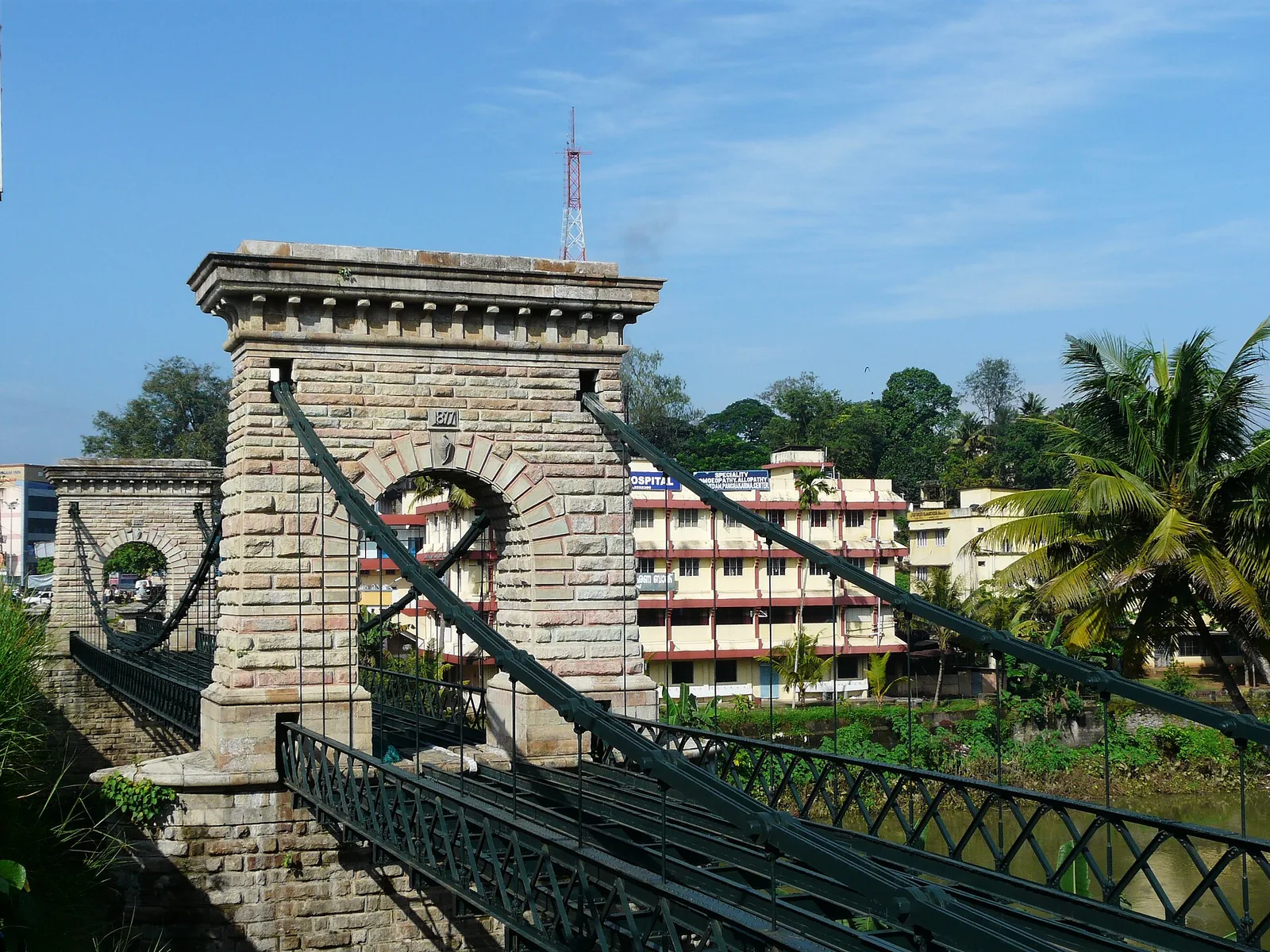
The received version of this bridge is a short one. A Travancore maharaja, Ayilyam Thirunal Rama Varma, built a suspension bridge over the Kallada at Punalur; it was finished in 1877; a Scottish engineer did the work. Every signboard and every tourism page tells it that way, and none of it is untrue.
It is simply not the beginning of the story. The one published history of Punalur we have been able to read in full — a 2019 paper in the International Journal of Innovative Research in Engineering & Management by Binu Raj B.K, a historian writing specifically about the architecture of this town — records how the decision was actually taken, and the king is the last person in it, not the first.
A visit in 1872
The principal secretary of the Madras government came to Travancore in 1872. The Diwan of Travancore at the time was Sir T. Madhava Rao, one of the most capable administrators in nineteenth-century India, and the visitor pressed on him the necessity, as the paper puts it, of the construction of a bridge across the Kallada river.
Madhava Rao neglected the proposal. That is the paper's word. The Diwan of a princely state, asked by a senior British official to spend Travancore money on a piece of infrastructure the British wanted, declined to act on it.
What happened next is the part worth carrying away. The engineer went around him. He explained the details of the bridge directly to the king, and the king gave his consent. The most famous piece of Victorian engineering in Kerala exists because a proposal that had been refused at the top of the administration was taken over that administration's head.
Why Madras wanted a bridge in this particular town
Punalur is not a random point on a river. It sits at the last inhabited place before the forest that climbs towards Aryankavu and the Shencottah Gap — the pass through the Western Ghats that connects Travancore to the Tamil country and the Madras Presidency beyond it. Downstream of the town the Kallada runs west to Ashtamudi and the port of Quilon.
So a crossing here is not a local convenience. It is the missing link in a corridor: forest at one end, port at the other, and a river in between that had to be forded. The paper's argument is blunt about what that corridor was for. It describes the British augmenting the rich forest resources — teakwood, hardwood, honey — and putting, in its phrase, a little alms in the begging bowl of Travancore.
The corroboration is in the dates that follow. The idea of the Kollam–Tirunelveli railway, running the same corridor through the same gap, was first conceived in 1873 — the year after the bridge was demanded. The line opened through Punalur to Sengottai on 26 November 1904. In 1888 a paper mill opened on the same riverbank at Punalur, working bamboo out of the same hills. A bridge, a railway and a mill, in that order, all eating the same forest.
The contradiction we are not going to smooth over
There is a problem with this account, and it is a year wide.
The Kerala Department of Archaeology, the bridge's own custodian, dates the start of work to 1871. The history paper has the Madras secretary arriving in 1872, the Diwan refusing, the engineer going to the king, and consent following. On those two timelines, work began a year before anyone asked for the bridge.
There are honest ways to reconcile it. "Work began in 1871" may mean survey and alignment rather than construction, with the political fight coming during it rather than before it. Or one of the two dates is simply wrong — the department gets several other things about this monument wrong, including publishing a coordinate for it that is not a valid coordinate. We cannot settle it from the sources we have, and we would rather leave the seam visible than quietly pick a year.
Whose bridge it is, in the end
It would be easy to read all of this as a colonial story, and a great deal of writing about the bridge does exactly that — Commons photo captions call it built by Britishers, blogs call it opened by the British, and until recently two of our own data files called it a colonial bridge. That is wrong, and the bridge itself says so.
Carved into the masonry above the arch on the tower face is a panel reading 1877. Directly beneath it, on the keystone, is a conch shell — the shankhu, the state emblem of Travancore. It is legible in photographs taken in 2007, 2012, 2016 and 2018, and it is a public work announcing its owner in the ordinary way of public works.
Both things are true at once, and that is what makes it interesting. The pressure was British. The refusal was Travancore's. The money was Travancore's, the emblem is Travancore's, and the 250 labourers who spent 2,212 days building it were local. T. Madhava Rao does not come out of this as anybody's stooge — his refusal is the whole point of the anecdote, and it is the only moment in the standard telling where anyone says no.
Stand on the deck and you are standing on a compromise nobody wrote down: an imperial demand, a princely refusal, and an engineer with enough access to the palace to make the refusal irrelevant.
Frequently asked questions
Who actually decided to build the bridge?
On the account in the 2019 history paper, the king — Ayilyam Thirunal Rama Varma — but only after the proposal had been pressed by the principal secretary of the Madras government in 1872 and set aside by the Diwan, T. Madhava Rao. The engineer took the plan directly to the king and obtained his consent.
Why did the Madras government want it?
Punalur is the last town before the forest below the Shencottah Gap, on the corridor between the Madras Presidency and the port at Quilon. The paper's thesis is that the bridge, and later the railway conceived in 1873 along the same route, were instruments for moving Travancore's forest produce — teak, hardwood, honey — out through that corridor.
Does the 1872 story fit the construction dates?
Not cleanly. The Kerala Department of Archaeology dates the start of work to 1871, a year before the visit described in the paper. Either "work began" means survey rather than building, or one of the two accounts is wrong. We have not been able to settle it and we do not pretend to have.
Is this a British or a Travancore bridge?
A Travancore government public work, built under Ayilyam Thirunal Rama Varma. The Travancore conch is carved above the arch beside the 1877 datestone. Travancore was a princely state, not British India — the pressure was British, the bridge was not.
Who was T. Madhava Rao?
Diwan of Travancore and one of the most influential administrators of nineteenth-century princely India; he also served Indore and Baroda. In Kerala he is associated with major public works of the 1860s and 1870s, including the Varkala tunnels begun in 1867 — which makes his refusal here a considered one rather than obstruction for its own sake.