Ask who built the Punalur suspension bridge and you will get the same sentence everywhere: Albert Henry, a Scottish engineer, chief engineer of Travancore. It is on tourism pages, on Wikipedia, in guidebooks, and until this week it was on this site too.
We went looking for him. What we found instead was a second man with a complete professional record, and a hole where the famous one should be.
The department cannot agree with itself
Start with the custodian. The Kerala Department of Archaeology publishes two pages about this monument on the same website. Its monument record names the builder only as "Henry, a Scottish engineer" — no first name at all. Its sister page gives "Albert Henry, a Scottish engineer".
That is a small thing and it is also the whole problem in miniature. The department that legally protects this bridge does not have a settled name for the person credited with it, and the fuller version — the one everyone repeats — is on the page with the weaker sourcing.
The man who is documented
English Wikipedia carries a detail almost nobody repeats: that construction started under Walthew Clarence Barton and was completed in 1877 by Albert Henry, both described as chief engineers of Travancore. Barton is a real, traceable person, and the trace is a good one.
His obituary was published by the Institution of Civil Engineers in 1903 and is transcribed on Grace's Guide. Walthew Clarance Barton — Clarance, not Clarence — born 29 August 1834 at Dartford, died 16 January 1903 at Ilkley. He entered the Government of India Public Works Department in 1855 as a Covenanted Civil Engineer, served six years as Assistant Engineer in the Bombay Presidency and two as Executive Engineer in the Ahmedabad district, transferred to Travancore in 1863, was appointed Chief Engineer of Travancore in 1873, and retired from Travancore state service in 1880.
The obituary credits him with the Trivandrum Secretariat and its Durbar Hall, the Arts College, University College, the Mental Hospital and the old drainage system of the capital, along with a network of roads from the Ghats to the seaboard and the bridging of what it calls dangerous and impassable rivers.
It does not name the Punalur bridge. It does not name any bridge individually — that phrase about dangerous and impassable rivers is as specific as it gets. So the obituary does not prove Barton built this one. What it does prove is the dates, and the dates are enough to break the received sentence.
Both men cannot have held the same post
Barton was Chief Engineer of Travancore from 1873 to 1880. The bridge was under construction from 1871 to 1877. Barton therefore held the post through four of its six construction years — and it is not a post two people hold at once.
The correction that follows is narrow but real. Albert Henry may well have designed this bridge, taken it to the king, and seen it finished; the history paper on Punalur gives him precisely that role and no other. What he cannot have been, for most of the build, is the chief engineer of Travancore. The man in that chair was Barton. Our own page said otherwise until now, and so does most of the internet.
And then the hole
Here is the part we did not expect. Having found Barton's full career in a couple of minutes, we went looking for the same thing for Albert Henry: an Institution of Civil Engineers obituary, an admission record, a professional membership, a biographical note, anything.
There is nothing. Grace's Guide, which catalogues Victorian engineers in extraordinary depth and has Barton's whole life, has no Albert Henry answering to this description. No obituary, no institutional record, no birth or death dates, no other project. For the man whose name is attached to the most photographed piece of Victorian ironwork in Kerala, the professional record is empty.
We want to be careful about what that does and does not mean. Absence of evidence in the surviving British engineering literature is not proof that a man did not exist or did not build this. Travancore was a princely state; it employed people outside the covenanted British Indian services, and those careers are far less well catalogued than the ones that ran through the PWD. Henry may have been exactly what the department says — a Scottish engineer in Travancore service — and simply never have belonged to the institutions that keep records.
But the asymmetry is striking. One name, endlessly repeated, with nothing behind it. Another, almost never repeated, with a career you can read.
What the bridge says about itself
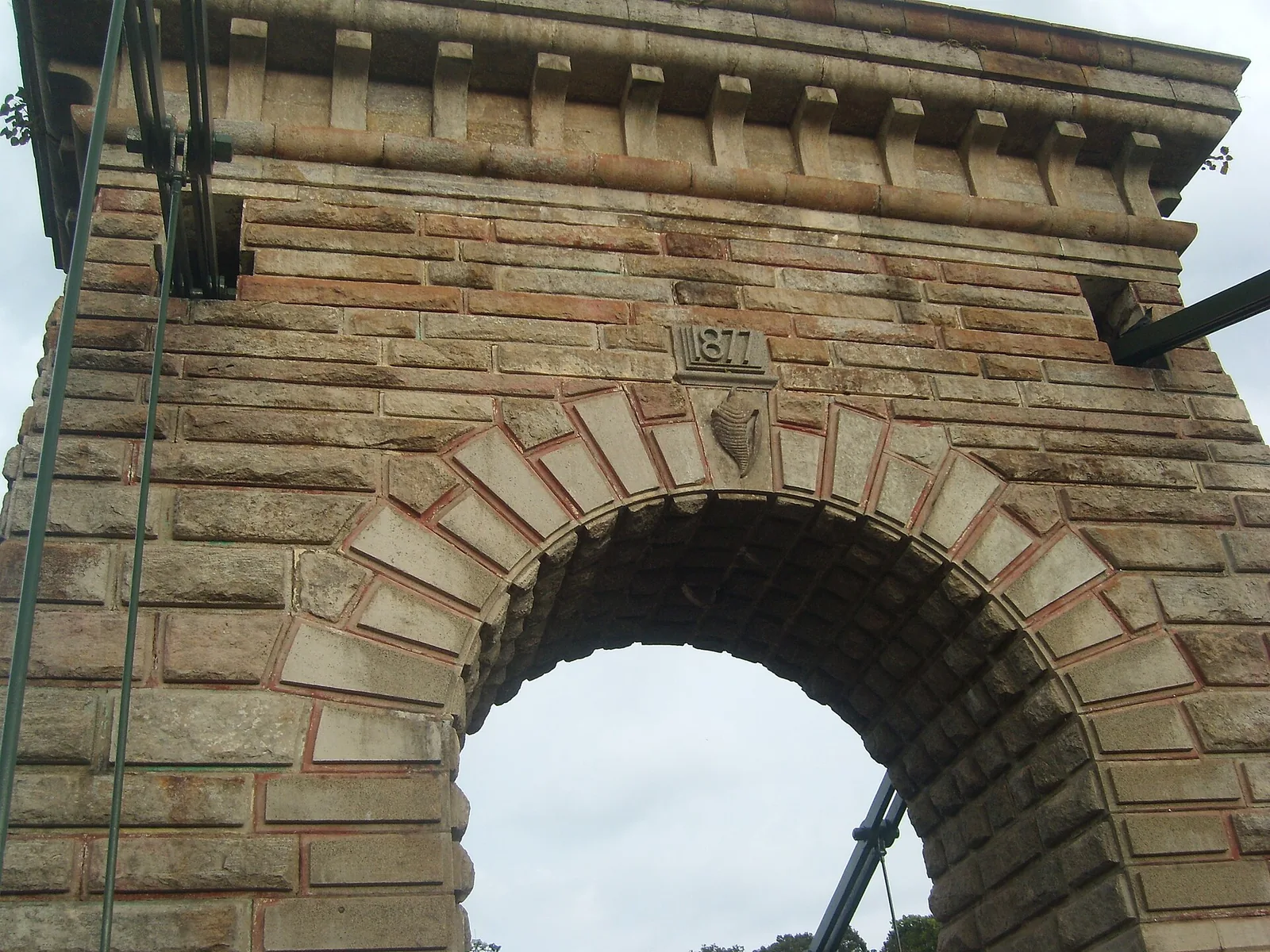
The structure carries exactly one inscription, and it names nobody. Above the arch on the tower face there is a carved panel reading 1877, and below it on the keystone a carved conch — the emblem of Travancore. That is the entire authorship claim: a year and a state. In the 2007 photographs, before the restoration, the same panel is picked out as a blue plate with white numerals and there is a second 1877 on the inner arch; today it is bare stone. Either way, no engineer's name has ever been on it.
What the record does agree on is the workforce. Both the archaeology department and the history paper give the same two figures: approximately 250 labourers, 2,212 days. That is six years and one month, which is the arithmetic check on 1871 to 1877, and it is the only number about this bridge that two independent sources state identically.
Two hundred and fifty people, for six years, and the only names to survive are two Scotsmen — one of whom we cannot find.
It is a familiar shape in this district. An hour west, Thevally Palace in Kollam is dated by everybody to 1811–1819 and by no primary source at all. Here, the most famous bridge in Kerala is credited to a man with no professional record. The confident sentence and the empty file turn out to be the same phenomenon: something repeated often enough that nobody went back to check whether anything was under it.
Frequently asked questions
So who built the Punalur suspension bridge?
The honest answer is that the work is attributed to a Scottish engineer whom the Kerala Department of Archaeology names only as Henry, and its second page and other sources call Albert Henry. Walthew Clarance Barton was Chief Engineer of Travancore from 1873 to 1880 and was therefore in post for four of the bridge's six construction years.
Was Albert Henry the chief engineer of Travancore?
He cannot have been for most of the construction. That post was held by Walthew Clarance Barton from 1873 to 1880, documented in Barton's 1903 Institution of Civil Engineers obituary. The widely repeated description of Henry as chief engineer conflicts with it.
Is there any record of Albert Henry at all?
We could not find one — no obituary, no institutional membership, no biography — while Barton's full career is readily available. That is not proof he did not exist: Travancore employed engineers outside the British Indian covenanted services and those careers are much less well recorded. But the asymmetry is real.
Does Barton's obituary mention this bridge?
No. It credits him with the Trivandrum Secretariat and Durbar Hall, University College, the Arts College, the Mental Hospital, the old drainage system, roads from the Ghats to the seaboard, and the bridging of "dangerous and impassable rivers" — but it names no individual bridge.
Is there an inscription on the bridge?
Only a date and an emblem: a carved panel reading 1877 above the arch on the tower face, with the Travancore conch on the keystone below it. No engineer is named anywhere on the structure.
How many people built it?
Approximately 250 labourers over 2,212 days — the same two figures given independently by the Kerala Department of Archaeology and by the 2019 history paper on Punalur. 2,212 days is six years and one month, consistent with a start in 1871 and completion in 1877.