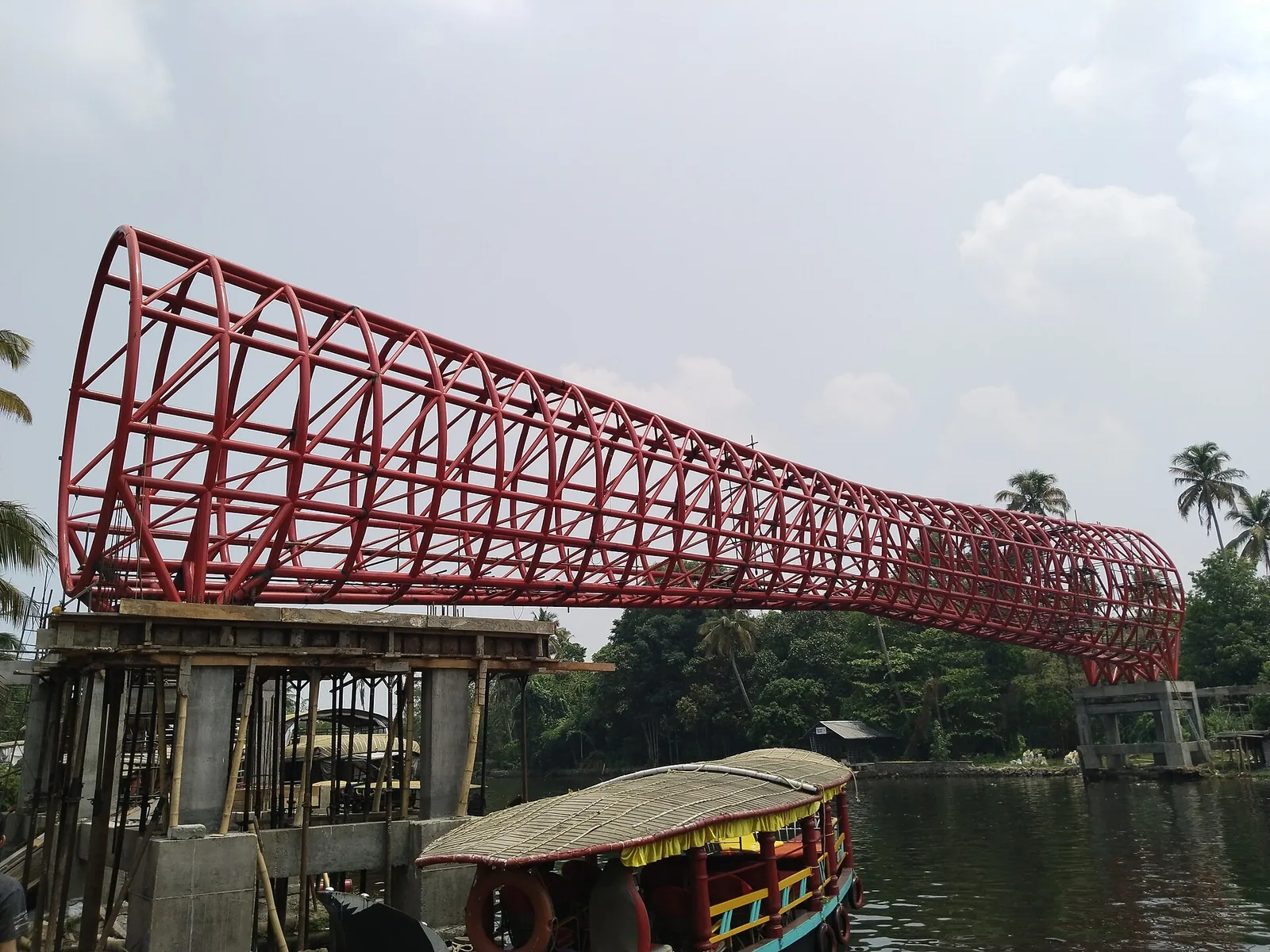
At the starting end of the Nehru Trophy course on Punnamada, a red steel footbridge crosses the water. It is worth a paragraph of its own, because it is not an ordinary footbridge with some local motif bolted onto it. The whole structure is the shape of a chundan vallam.
What you are looking at
A chundan has a very particular profile: an enormously high, flared prow that rears up out of the water, and a hull that runs back from it long and low and narrowing, a hundred-odd feet of it, until it tapers away at the stern. It is the most recognisable object in Kerala and it looks like nothing else afloat.
The bridge reproduces it structurally rather than pictorially. At one end the steel lattice opens into a wide, tall, rounded mouth — the prow. From there it tapers continuously along the entire span, ring after ring of red tubular frame getting smaller, until it comes down to a narrow tail on the far bank. Walking across it, you would be walking through the inside of a snake boat.
Two photographs of it exist on Wikimedia Commons and they catch it at two stages: first as a bare frame sitting on temporary timber formwork with a thatched shikara moored beneath, then decked and railed, with its piers painted red and yellow and houseboats moored along the bank behind. Together they show the thing being built.
Why we are making a point of it
Because of how nearly we missed it, and because that is a lesson this site keeps relearning. The two files are called “Nehru Trophy Starting Point Walking Bridge Alappuzha 2025” and “Nehru Trophy Ward Footover Bridge Punnamada, Alappuzha”. Neither says anything about a shape. Read the filenames and you have a footbridge near a boat race; open the images and you have one of the more charming pieces of public design in the district.
This cuts the other way just as often, and on this very page it did. The two photographs that illustrated Punnamada here until August 2026 were called “Life in Vembanad Lake, Alapuzha” and “Kerala backwaters, Vembanad Lake, India”, and the hero was the first of them. None of the three was Punnamada. They were not false — Punnamada is a reach of Vembanad, so a Vembanad photograph is technically of the right lake — but a page about a specific stretch of water, with a specific race on it, was illustrated with frames that could have been taken forty kilometres away. A filename is not evidence, in either direction.
The boats it is shaped like
The chundan vallam is a war boat that became a racing boat. The legend of its design — a king of Chembakassery losing battles because his canoes were too slow, and commissioning a carpenter to build something long and low enough to slip through narrow channels and outrun anything on them — belongs to Chembakassery and Ambalappuzha rather than to this water, and we say so on the place page rather than quietly adopting it. Punnamada is where these boats race today; it is not where the form was invented.
They are not the only class on the course either. Alongside the chundans race iruttukuthi, veppu, churulan and thekkanodi boats — a whole taxonomy of hull forms that the English-language coverage tends to compress into “snake boats”. And the fastest run ever recorded here, 4:14.35, was set by Pallathuruthy Boat Club rowing Karichal in 2024; Karichal is the most successful chundan in the race's history, with sixteen wins including two hat-tricks.
So the footbridge is a reasonable thing for Alappuzha to have built. On a stretch of water whose entire significance is a boat, somebody made the crossing into the boat.
The race, the trophy and the 1952 story are in our companion piece on the Prime Minister who jumped into the winning boat.
Frequently asked questions
What is the red bridge at the Nehru Trophy starting point?
A steel footbridge across the water, built in the profile of a chundan vallam — a wide flared mouth at one end tapering the whole length of the span to a narrow tail, so that crossing it means walking through the shape of a snake boat. Two photographs on Wikimedia Commons show it at different stages of construction.
What is a chundan vallam?
The Kerala snake boat: a very long, low racing hull with a high flared prow, pulled by scores of oarsmen. Its origin legend — a Chembakassery king commissioning a boat fast and narrow enough to outrun his enemies — belongs to Chembakassery and Ambalappuzha rather than to Punnamada, which is where the boats race rather than where the design was invented.
Are all the boats in the race chundans?
No. Iruttukuthi, veppu, churulan and thekkanodi boats race in their own classes alongside the chundans. English-language coverage tends to compress the whole field into "snake boats".