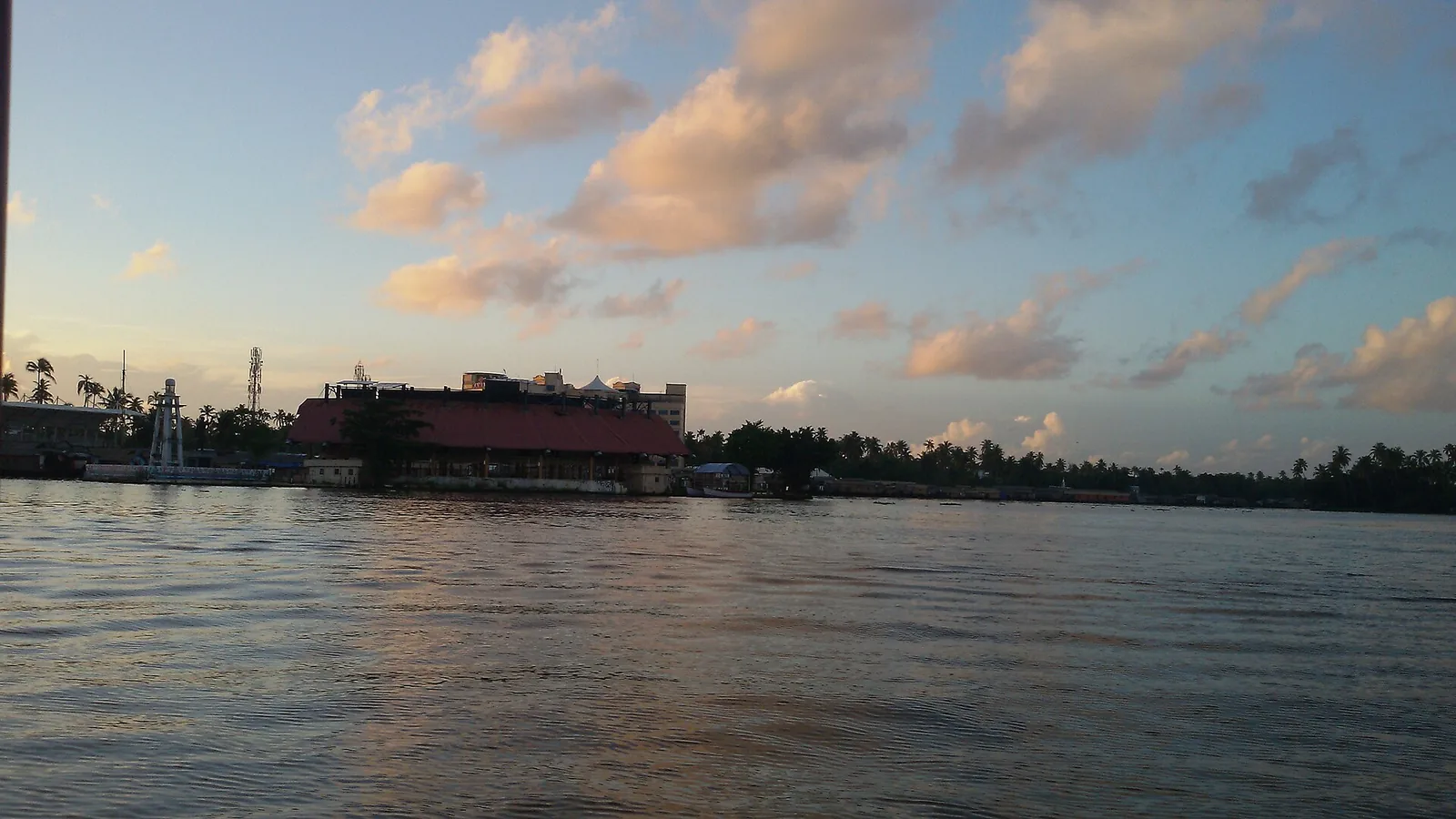
Search for Punnamada Lake and you will be shown a lake. Guidebooks list it separately from Vembanad. Maps label it. This page called it “the broad, shimmering north-eastern arm of Vembanad” until August 2026, which sounds authoritative and is not supported by anything we could find.
Punnamada is not a lake, and it is not an arm of one. It is a name for a stretch of one.
One water, three names
Vembanad is the largest lake in Kerala, and along its length it is called different things by the people living beside each part of it. In the Alappuzha, Punnapra and Kuttanad reach it is Punnamada. At Kottayam it is Vembanad. At Kochi it is Kochi Lake. It is also called Vembanad Kayal and Vembanad Kol. None of these is a sub-lake or a tributary or a bay. They are local names for local stretches of one continuous body of water.
This matters more than a pedantic correction usually does, because it produces a specific and very common confusion. Our own page on Kumbalangi, up in Ernakulam, already puts it well: the fact that one lake carries three names is exactly why visitors so often think the Kumbalangi creeks and the Alappuzha lake are unrelated. People book a backwater trip at one end and a boat race at the other and never realise they were on the same lake.
The distinction that does exist here is not hydrological, it is functional. Punnamada is the reach where the Nehru Trophy course is laid — near the Punnamada jetty at one end, the pavilion and the finish tower at the other. That is what makes this stretch of water worth its own page: not a separate geography, but a distinct use.
What the Malayalam entry says, and what it does not
The Malayalam Wikipedia article on പുന്നമട കായൽ is 844 bytes long. It contains no legend and no etymology. What it does contain is three useful facts: that Punnamada is part of Vembanad; that the Kottayam and Changanassery waterway passes through it; and that it encloses three islands — Pathiramanal, Perumbalam and Pallippuram. The first of those is a bird-rich island inside the Vembanad-Kol Ramsar site, with its own page on this site.
The absence of a legend is worth stating explicitly, because on this site an English-language blank has proved a bad guide to whether a story exists. A few kilometres from here, at Punnapra, we published the sentence “there is no folklore” and were wrong — the Malayalam sources carry a full goddess legend with a temple pool still standing in it. So this absence was checked in Malayalam script before it was written down, and it survives the check. Old settlements and shrines in this district nearly always have lore. A named reach of open water does not necessarily, and this one appears not to.
The name, labelled honestly
There is a name story in circulation. Punnamada is locally explained as the water of the punna trees — punna being Calophyllum inophyllum, common across Kuttanad, its timber used for vallam hulls and for water-wheels, its seeds pressed for lamp oil. It fits the landscape and it is pleasing.
It is also unsourced. We could not trace it to a lexicon, a gazetteer or any Malayalam reference; what carries it is blogs and secondary writing. So we print it as a folk explanation and not as a derivation. A plausible etymology repeated confidently is still just a plausible etymology.
And an argument about how long the course is
While we are on the subject of things everybody prints without checking: nobody agrees how long the Nehru Trophy course is. The figure in almost universal use, including on this site, is about 1,380 metres. Other reporting gives 1,370 m or 1,400 m, with four tracks ten metres wide.
But the Alappuzha district administration's own page — which should be the most authoritative source available on a race its district runs — says the course is one mile, roughly 1,609 metres, with eight lanes of thirty metres. That is the official source disagreeing with everybody else about both the length and the number of lanes, by a wide margin.
We have not resolved it and we are not going to pretend to. We give the commonly used 1,380 m because it is what the organisers and the reporting use, and we say plainly that the government and the sport do not agree about the dimensions of the course. That is a more useful thing for a reader to know than a confident single number would be.
The race itself, and the story of the trophy, are in our companion piece on the Prime Minister who jumped into the winning boat.
Frequently asked questions
Is Punnamada a separate lake from Vembanad?
No. Punnamada is a local name for a stretch of Vembanad, Kerala's largest lake — not a separate lake and not an arm of one. The same water is called Punnamada in the Alappuzha, Punnapra and Kuttanad reach, Vembanad at Kottayam, and Kochi Lake at Kochi.
Where does the name Punnamada come from?
It is locally explained as the water of the punna trees — punna being Calophyllum inophyllum, common in Kuttanad and used for boat hulls, water-wheels and lamp oil. We could not trace that to a lexicon, gazetteer or any Malayalam reference, so treat it as folk explanation rather than established derivation. The Malayalam Wikipedia entry gives no etymology at all.
Does Punnamada have any folklore or origin legend?
None that we could find, in English or in Malayalam, and we checked in Malayalam script specifically because an English blank is unreliable. The chundan vallam origin legend often told here belongs to Chembakassery and Ambalappuzha, not to this water — Punnamada is where the boats race, not where the design was invented.
Which islands are in Punnamada?
The Malayalam Wikipedia entry names three enclosed by it: Pathiramanal, Perumbalam and Pallippuram. Pathiramanal is the bird-rich island that lies within the Vembanad-Kol Ramsar site, and it has its own page on this site. It is not, despite the label appearing widely, a notified bird sanctuary.