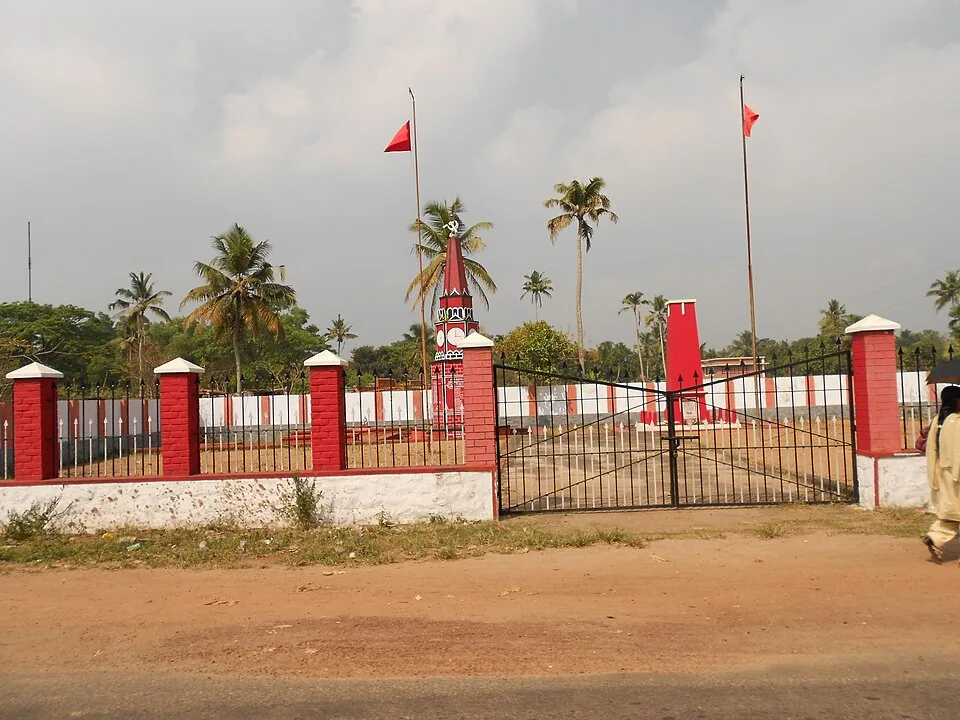
A memorial tells you that something happened. It rarely tells you why it happened there. Standing at the enclosure at Vattappally, on a quiet coastal lane south of Alappuzha, there is nothing in the view to explain why a rising against the government of Travancore took place on this particular stretch of sand rather than somewhere else in the state.
The explanation is four kilometres north, and it is industrial.
The factory town
Alappuzha in 1946 was not a backwater destination. It was a working port and a manufacturing town, and its industry was coir — the fibre beaten out of coconut husk, spun into yarn and woven into mats and matting for export. The trade had built the town: the canals were cut for it, the warehouses were built for it, and by the 1940s a dense workforce laboured in factories along the waterfront and in the villages around it.
A concentrated industrial workforce in a small area is the classic precondition for organised labour, and Alappuzha organised unusually early and unusually thoroughly. The Travancore Coir Factory Workers’ Union was among the strongest labour bodies in the princely state. This was a place with strike experience, with union structures, with people who had run collective action before and knew how to do it again.
What people were actually striking about
The immediate grievances of 1946 were the ordinary ones of industrial life, sharpened by the aftermath of the war: wages, conditions, and the security of the job. Layered on top was a food-rationing crisis, which in a wage-earning town that bought rather than grew its food was not an abstraction. And beneath both lay the political question of the moment — what kind of state Travancore was going to be, and who would have a say in it.
The Diwan, Sir C. P. Ramaswami Iyer, had proposed a constitutional reform modelled on what was described at the time as the American system, with an executive outside the legislature. English Wikipedia states it was scheduled to come into effect on 25 October 1946. The slogan raised against it — American Model Arabikkadalil, throw the American Model into the Arabian Sea — is the one line from this episode that most Malayalis can still quote.
So the general strike that autumn was simultaneously an industrial action and a political one, which is exactly the combination that governments find hardest to negotiate with and easiest to characterise as insurrection.
From camps to confrontation
As the strike hardened, workers established camps in the coastal villages south of the town — Punnapra among them. These were organising centres, and they were also, by most accounts, training and defensive positions. Whether that made what followed an armed uprising planned as such, or a strike that escalated when the state moved against it, is one of the things people still argue about. What is not in doubt is that by late October there were organised bodies of workers outside the ordinary structures of employment and policing, and a state that had decided to end the situation.
On 24 October the police camp at Punnapra was attacked and a sub-inspector and three policemen were killed; police fire killed twenty-seven. Martial law followed on the 25th. On the 27th the army moved on Vayalar, and the strike ended in a way that no wage dispute normally ends.
Why this matters for how you read the memorial
The uprising is usually narrated politically — the Diwan, the constitution, the communists, the princely state. That framing is not wrong, but it starts the story too late, and it makes the events look like a set-piece confrontation between ideologies rather than something that grew out of the specific economy of one town.
Read it the other way round and the geography suddenly makes sense. This memorial stands south of Alappuzha because that is where the coir workers lived. The uprising happened in 1946 because that is when the wage dispute, the ration crisis and the constitutional question arrived together. And it took the form it did — organised, structured, capable of holding a position for days — because this workforce had a decade of union experience behind it.
There is a coda worth knowing. The suppression did not end the movement. Within a few years Travancore had acceded to India, the Diwan had left office after an attempt on his life in July 1947, and the political forces organised in these coir factories went on to form governments in the state. The factories themselves have largely gone the way of most twentieth-century manufacturing, and the coir industry that produced all this is now mostly a household trade. The memorial has outlasted the industry that explains it.
Seeing both halves
If you want the whole picture in a morning, take the memorial and the coir story together rather than separately: the enclosure at Punnapra, and then the coir-making and the canals in Alappuzha town itself. They are twenty minutes apart and they are the same subject. Visiting only the monument gives you the ending without the argument.
Frequently asked questions
Was the uprising about the Diwan’s declaration of Travancore’s independence?
Not by the chronology. That announcement came on 2 June 1947, some eight months after these events. What was contemporaneous was the proposed American Model constitution, which English Wikipedia says was scheduled for 25 October 1946. Whether the rising counts as part of the freedom struggle at all is actively disputed in print.
What was the coir connection exactly?
Alappuzha was a coir manufacturing town with a large, concentrated factory workforce and unusually strong unions, notably the Travancore Coir Factory Workers’ Union. The 1946 general strike came out of wage and conditions disputes combined with a food-rationing crisis, and the workers’ camps that formed during it were in the coastal villages including Punnapra.
Can I still see the coir industry in Alappuzha?
In part. The large factory sector has largely gone, but coir remains a working household trade across the district, and the canals, warehouses and the town’s layout still show what it was built for. It pairs naturally with a visit to the memorial.