If you look up the Punnapra-Vayalar uprising you will be given a number. Which number depends on where you look, and the spread is not a matter of rounding. It runs from around a hundred to several thousand — a range of more than an order of magnitude, for an event that happened within the lifetime of people still living on this coast.
This is not a failure of research. It is the historical fact, and it is worth understanding why.
The figures, side by side
Start with the part that is relatively firm. At Punnapra on 24 October 1946, the accounts broadly agree: sub-inspector Velayudhan Nadar and three policemen were killed when the police camp was attacked, and the police fire that followed killed twenty-seven. That gives twenty-eight dead at Punnapra including the four policemen. It is a small enough event, in a populated place, with an official force involved on one side, that it could be counted.
Vayalar, three days later, was not that. The published figures include: one hundred and three, given by D. Sugathan, a former Congress MLA, working from burial records; at least a hundred and thirty killed in army firings at different places; over four hundred and seventy communists killed in the Vayalar confrontation; more than a thousand dead; and thousands, in the account of the historian A. Sreedhara Menon. A commonly repeated formulation is that at least a hundred and fifty were killed on the spot on 27 October and many more died later of their injuries. English Wikipedia’s infobox additionally gives forty deaths on the Travancore side.
Two of those figures — at least a hundred and thirty, and over four hundred and seventy — appear in the same Wikipedia article, which is a useful reminder that a single source is not necessarily a single position.
Why Vayalar could not be counted
Three things make the Vayalar dead uncountable, and they compound each other.
The first is the shape of the action. Vayalar is surrounded by water on three sides. On 27 October the Travancore army moved in while the state navy closed off the water, so the encircled crowd had nowhere to disperse to. Casualties in an encirclement are not distributed across a wide area where they can be found and recorded; they are concentrated, and the survivors are not free to move among them afterwards.
The second is that martial law was in force. There was no independent enumeration — no press free to report on the ground, no neutral body counting, no inquest process that produced a public list. What records exist were made either by the administration that had ordered the operation or by the movement that had been on the receiving end of it.
The third is the most direct. Local accounts and contemporary press reported that bodies were disposed of by the army. If that is so — and it is reported rather than established — then burial records of the kind D. Sugathan worked from would capture only the dead who were returned to their families, which is precisely why his hundred and three sits at the bottom of the range while eyewitness-derived estimates sit far above it. The low figure and the high figures are not necessarily contradicting each other. They may be counting different populations.
What the numbers are doing
It would be naive to pretend the figures are purely a technical problem. This is contested political history in a state where the movement involved went on to govern, and a death toll is not a neutral quantity: a larger number makes a massacre, a smaller one makes a suppressed riot. Both framings are available in print and both have partisans.
Our position is to give the range with attributions and to decline to pick from it. That is not fence-sitting. When the sources disagree by a factor of ten and the reasons for the disagreement are themselves documented, presenting one figure as the answer would be the inaccurate choice, however much cleaner it reads. A visitor standing at the memorial is better served knowing that the number is disputed, and why, than being handed a confident total that the next page they read will contradict.
What the memorials say
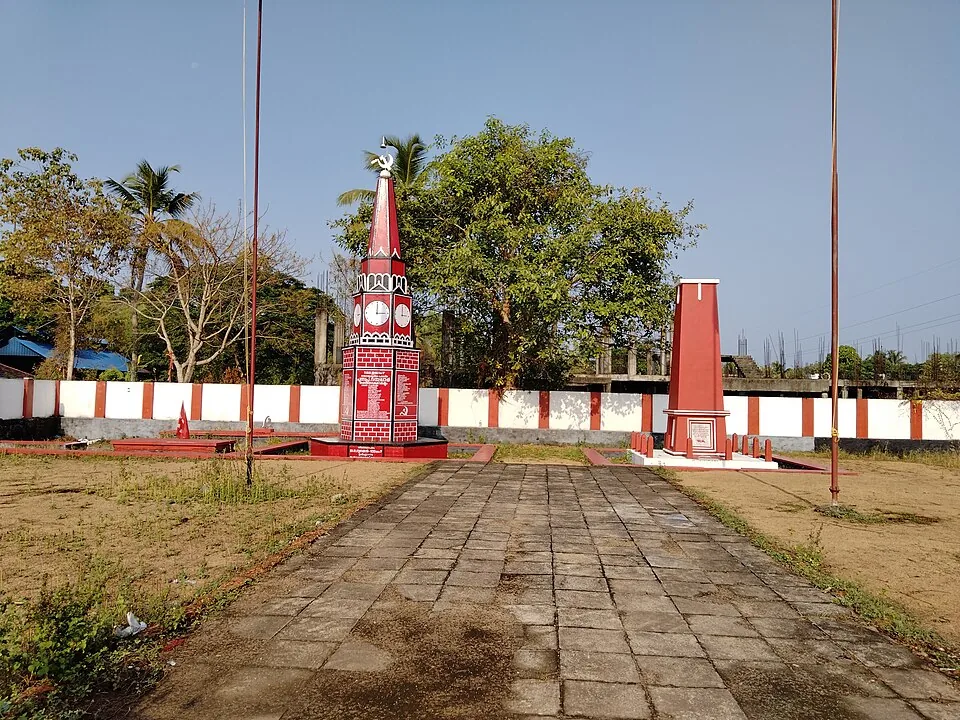
It is worth noticing what the monuments themselves do here. The obelisk in the enclosure at Punnapra carries a panel of names. It does not carry a total. Nor, so far as we have seen, does any of the other memorials in the area. Whether that is deliberate or simply the way these things were built, the effect is that the stone commits to the individuals it can name and stays silent on the arithmetic — which is a good deal more careful than most of what has been written about it since.
The Vayalar site itself, where the greater part of the killing happened, is about twenty-five kilometres north of Punnapra at Vayalar in Cherthala taluk, and has its own Rakthasakshi Mandapam. It is a separate visit, and a separate memorial, and it is regularly confused with this one.
Frequently asked questions
What is the best single estimate of the dead?
There isn’t one that we would defend. For Punnapra on 24 October the figure of twenty-eight, including four policemen, is reasonably firm. For Vayalar on 27 October the published range runs from one hundred and three, from burial records, to thousands, and the reasons for that spread — encirclement, martial law, and reports that bodies were disposed of by the army — are themselves part of the record.
Who gives the lowest figure and who gives the highest?
The lowest commonly cited figure, one hundred and three, comes from D. Sugathan, a former Congress MLA, counting from burial records. The highest come from the historian A. Sreedhara Menon, who wrote of thousands, and from the casualty box of the English Wikipedia article, which gives more than a thousand.
Were there casualties on the government side?
Yes. At Punnapra a sub-inspector, Velayudhan Nadar, and three policemen were killed. English Wikipedia’s infobox gives forty deaths on the Travancore side across the episode as a whole.