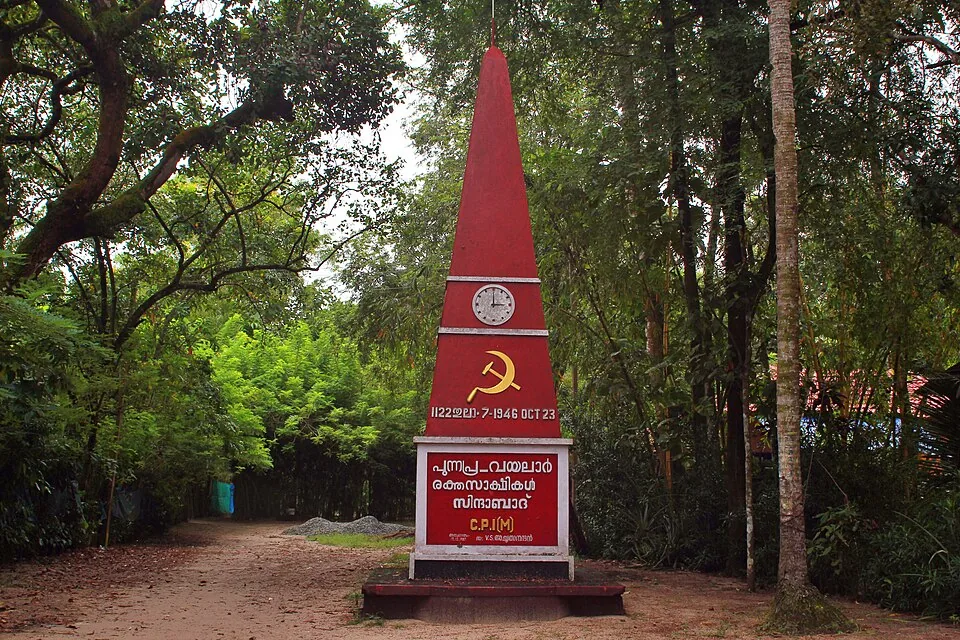
On a shaded lane at Punnapra, four kilometres south of Alappuzha town, there is a red concrete obelisk about the height of two people. Near the top is a painted clock face. Below that, a hammer and sickle in yellow. And below that, in raised letters that catch the light, a date: the Malayalam-era year 1122, a month, the day 7 — and then, in Latin script on the same line, 1946 OCT 23.
Almost every published account of what happened here says the 24th.
Three dates, one week
The events remembered at Punnapra took place across a few days at the end of October 1946, and the sources do not agree on when they started. The most widely printed date for the attack on the police camp at Punnapra is 24 October. English Wikipedia’s article on the uprising instead dates the beginning of the revolt to 25 October, noting that this was the Maharaja’s birthday — and 25 October is also the day martial law was declared at Alleppey, and the day it says the Diwan’s proposed American Model constitution was scheduled to come into effect. The monument in the lane says the 23rd.
None of these is an obviously careless number. The 25th is tied to two documented administrative events. The 24th is the date carried by the standard accounts and by contemporary reporting. And the 23rd is the date the people who built the memorial chose to cast in concrete and have maintained ever since — which is not nothing, because they were closer to it than any of us.
What we could and could not read
We pulled the original photograph of the obelisk at its full resolution and cropped in on the inscription rather than relying on a thumbnail, because reading text off a photograph at small sizes is how errors get manufactured. At full size the Latin portion is unambiguous: 1946 OCT 23. The Malayalam-era portion resolves to the year 1122 and the day 7, which is consistent — Malayalam-era 1122 covers the second half of 1946 — but the month name between them would not come clear even magnified nine times.
So we do not print it. That may seem like a small scruple, but the difference matters: one candidate month would place the day in October and agree with the Latin date beside it, while another would place it in the following May and mean the stone contradicts itself. We are not able to say which, and a guess dressed as a reading is exactly the kind of confident detail that then gets copied onto twenty other pages. If you can read it in person, the answer is standing in a lane at Punnapra.
Why a monument would keep its own date
It is worth resisting the assumption that the books are automatically right and the stone is automatically a mistake. Memorials are not usually built by historians. They are built by people who were there, or by the organisations those people belonged to, often working from a memory of a day rather than from a file. Where such a memorial gives a date at odds with the record, there are only a few possibilities: the builders were working from local memory that the record later smoothed over, or the record is right and the stone preserves an error that nobody has wanted to correct, or the two are counting different things — the first shot, say, against the day the fighting was at its height.
We cannot tell you which of those applies here, and we have not found a source that resolves it. What we can tell you is that the disagreement is real, it is visible to anyone standing in front of the monument, and it is a useful thing to have seen before you read any confident single-sentence summary of the uprising.
The rest of the week
Whichever day it began, the sequence afterwards is not seriously disputed. At Punnapra an armed body of workers attacked the police camp; sub-inspector Velayudhan Nadar and three policemen were killed, with most accounts saying the sub-inspector had gone forward to talk before he was attacked, and the police fire that followed killed twenty-seven. Martial law was declared at Alleppey on 25 October. On 27 October the Travancore army moved against Vayalar, twenty-five kilometres north, with the state navy closing off the water around a place surrounded on three sides — and that was the day the killing became impossible to count. That second day has its own memorial and its own story, and we have written it separately.
The 27th is the day observed each year as Punnapra-Vayalar Martyrs’ Day. The commemorative week runs from the 23rd — the date on the stone — to the 27th, which means that in practice the monument’s date and the standard date are both inside the period people gather to mark. The argument, such as it is, is quieter than the anniversary.
If you go
There is more than one memorial at Punnapra and they are easy to confuse. The main site is a walled enclosure at Vattappally, off the Eravukad road, with a boundary wall banded red and white, iron gates, two flagstaffs and a clock-faced obelisk at the centre. The obelisk photographed for this story is a separate roadside monument nearby. And the Vayalar Rakthasakshi Mandapam is a different site entirely, about twenty-five kilometres north in Cherthala taluk. Photographs online mix all of them up without comment, so navigate by coordinates rather than by name.
Frequently asked questions
What date does the memorial actually give?
The raised inscription on the CPI(M) obelisk reads, in Latin script, 1946 OCT 23, beside a Malayalam-era date giving the year 1122 and the day 7. The month name in Malayalam could not be read reliably even from the full-resolution original, so we do not quote it.
So which date is correct?
We do not know. The most widely published date for the attack at Punnapra is 24 October 1946; English Wikipedia dates the start of the revolt to 25 October, which is also when martial law was declared; and the monument says 23 October. All three are in print or in concrete, and we have not found a source that settles it.
Is this obelisk the main memorial?
No. The main site is the walled Punnapra Vayalar Rakthasakshi Mandapam enclosure at Vattappally. The obelisk with the legible date is one of at least two further CPI(M) monuments in the Punnapra area, including one at Punnapra South that was unveiled by V. S. Achuthanandan.