A padasekharam is not a field. It is a device for holding a lake off a crop, and the Kerala State Planning Board describes it in exactly those terms: a single group consisting of an outer bund and a series of small canals that take water into the individual paddy fields, with the outer bund serving the function of flood protection. Water enters through a sluice gate in the bund and travels to the fields through distributing canals and field canals.
Three generations of wall
The first bunds at R Block were clay, dug out of the canal beds and stabilised with bamboo and coconut trunks. The planning board does not romanticise how that performed: there was a high risk of the bunds being breached, and these bunds were indeed breached frequently.
From the 1950s the state moved to permanent bunds with a top width of three metres. The current method is the pile-and-slab bund — concrete piles driven into the lake bed with slabs spanning between them — and the planning board’s own illustration of completed pile-and-slab outer bunds is captioned Kainakari North, which is this parish.
And the pump
A wall alone would just make a bowl. Rain and seepage have to be lifted back out over the bund, every season, and in Kuttanad that is called dewatering.
The planning board notes that excess floodwater is pumped out using the old petti and para mechanism or motor pumps, and that the pumping station is popularly known as the engine thara or motor thara — essentially a platform for installing the dewatering devices. The petti and para is a wooden scoop-and-box arrangement; its ancestor is the foot-driven chakram, its successors the kerosene engine and the electric motor.
You would expect all this to be past tense. It is not.
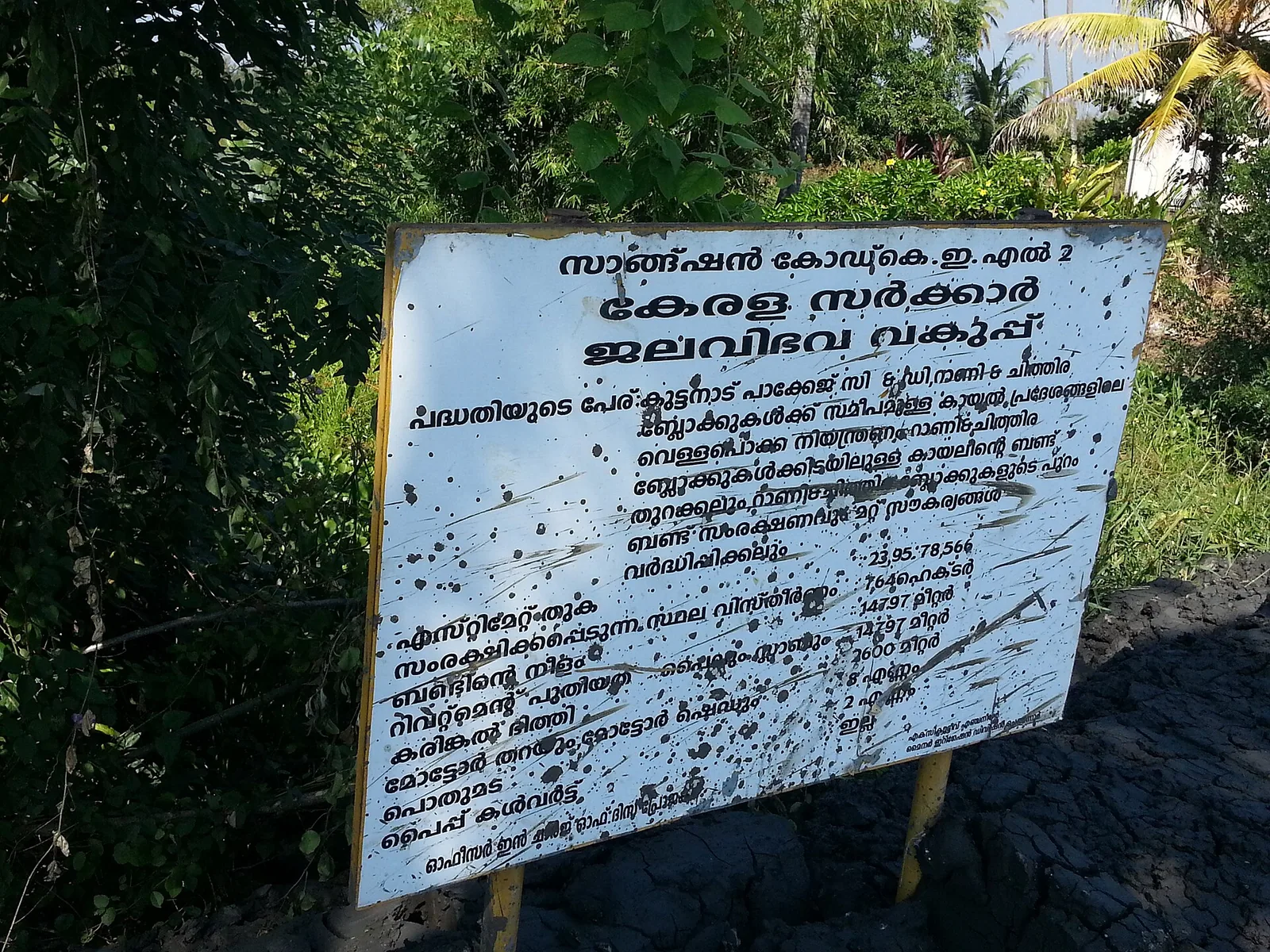
The board on the bund
Standing at R Block is a Kerala Water Resources Department project board — sanction code K.E.L. 2 — for flood-control work in the kayal areas near the Rani and Chithira blocks under the Kuttanad Package. Its quantities read as a bill of materials for the whole idea:
Estimate ₹23,95,78,566. Area protected, 764 hectares. Bund length, 14,797 metres. New revetment, 14,797 metres. Granite wall, 2,600 metres. Motor platforms and sheds, 8 nos. And: petti and para, 2 nos.
A state contract in the 2010s, worth nearly twenty-four crore, procuring two petti and para. That single line is the argument this landscape keeps having with itself, printed on a signboard.
The 764 hectares is not decoration either. The planning board records that from 2014, for the first time since 1992, paddy cultivation could be restarted in about 764 hectares of kayal land in the Rani and Chithira blocks — which yielded 1,402.49 tonnes of puncha paddy in 2016–17. The board at the bund and the figure in the report describe the same work.
How it actually fails
The one recorded breach of a pile-and-slab kayal bund happened west of D Block, at Puthanarayiram, on 26 November 2016 during the vrischika veliyettam — the November flood surge. About fifty metres of bund went.
The cause was not the flood. It was a kundarikuzhi — a deep pit dug in the field to trap fish while the block was being dewatered, roughly eighty metres deep, over which the bund had subsequently been built. The wall was standing on a hole somebody had made and nobody had recorded.
That is worth sitting with, because it inverts the usual story about this landscape. Kuttanad is normally narrated as people against water. The one documented failure of its best modern engineering was people against their own undocumented earlier work.
The arithmetic nobody says out loud
The planning board has recommended shrinking padasekharams from around 600 acres to about 250, on the straightforward logic that a smaller block has less wall to fail and fewer owners who must agree before it is repaired. R Block, at some 1,400 acres, is more than twice the size now considered sensible.
Which leaves the fact that every visitor photographs without quite registering: standing on the bund, the surface of the lake is higher than the crop. Not seasonally. Permanently. The only thing in between is maintenance — a wall that must be rebuilt, a pump that must run, and a contract that must keep being signed.
Frequently asked questions
What is a padasekharam?
A single unit of reclaimed paddy land consisting of a continuous outer bund for flood protection plus a system of distributing and field canals, with water admitted through a sluice gate in the bund. In the kayal lands the field inside sits permanently below the water outside.
What is a petti and para?
The traditional wooden dewatering mechanism used to lift water out of a polder — descendant of the foot-driven chakram and predecessor of the kerosene engine and electric motor. Remarkably, a Kerala Water Resources Department project board at R Block lists "petti and para, 2 nos." among the works procured.
What is an engine thara?
The pumping station — literally a platform built to carry the dewatering equipment. Also called a motor thara. It is a distinct building type in Kuttanad.
Have these bunds ever failed?
Once, in the pile-and-slab era: about 50 m west of D Block at Puthanarayiram on 26 November 2016, during the vrischika flood surge. The cause was traced to a kundarikuzhi — a deep pit dug in the field to trap fish during dewatering — over which the bund had been built.