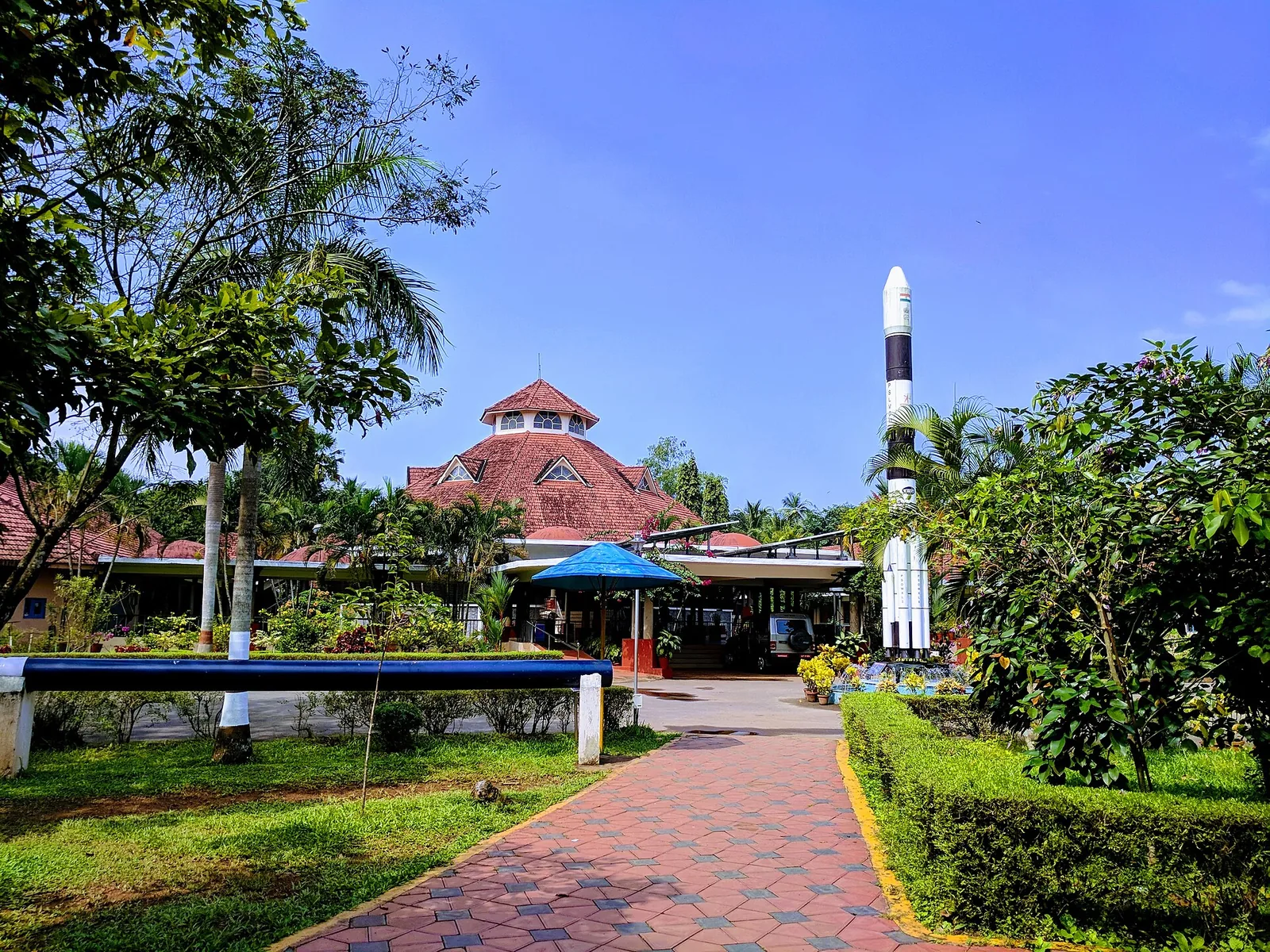
On 10 July 2026 the Regional Science Centre and Planetarium at Kozhikode published a notice. From Monday 13 July, planetarium shows would be suspended while the projection system was replaced. The reopening date, it said, would be announced through official channels. As of the middle of August 2026 no such announcement had appeared.
We are leading with that because a family that drives across the city for a star show and finds a locked dome will feel cheated — and rightly, and by whoever told them it was open, not by the centre. So: the dome is dark, and nobody knows for how long.
What is actually closed
One thirty-minute show, on a fixed schedule of four slots a day. That is all. The same notice is explicit that all other facilities and activities — 3D shows, galleries, the Science Park, educational programmes — continue to function as usual, and everything we can check bears that out.
And there is a fact about that show which almost nothing published about this centre mentions, and which changes the calculation completely for most visitors. The shows run in Malayalam by default. English is arranged only on request, for a group of more than thirty. A reviewer quoted on the centre’s own about page puts it without malice: it was all in Malayalam, they could not understand it, and for locals it is good.
So for a visiting non-Malayali family, the planetarium was arguably the weakest item on the ticket rather than the strongest. What is closed is half an hour in a language they may not follow. What is open is everything that actually fills the afternoon.
And the timing is unusually kind
Thirteen months before the dome went dark, on 14 June 2025, the centre opened a new gallery: Astronomy — unveiling the universe. It is a serious piece of work rather than a corridor of posters.
It runs from Aristotle and Ptolemy through Aryabhata and Bhaskara to Copernicus; it has a light-animated model of the Samrat Yantra, the great sundial of the Jantar Mantar, and a life-size statue of Galileo at his telescope. There are interactives on lunar phases, on Kepler’s laws, on transits, occultations and eclipses. There is a large video wall on the Big Bang, a Solar System zone where you can weigh yourself on other planets, a section on the electromagnetic spectrum, a cyclorama, exoplanets and astrobiology, a touch kiosk on Einstein’s curvature of spacetime, and scale models of the Hubble Space Telescope, its repair mission and the James Webb.
In effect it is a walk-through planetarium. It is self-paced instead of a fixed half-hour slot, and it is visual instead of narrated — which means the language barrier that limited the dome simply is not there. A family that would have been shut out of the show gets more from the gallery than they would have from it.
What a half-day actually looks like
Roughly: twenty to thirty minutes in the Hall of Ocean, which at 4,800 square feet is the biggest gallery and holds the blue whale and the ocean-depth column. Thirty to forty in Mirror Magic, which is where children lose track of time — a mirror maze, a table where you dine with several images of yourself, and set pieces called floating in air, vanishing image and the tunnel of infinite depth. Twenty-five to thirty in Fun Science, the hands-on physics room. Ten to fifteen at the Aqua Life Corner, a freshwater tank. Thirty to forty-five in the Astronomy Gallery, more if anyone is over ten. About thirty for a 3D show once you count the queue. And forty-five to ninety in the Science Park.
That is three to four hours, at ₹65 a head for entry and a 3D show. Even before the closure the top ticket was ₹100.
The one honest caveat
The Science Park is outdoors and unroofed, and it is the part reviewers rate highest — the steel Newton’s cradle with its five iron spheres, the whispering dishes, the tuned resonance pipes with bilingual instruction plates, the walk-in delayed-hearing chamber, the gravity well, the netted geodesic dome over the play area, and a human sundial where you stand in for the gnomon.
On a genuinely heavy monsoon day the visit compresses to the indoor galleries and the 3D show. That is still two to two and a half hours and still worth doing. But the best ninety minutes of this place are weather-dependent, and a page that recommends it as the rainy-day answer owes its reader that sentence.
When to come
A weekday afternoon, or any Sunday. The centre’s own visitor information says the general public should plan an afternoon visit because the morning session is usually crowded with school groups — and, in a detail that quietly inverts the obvious advice, it asks schools wanting a full day to come between June and September. The monsoon months, in other words, are peak excursion season.
Open ten to half past six, every day including Monday. And the hardest deadline on the page: ticket sales close at 17:55.
Frequently asked questions
When will the planetarium reopen?
Unknown. The closure began on 13 July 2026 and the operator has said only that the reopening date will be announced through official channels. Phone 0495 277 0571 before travelling if the dome is why you are going.
Is the 3D theatre affected?
No. It seats 120 and runs 15-to-20-minute shows at 11:00, 13:00, 15:00 and 17:00, entirely unaffected. Do not plan around a particular title, though — the operator’s own two pages disagree about what is screening.
How long should we allow?
Three to four hours for everything; two to two and a half if heavy rain keeps you indoors, since the Science Park is unroofed.
Are the shows in English?
No — Malayalam by default, with English arranged on request for groups of more than thirty. This is the most useful thing a visiting family can know about the place.