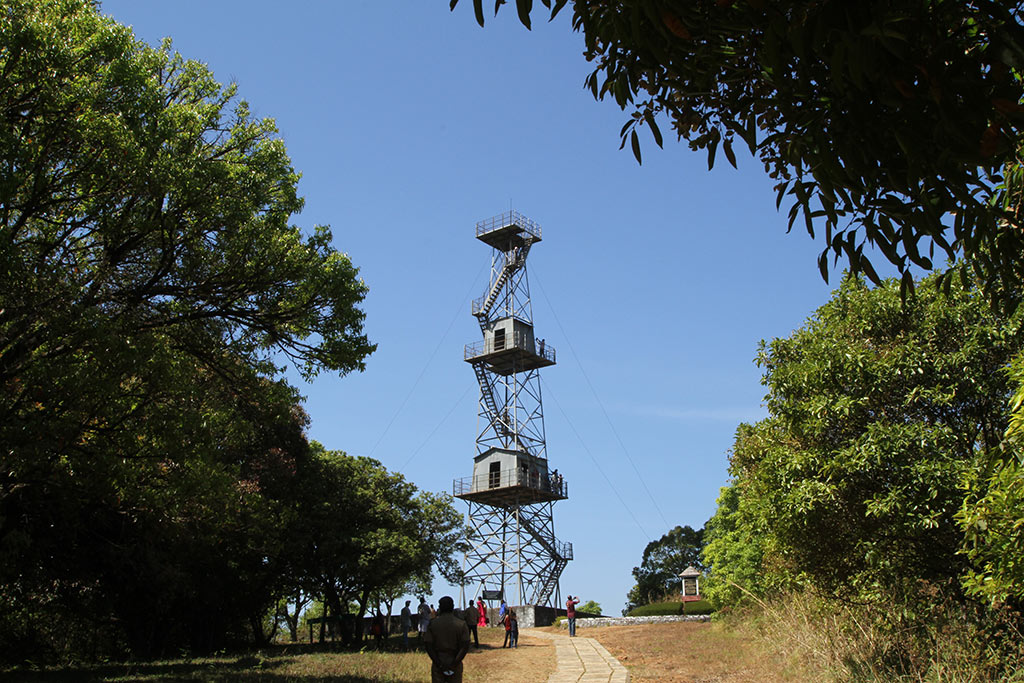
A steel watchtower rises from a clearing near the end of Silent Valley’s best-known visitor road. The name attached to it — Sairandhri — reaches much farther back than the tower, into the Mahabharata story of Draupadi living in concealment. Holding those two things together requires care: one is a living place tradition, the other is a modern visitor landmark in a protected forest.
The woman living under another name
In the Mahabharata, Sairandhri is the identity Draupadi assumes during the Pandavas’ final year of exile, when they must remain unrecognised at the court of Virata. The word becomes a name for a woman skilled in attending and adorning the queen. Around Silent Valley, tradition connects that hidden identity with a remote river valley screened by the Western Ghats.
This is cultural geography, not an excavated date or an archaeological proof. Saying so does not empty the name of meaning. Place traditions often explain how a landscape feels to generations who know it: concealed, difficult to enter and carrying a life beyond the view from the road. Sairandhri gives that impression a human story.
The tower makes the forest measurable
From ground level, tropical evergreen forest can appear as a green wall. The Sairandhri watchtower reverses the scale. Its narrow flights climb above the clearing and bring the upper canopy and surrounding slopes into relation with a person. The tower is conspicuous in photographs precisely because everything around it is larger: crowns spread beyond the platform, and the valley continues where the road cannot.
The nearby Kunthipuzha supplies the other line through the scene. It drains west through the national park and eventually joins the Bharathapuzha system. The river is not a recreation pool; official visitor guidance prohibits bathing. At Sairandhri it is better read as the organising force of the valley and as the river once threatened by a proposed hydroelectric project.
A conservation history beyond the epic
The documented modern history belongs to the Save Silent Valley campaign. A hydroelectric proposal on the Kunthipuzha drew sustained opposition from scientists, writers, campaigners and citizens concerned about the evergreen rainforest that would be transformed. The project was abandoned, and Silent Valley was declared a national park in 1984. A large buffer added in 2007 now helps protect the 89.52-square-kilometre core.
That history explains the present visitor design better than any idea of an open wilderness trail. The road is controlled, vehicles belong to the Forest Development Agency system, stops are interpreted and movement beyond them is restricted. Sairandhri is a way to encounter the protected valley without converting it into a network of independent routes.
Why this is not the main trek
The standard Sairandhri programme takes about five hours and travels mainly by jeep or bus from Mukkali through moist deciduous and evergreen forest. Short walks and stops may be part of the experience, but the vehicle is its spine. That distinction matters because photographs of the tower and river can make the destination look like the end of a long hiking route.
For sustained walking and a forest overnight, Keerippara is the clearer choice. For a broader nature camp, Walk with the Master has another purpose again. Sairandhri is the day journey: a controlled traverse that lets the changing forest types, tower and Kunthipuzha convey the scale of a place most visitors are rightly not free to cross on foot.
- The Draupadi association is a local place tradition; it should not be presented as documented archaeological history.
- The watchtower is a modern visitor landmark and a vantage over the canopy, not evidence of an unrestricted trail.
- The conservation movement and national-park declaration are the documented history that shaped today’s controlled access.
Frequently asked questions
Who is Sairandhri?
Sairandhri is the identity Draupadi assumes while living unrecognised during the Pandavas’ exile in the Mahabharata. Silent Valley’s use of the name belongs to local place tradition, not archaeological proof.
Is Sairandhri a trek from Mukkali?
The usual official visit is mainly a Forest Development Agency jeep or bus journey with controlled stops. It is different from the guided Keerippara walking-and-camping programme.
What does the Sairandhri watchtower show?
It lifts the viewpoint above a forest clearing, giving a sense of the upper canopy, surrounding slopes and the scale of the protected valley.