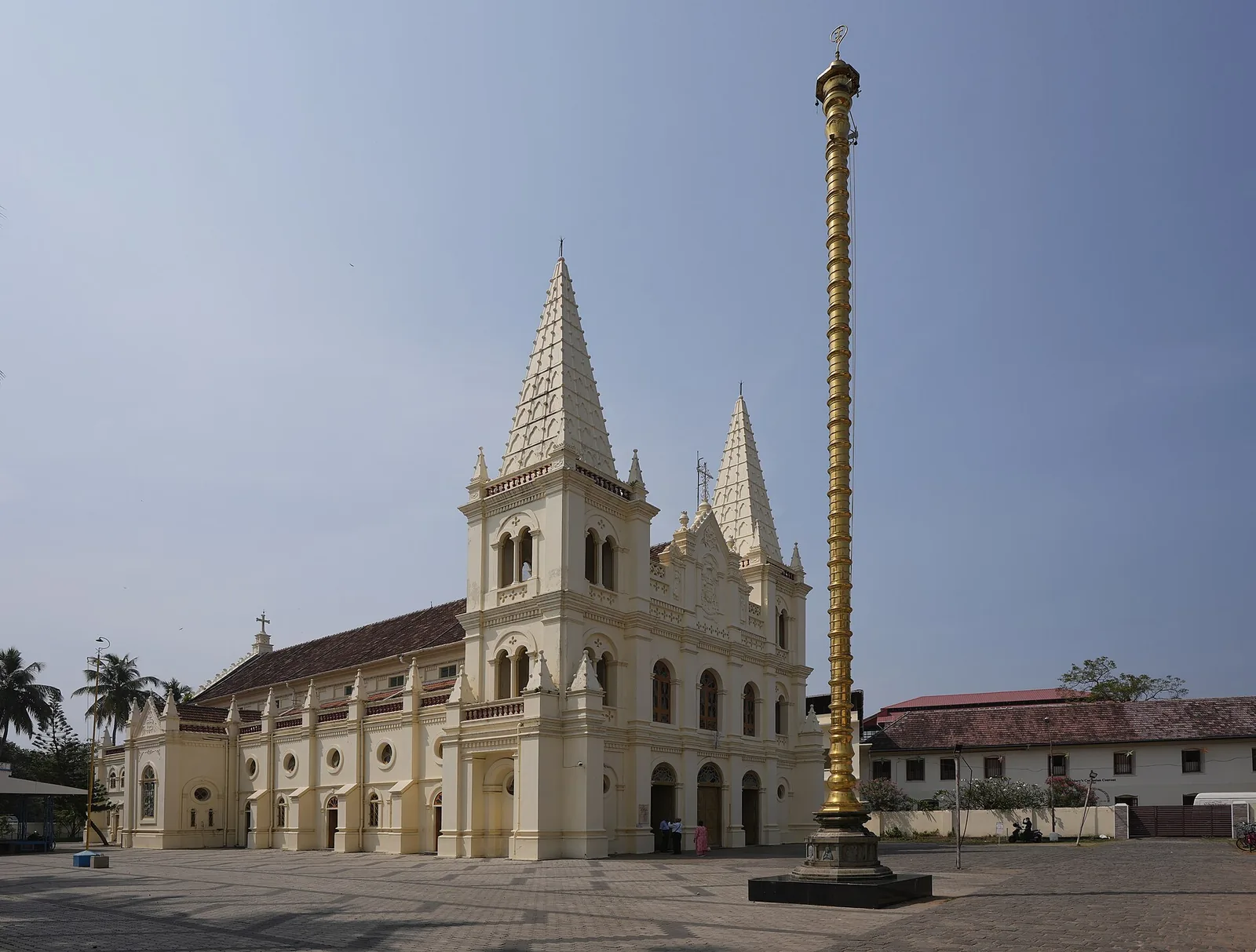
The line is on the signage, in the guidebooks, in the tourism copy: Santa Cruz is one of only eight basilicas in India. It is a good line. It has not been true for a long time.
The number moved
India passed thirty minor basilicas some years ago. By March 2024 the elevation of Mount Carmel at Munnar was being reported as the country’s thirty-first, and the eleventh in Kerala alone. The figure of eight belongs to an earlier decade and simply never got updated as the list grew.
It is worth saying that plainly rather than quietly deleting it, because the claim is repeated in good faith by people who read it somewhere reputable. Nobody is inventing anything. A true statistic aged badly and kept being copied.
What a basilica actually is
A minor basilica is a papal honour, granted to a church of particular significance — historical, architectural, devotional — and carrying certain liturgical privileges. It is a title conferred, not a category of building. Santa Cruz received it from Pope John Paul II on 23 August 1984, which does put it among the earlier Indian churches to hold the rank.
But a rank granted in 1984 is the least old thing about this church, and leaning on it undersells the place badly.
The date that actually matters is 1558
The church was founded in 1505, when the first Portuguese viceroy Dom Francisco de Almeida obtained the King of Cochin’s permission to build in stone. Most sources place the foundation on 3 or 4 May, matching the feast of the Invention of the Holy Cross — which is where the name comes from.
Then in 1558 Pope Paul IV raised it to the status of a cathedral, making Cochin one of the earliest dioceses in India, with a jurisdiction said at its height to cover an enormous stretch of the East. That is the honour worth carrying around the building: a cathedral seat established here within fifty years of the Portuguese arriving, four and a quarter centuries before the basilica title.
- 1505 — founded, on the King of Cochin’s permission to build in stone.
- 1558 — raised to cathedral by Pope Paul IV; Cochin among India’s earliest dioceses.
- 1663 — Dutch conquest. Spared, and put to secular use — reportedly a warehouse or arms store.
- 1795 or 1806 — demolished by the British. Sources differ on the year.
- c. 1887–1905 — rebuilt; consecrated 19 November 1905.
- 23 August 1984 — proclaimed a minor basilica by Pope John Paul II.
Warehoused, then demolished
The Dutch took Cochin in 1663 and pulled down a great deal of Portuguese Catholic building. Santa Cruz and St Francis were spared, and this one is recorded as having been put to secular use — reportedly a warehouse or an arms store. Being useful to a Protestant administration is what carried a Catholic cathedral through the Protestant century intact.
The British had no such use for it, and demolished it — sources give either 1795 or 1806. The site then sat in ruins for most of the nineteenth century. Rebuilding began around 1887 under Bishop João Gomes Ferreira and was completed under his successor, and the new Gothic church was consecrated on 19 November 1905 by Dom Sebastião José Pereira, Bishop of Damão.
One pillar
Of the church founded in 1505, a single granite pillar survives, kept in the south-eastern corner. Everything else you can see — the twin spires, the pastel nave, Moscheni’s painted ceiling — is younger than the 1880s.
Go and find that pillar. A church that can be demolished, lie in ruins for fifty years and come back is a far better story than a church that has stood untroubled since 1505, and the pillar is the only object in the building that has witnessed both versions.
Why the distinction matters
Because a visitor who repeats the eight-basilicas line and is later corrected has reason to doubt everything else they were told at the same time. The rank is a genuine honour and Santa Cruz genuinely holds it. It is simply not rare, and the church does not need it to be.
What is rare is the sequence: founded on a king’s permission in 1505, a cathedral by 1558, a Dutch warehouse after 1663, rubble after the British, and a working basilica now, seat of the Diocese of Cochin, with Mass said under a ceiling painted by a man who died days before it opened.
Frequently asked questions
Is Santa Cruz one of only eight basilicas in India?
No — that figure is out of date. India passed thirty minor basilicas some years ago, and by March 2024 the elevation of Mount Carmel at Munnar was reported as the thirty-first in the country and the eleventh in Kerala. Santa Cruz was among the earlier Indian churches to receive the rank, which it did in 1984.
What does “minor basilica” mean?
It is a papal honour granted to a church of particular historical, architectural or devotional significance, carrying certain liturgical privileges. It is a title conferred on a church rather than a description of how it was built. Santa Cruz received it from Pope John Paul II on 23 August 1984.
When was Santa Cruz founded?
In 1505, after the first Portuguese viceroy Dom Francisco de Almeida obtained the King of Cochin’s permission to build in stone. Most sources give 3 or 4 May, matching the feast of the Invention of the Holy Cross, from which the church takes its name.
What happened to the original cathedral?
The Dutch spared it in 1663 and used it for secular purposes — reportedly as a warehouse or arms store. The British demolished it, in either 1795 or 1806 depending on the source, and the site lay in ruins for most of the nineteenth century. Rebuilding began around 1887 and the present church was consecrated on 19 November 1905.
Is anything left of the 1505 building?
One granite pillar, kept in the south-eastern corner of the present church. It is the only surviving fabric of the original and the only thing in the building that predates the 1880s rebuilding.
When did it become a cathedral?
In 1558, when Pope Paul IV raised it to cathedral status — making Cochin one of the earliest dioceses in India, with a jurisdiction said at its height to extend across a very large part of the East. That is a far older distinction than the basilica title, and a rarer one.