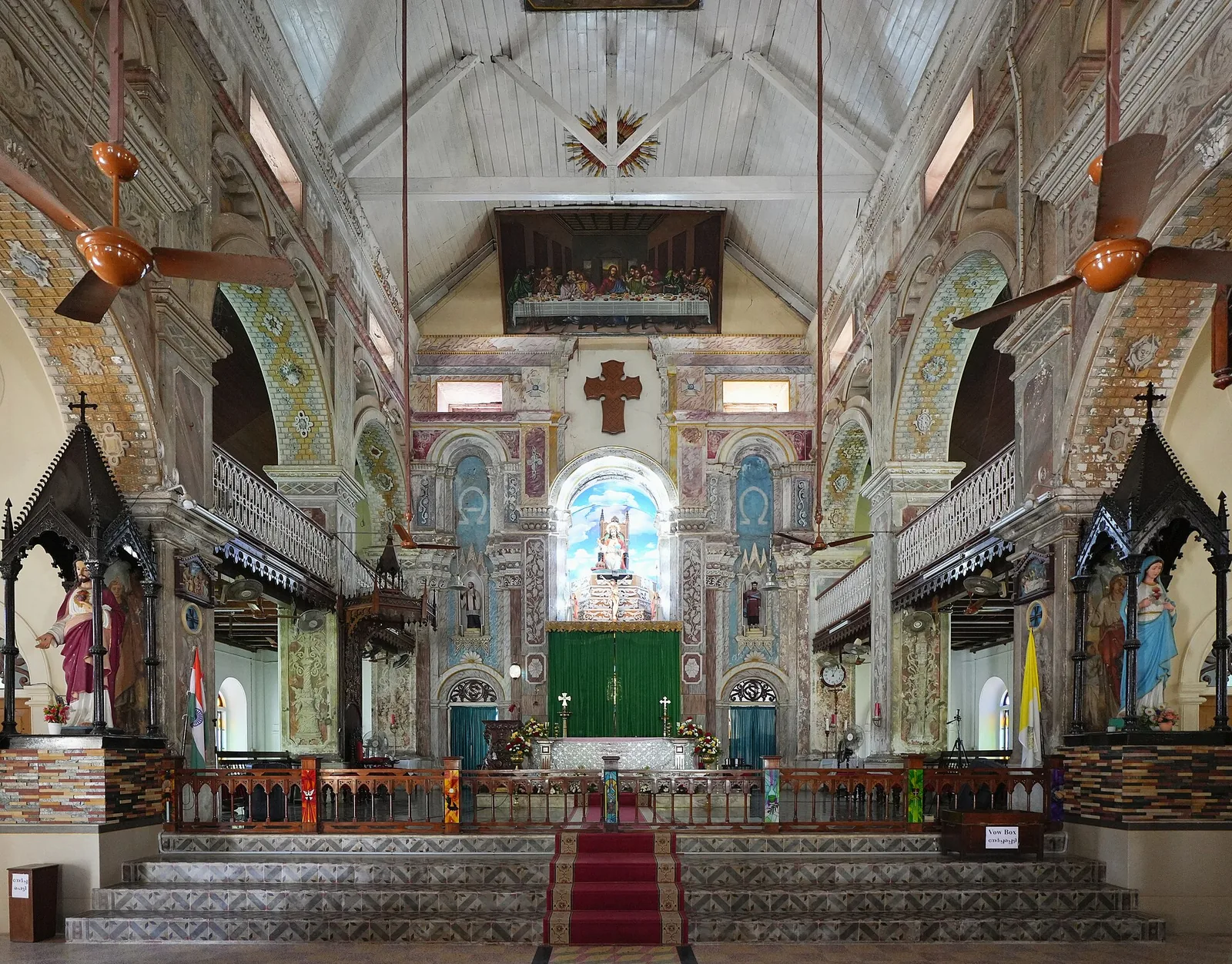
From the street, Santa Cruz gives almost nothing away — a buttermilk-pale façade and two towers, handsome but not startling. Then you cross the threshold and people stop talking. The nave opens up long and high and washed in pastel, and the ceiling above it is painted end to end with the Passion.
The man who painted it did not live to see the doors open.
Who Moscheni was
The interior murals, the column frescoes and the altar paintings are attributed to Fra Antonio Moscheni, an Italian Jesuit painter from Bergamo, working with an Indian disciple recorded as a Mr De Gama. Across the ceiling unfold scenes from the Passion — the road to Calvary, the day of the crucifixion — and above the altar Moscheni painted his masterwork on the death on the Cross.
Flanking the nave hang seven large canvases of the Passion and death of Christ, so that walking down the aisle is itself a slow procession through the story. There is also a much-loved reproduction of Leonardo’s Last Supper, and stained glass that drops coloured pools onto the floor through the afternoon.
The date that changes the room
Moscheni is recorded as having died in Kochi on 15 November 1905. The rebuilt church was consecrated on 19 November 1905, by Dom Sebastião José Pereira, Bishop of Damão.
Four days. He finished the work, and then the building he had filled was blessed and opened without him in it.
It is worth carrying that up to the ceiling with you. Painted Passion cycles are, by design, about a death that the painter is looking at from outside. This one was finished by a man who was, as it turned out, looking at it from very close indeed.
- 1505 — foundation laid, most sources on 3 or 4 May, the feast of the Invention of the Holy Cross, which is where the name comes from.
- 1558 — raised to a cathedral by Pope Paul IV, with a jurisdiction said at its height to run from the Cape of Good Hope to East Asia.
- 1663 — the Dutch take Cochin and demolish many Catholic institutions, but spare Santa Cruz and St Francis, reportedly putting this one to use as a store.
- 1795 or 1806 — the British demolish the structure. Sources differ on the year. A single granite pillar of the old cathedral survives, kept in the south-eastern corner.
- c.1887–1905 — rebuilt under Bishop João Gomes Ferreira and his successor; consecrated 19 November 1905.
- 23 August 1984 — proclaimed a Basilica by Pope John Paul II.
The one thing to find before you leave
Go and look for the granite pillar in the south-eastern corner. It is the only substantial piece of the cathedral that the British demolition left standing, and it is easy to walk straight past. Everything else you are admiring is a hundred and twenty years old. That pillar is five hundred.
Knowing it is there rearranges the visit. Santa Cruz is not an old building with old paintings. It is a very old idea, knocked down, left in ruins through most of the nineteenth century, and then rebuilt and painted by a man who died before it opened — with one column of the original propped in the corner as the receipt.
Visiting it properly
It is free and it is a working cathedral, the seat of the Roman Catholic Diocese of Cochin, with regular Mass. Photograph the architecture if you like, but not people at prayer, not with flash near the paintings, and not at all during Mass. Give it twenty-five minutes, sit down for part of that, and go in the afternoon when the stained glass is doing its work on the floor.
Frequently asked questions
Who painted the ceiling at Santa Cruz Basilica?
The murals, column frescoes and altar paintings are attributed to Fra Antonio Moscheni, an Italian Jesuit painter from Bergamo, working with an Indian disciple recorded as Mr De Gama. The ceiling carries scenes from the Passion, and the altar painting is described as his masterwork.
Is it true the painter never saw the church open?
Yes. Moscheni is recorded as having died in Kochi on 15 November 1905, and the rebuilt church was consecrated on 19 November 1905 — four days later — by Dom Sebastião José Pereira, Bishop of Damão.
How old is the building you actually stand in?
The present structure dates from the rebuilding begun around 1887 and consecrated in 1905. A church was first founded on the site in 1505 and raised to a cathedral in 1558, but that building was demolished by the British in either 1795 or 1806 depending on the source.
What is the granite pillar in the corner?
The surviving fragment of the original cathedral, left after the British demolition and kept in the south-eastern corner of the present church. It is easy to miss and is the oldest thing in the building by roughly four centuries.
Why is it called a Basilica?
Pope John Paul II proclaimed it a minor Basilica on 23 August 1984, a papal honour given to churches of special significance. It is one of only a small number of basilicas in India, which is a large part of why the church is on every Fort Kochi itinerary.
Can I photograph the interior?
Generally yes for the architecture and the painted interior, but this is an active cathedral: no flash near the artworks, never photograph people at prayer, and stop entirely during Mass. Check posted notices or ask a warden if unsure.