Kollam Junction is a place a great many people wait at and very few people leave. It is a major stop on the coastal line, connections are often long, and the standard move is to sit on the platform.
The police museum is about a hundred metres away — English Wikipedia says 100 m, DTPC Kollam says roughly 150 — and costs twenty rupees. If you have an hour, it is the best thing you can do with it in this district.
The numbers, and where they disagree
DTPC Kollam, the district tourism body, publishes ₹20 for adults and ₹10 for children, offline booking only, and hours of 9:00 to 18:00 daily.
Two warnings sit on top of that, and we would rather give you both than a tidy answer.
The first is the fee. Other listings in circulation give the entry as ₹50, more than twice DTPC’s figure. Kerala Tourism publishes no fee at all. DTPC is the district’s own body and is the best source available, but carry more than any figure you have read online, this page included.
The second matters more, because it can waste a journey. DTPC lists the museum as open daily and gives no weekly closing day. Other listings state it is open every day except Sundays. Kerala Tourism gives no timings whatsoever, so there is no third source to break the tie. We have not been able to resolve it. If you are making a special trip — and especially on a Sunday — ring ahead. It is a police compound; somebody will pick up.
What an hour gets you
The core of the collection is arms: police weapons and ammunition of the eighteenth and nineteenth centuries, guns, bullets and machines, arranged as a sequence you can walk.
The Martyr’s Gallery, which both Kerala Tourism and DTPC single out, commemorates officers killed in service, and gives the museum a weight that a room of old rifles would not have on its own.
The part most people do not expect is the forensics: information charts on fingerprints, on DNA testing and on human bones, alongside photographs of police dogs and long cases of medals awarded to policemen of every rank. For a small district museum it is a genuinely decent explanation of how a police force actually works.
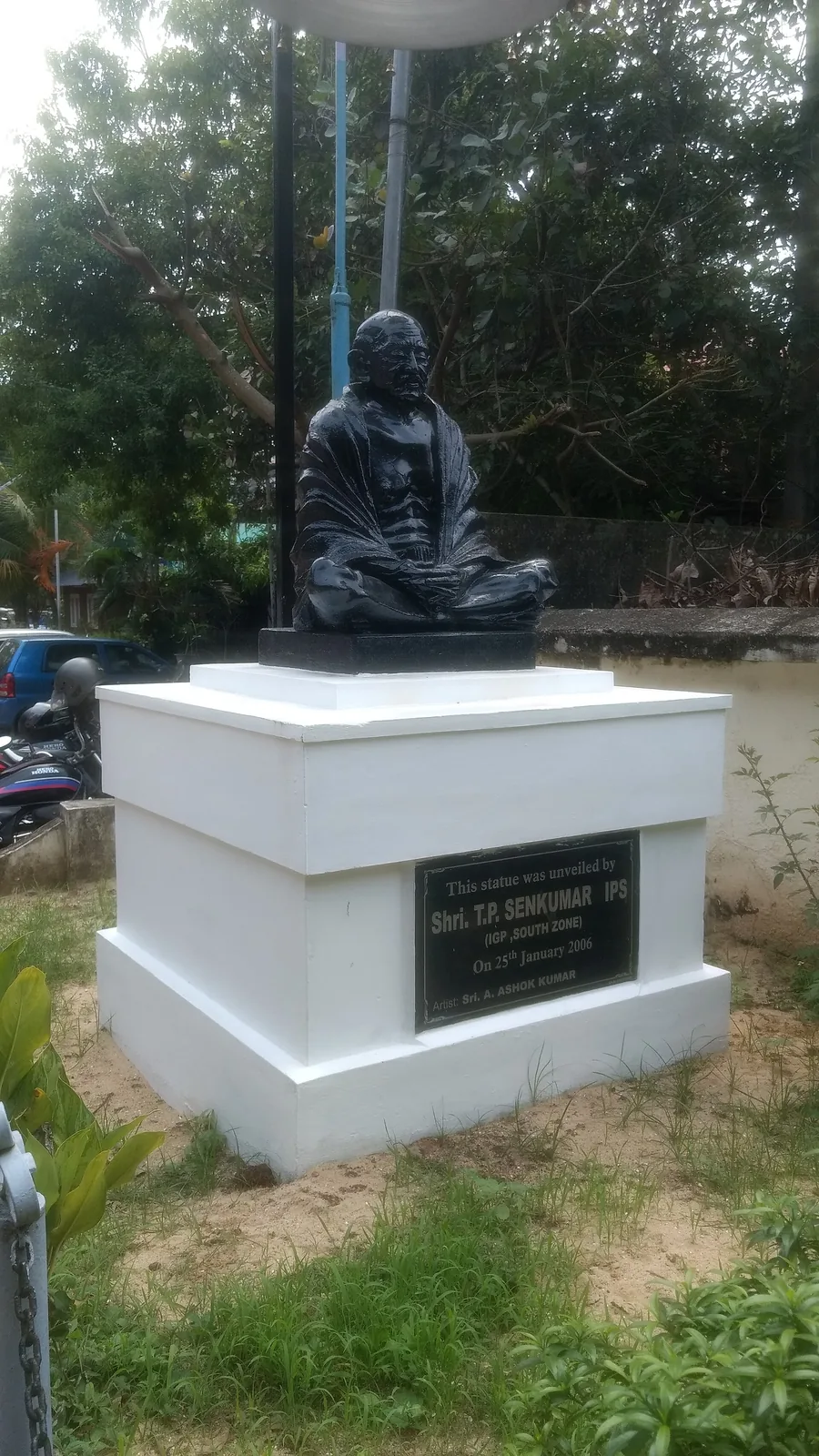
Outside, in the compound, the two statues and their plaques are free to look at without a ticket, which is worth knowing if your connection is tighter than you thought.
Three practical notes
It is a working police compound. The gate board carries the museum’s name, and directly below it another board reads വനിതാ സെൽ കൊല്ലം — the Kollam Vanitha Cell, the women’s cell. People come through here to report crimes. Be unobtrusive.
Photography rules inside are not published anywhere we could find. Ask at the desk rather than assuming, which is good practice in any police building.
And the building itself deserves a minute before you go in: a low single-storey mansion with a tiled roof, olive-green walls, a white columned porch and a scalloped timber bargeboard, which DTPC describes as having four courtyards. It is the oldest thing on the site and nobody has modernised it, which is much of the charm.
Frequently asked questions
Is it open on Sundays?
Unresolved, and worth a phone call. DTPC Kollam lists the museum as open 9:00–18:00 daily with no weekly closing day; other listings say it is closed on Sundays; Kerala Tourism publishes no timings at all, so there is no third source to settle it.
How much is the ticket?
DTPC Kollam publishes ₹20 for adults and ₹10 for children, offline booking only. ⚠ Other listings say ₹50 and Kerala Tourism gives no figure — carry more than you expect to need.
How long does it take?
About an hour, or two if you read the medal cases and the forensics charts properly. It is roughly 100–150 m from Kollam Junction, so it fits comfortably inside a long connection.
Can I see anything without paying?
Yes — the Patel and Gandhi statues and their dedication plaques stand in the compound outside the ticketed building, and the plaques are the most historically useful things on the site.