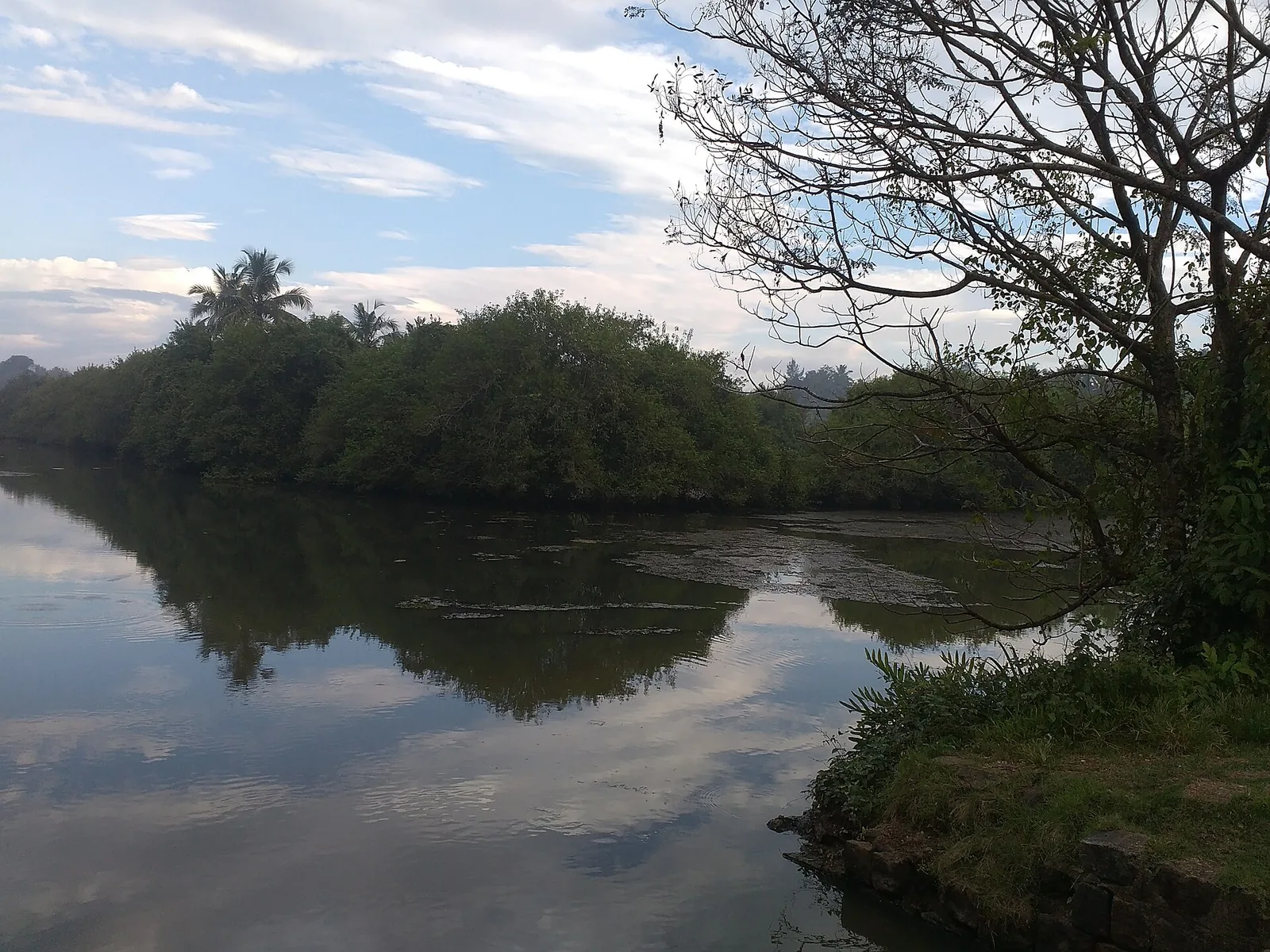
Almost everything published about the ecology of Sarovaram Bio Park is published under a different name, which is why the park looks under-documented until you know where to look. The park is the developed public portion of the Kottooli wetland, and it is under Kottooli — or Kottuli — that the bird checklists, the conservation reporting and the litigation all appear.
The wetland is the container and the park is the visitable part of it. Kottooli covers 87.04 hectares, about 215 acres, originally under rice cultivation, of which 22.5 hectares has been reclaimed for settlement. It is described in the reference literature as the largest eco-patch within the Kozhikode city limits, and it is interlinked with the man-made Conolly Canal, which brings it tidal water from the Kallai and Korapuzha estuaries. That tidal influx is the single most important ecological fact about the place: it is what allows mangroves to grow this far inside a city.
The case
On 23 February 2026 a Division Bench of the Kerala High Court — Chief Justice Soumen Sen and Justice Syam Kumar V. M. — decided a writ petition and connected matters brought against the Union Ministry of Environment, Forest and Climate Change and others.
The petitioner’s name is the part worth pausing on: the Sarovaram Prakrithi Samrakshana Samiti, the Sarovaram Nature Protection Committee. A citizens’ body named after this park went to the High Court on behalf of the wetland the park sits in. Its petition alleged construction and reclamation in the Kottooli wetlands that would destroy the habitat and render any later protected-wetland declaration meaningless — that is, that the wetland would be built over faster than the state could finish designating it.
The court agreed on the principle. It barred new construction in the area designated under the Wetlands (Conservation and Management) Rules, 2017 while the designation process runs. It directed the authorities to complete Ramsar Site designation within three months. It ordered the Kozhikode Municipal Corporation to publicise the restrictions widely. And it deferred the legality of existing buildings to the final outcome. Permitting construction during designation, it observed, would defeat the ultimate objective of both the 2017 Rules and the Ramsar Convention.
What we do not know
The next hearing was listed for 21 May 2026. We could find no reporting on it, and no confirmation that Ramsar designation was in fact granted. This matters for how the park is described: a great deal of copy already calls Sarovaram a Ramsar site, and it is not one. The accurate sentence, until someone can show otherwise, is that designation was under way as of February 2026 under a court order to complete it.
What the wetland actually holds
Tourism copy about this park says thirty-four species of birds. The Malabar Natural History Society’s preliminary checklist for the Kottooli wetland records 134 species, in 102 genera, 53 families and 15 orders — the perching birds most diverse at 54, then the pelicans and their relatives at 17, then the waders at 14. The eBird hotspot inside the park gates lists around two dozen, which measures how little birding has been logged there rather than what lives there.
The wetland also carries seven mangrove species and twenty-nine associated plants, a count that is consistent across every source and named by none of them. We looked. The Kerala government’s own Kottuli wetland notification, which would settle the species list along with the area and the fauna, could not be reached, and we are not going to guess at seven binomials to fill a gap. There are otters here too, or there were: the reference sources give a species name that is a garbled form of the Eurasian otter’s, the animal most likely present in Kerala’s backwaters is the smooth-coated otter, and the district tourism body advertises an otter park. That is as far as the evidence goes.
And Kottooli is not one of twenty-seven wetlands of India, a claim carried by Kerala Tourism and repeated everywhere downstream. The designation that exists is different in both number and subject: Kottooli is one of ninety-four wetlands of national importance identified by the Government of India under the National Wetland Conservation Programme in 2006–07.
Frequently asked questions
Is Sarovaram Bio Park a Ramsar site?
No. Designation was under process, and on 23 February 2026 the Kerala High Court ordered it completed within three months. We found no reporting on whether it was granted.
What did the High Court actually order?
No new construction in the Kottooli wetlands area designated under the Wetlands (Conservation and Management) Rules 2017 while designation runs; completion of Ramsar designation within three months; and wide publicity for the restrictions by the Kozhikode Municipal Corporation. The legality of existing buildings was left to the final outcome.
Why is the ecology published under a different name?
Because the park is the developed part of the Kottooli wetland, and the bird checklists, conservation reporting and litigation are all filed under Kottooli or Kottuli rather than Sarovaram.
How many bird species are there?
134 on the Malabar Natural History Society’s checklist for the wetland. The widely printed figure of 34 is unsourced and a serious undercount.