The local name for Sarovaram Bio Park is Swapnanagari, and it means Dream City. It is not brochure language — it is the vernacular name, strong enough that photographers on Wikimedia Commons file their pictures of the place under it, and it comes from the park having been a component of an urban development initiative of that name. The word marks an aspiration: an eco-friendly public space carved out of a congested city.
Which makes the reporting history read strangely. A place called Dream City has spent most of its life being described as not yet the dream.
The chronology
It opened in 2008, in phases — which is why visitor accounts from the middle 2010s mention paying separately for one phase or for both. By May 2019 Manorama News was reporting the bird area, the boating, the musical park and the pathways as on the brink of destruction, with streetlights that had been installed years earlier simply not working. A ₹79 lakh revival followed: twenty-four CCTV cameras across the ninety-eight acres, wheelchair access, accessible toilets, and the state tourism development corporation preparing to tender the boating back into service.
In October 2024 a second and larger revival was approved, at ₹2.19 crore, executed by the Department of Tourism. By the end of June 2025 the minister was noting that ₹1.74 crore of it had already been spent. And in January 2026 a visitor recorded that the site was still under construction — no theatre, no café, no boat rides.
What that leaves you with, which is better than it sounds
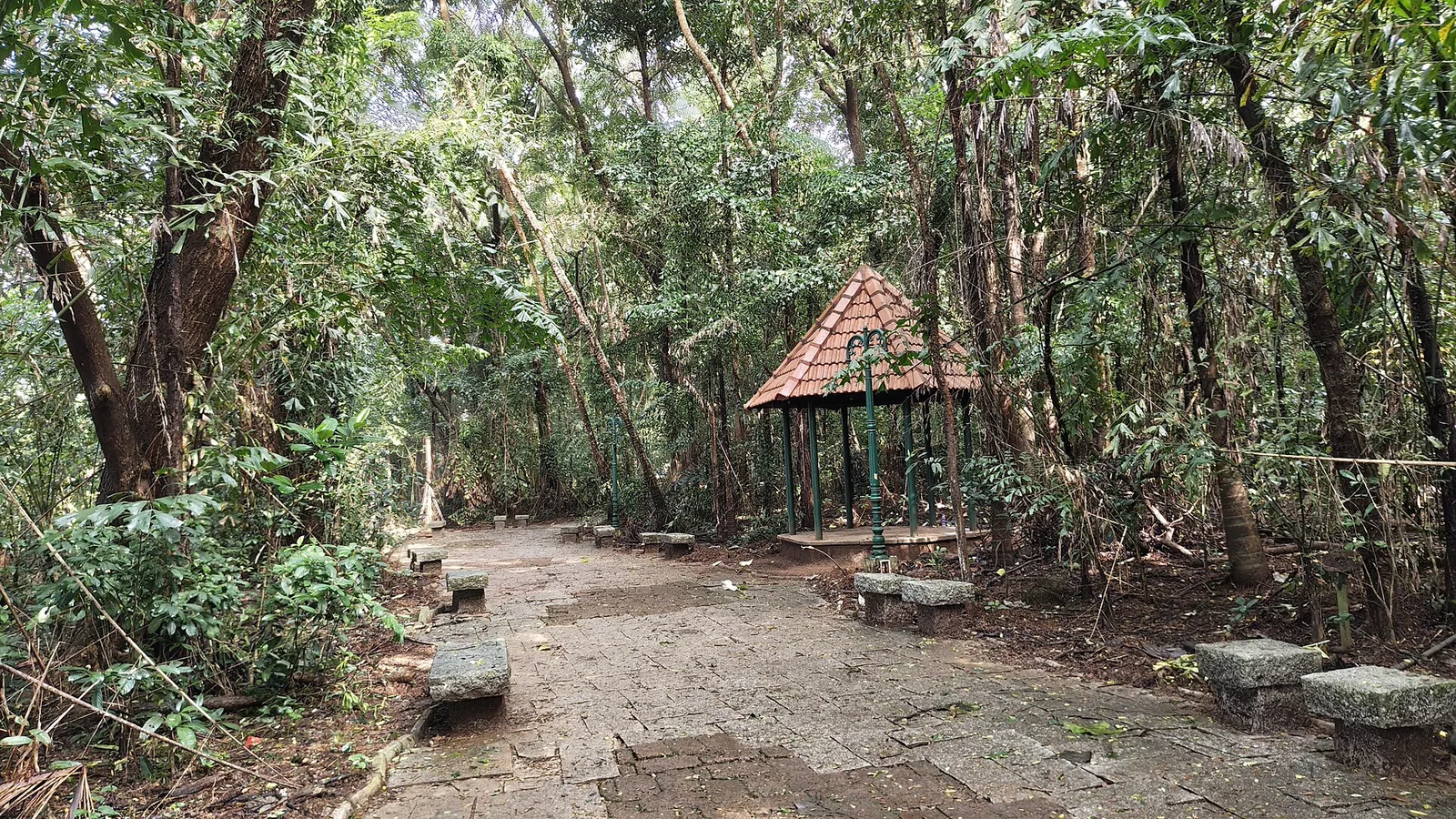
Photographs from July 2026 show closed-canopy secondary forest with heavy liana growth; laterite and stone-slab walkways running through it; green cast-iron lamp standards; rough stone benches; a small pavilion with a tiled pyramidal roof on green iron columns; and green iron arch footbridges, one of them with a bright new timber deck freshly laid across it.
That is not a municipal garden. There are no lawns, no bedding plants, no clipped edges. It is a piece of city woodland left alone long enough to become woodland, with paths through it and a few Victorian-looking lamp posts standing about in the undergrowth. The reasonable inference — and we flag it as an inference — is that the neglect is precisely why it looks like that. Eighteen years of being nearly finished is eighteen years of nothing being mown.
What to expect, honestly
The paths, bridges and forest are the reliable part. A musical fountain, butterfly park, science centre, floating rafts, boardwalk, open-air theatre and café appear in older listings, but their 2026 operating status is not established. A mapped boating jetty shows where a facility existed, not whether boats are currently running; check at the entrance before paying or planning around an activity.
The one photograph of boating here that exists on Commons dates from 2012: a timber jetty, three canopied pedal boats with blue and white awnings and one red hull, old tyres for fenders, dark still water, a red laterite bank. It is a good picture of a small pedal-boat operation, and it is fourteen years old. We have kept it out of the gallery for that reason.
Entry is given as ₹30 by the district tourism body and the hours as nine to eight, but that is an aggregator figure rather than the operator’s — there is no park website, and Kerala Tourism’s own page declines to state opening times at all. It also sits oddly beside the long-standing local practice of free entry for morning walkers from about six. Go early, take the ₹30 in change, and treat everything else as subject to whatever stage the renovation has reached.
Frequently asked questions
What does Swapnanagari mean?
Dream City. It is the park’s genuine local name in Malayalam, from the urban development initiative the park was part of.
Is the boating open?
It was not in January 2026, when a visitor recorded that the theatre, café and boat rides were all absent. There is a jetty and there is a mapped boating facility; neither tells you a service is running. Confirm before travelling for it.
Is it worth going if half of it is shut?
Yes, for what it actually is — a stretch of mature closed-canopy forest inside the city, with paved paths, footbridges and open water. Go early in the morning.
What does it cost?
₹30 per person per the district tourism body, with a local practice of free entry for early-morning walkers. There is no operator-published tariff.