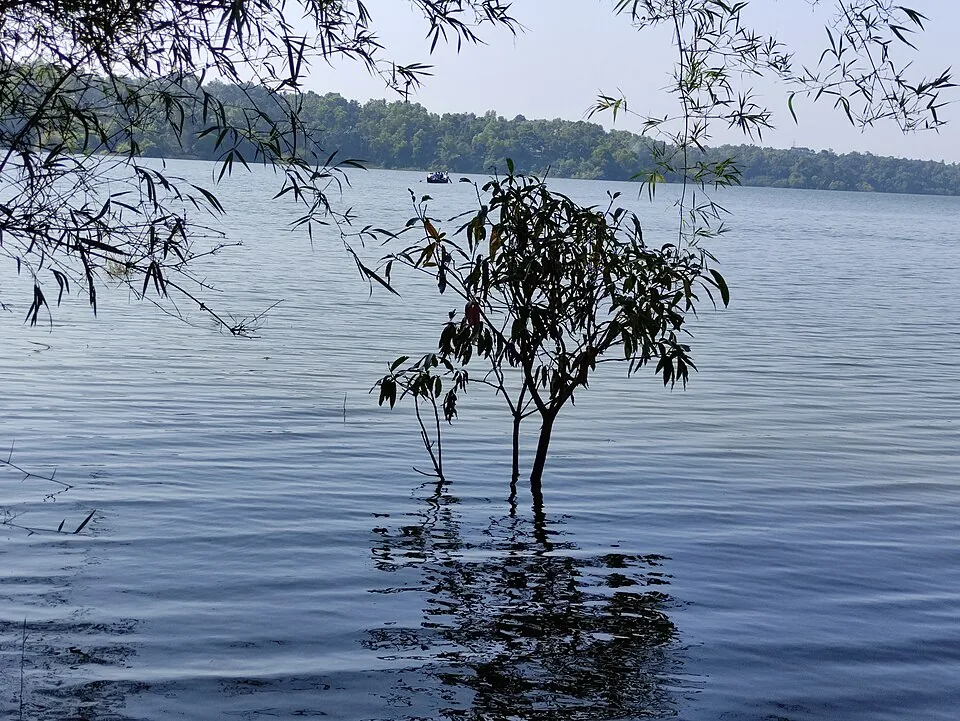
There is a sentence that appears in almost everything written about Sasthamcotta Lake, Kerala’s largest freshwater lake and the drinking-water source for a large part of Kollam district. The water, it says, is exceptionally pure because the lake teems with a larva called cavaborus, which eats the bacteria. You will find it on tourism pages and travel blogs, in general-knowledge compilations and encyclopaedia entries, in competitive-exam notes, and — the reason it is everywhere — in the official Ramsar Information Sheet that accompanied the lake’s designation as a Wetland of International Importance in 2002.
It is not true. There is no organism called cavaborus. It is not a genus, not a species, not a common name in English or Malayalam or Latin. It is a word that entered one document, was copied out of it, and has been reproduced without checking for more than twenty years. And the evidence for the correction is not hidden in some specialist journal — it is four pages further into the same Ramsar sheet that contains the mistake.
What the official document actually says
The Information Sheet for Sasthamkotta Lake is dated 19 August 2002, the day of designation. It was compiled by WWF-India with input from the Centre for Water Resources Development and Management at Kozhikode, and it runs to thirty numbered items covering geography, hydrology, chemistry, fish, ownership and threats. At item 16, under ecological features, it states that the water is special in that it does not contain common salt or other minerals and metals, that no water plant grows in the lake, and that a larva called Cavaborus abounds in it — eating up the viruses and bacteria in the water and thus contributing substantially to the high degree of purity.
The word is in inverted commas in the original, which is the mark of a compiler copying a term rather than using one. And the passage carries a source. It is not a paper or a survey — it is a web address on a consumer internet service that most Indian households used in the late nineties, long since offline. That is the provenance of the most-quoted fact about a Ramsar wetland.
The right word was in the bibliography all along
Item 30 of the same sheet lists its scientific and technical references, and the second entry reads: Pillai, 1981, Studies on some aspects of the ecology of larvan Chaoborus in Lake Sasthamcotta, M.Phil. dissertation, University of Kerala. There it is. Chaoborus, not cavaborus. A real genus, studied at this specific lake, by a researcher at the University of Kerala, twenty-one years before the designation. Somewhere between the reference list and the descriptive paragraph, a Chao became a Cava, and the world has been repeating the typo ever since.
Chaoborus is the phantom midge. Its aquatic larva is one of the most familiar animals in freshwater biology — almost perfectly transparent, which is why it is called the glassworm, with a pair of dark air sacs that make it look like a tiny submarine hanging in the water column. It migrates vertically, resting deep by day and rising at night. In a deep, clear, low-nutrient lake it is exactly the kind of animal you would expect to find, and finding it at Sasthamcotta is a perfectly good piece of natural history.
But it does not eat bacteria
The trouble is that correcting the spelling does not rescue the claim. Chaoborus larvae are predators. What they hunt is zooplankton — copepods and cladocerans, the small crustaceans that graze a lake’s algae — which they seize with a specialised catching basket built from modified head appendages. They are studied precisely because they are efficient enough to reshape the size structure of the plankton community around them. Early instars will take algae as well. Bacteria are not on the menu at any stage, and the sheet’s additional claim that the larva consumes viruses has no basis at all.
So the fact fails twice. The animal is misnamed, and the animal that was meant does not do the thing it is credited with. No study we could locate demonstrates bacterial grazing by Chaoborus at Sasthamcotta or anywhere else, and the 1981 dissertation the sheet cites is not available to check what it actually concluded.
What does keep the water clear
The real explanation is less charming and more useful, and it is in the same document. Sasthamcotta has no river flowing into it and none flowing out. It is filled by rain and by groundwater seeping in from the laterite hillocks that ring it, with a bund closing the southern side against the paddy. That means no river-borne silt, no upstream town’s sewage, no fertiliser slug arriving with the first flood. The water is soft, with very low phosphate, low primary productivity and scarce phytoplankton, and it is deep by Kerala standards — averaging about 6.5 m and reaching some 15 m. A deep, soft, nutrient-poor, spring-fed basin is clear because of its plumbing, not because of an insect.
The month the purity story failed
There is a date on which all of this stopped being an academic point. In May 2018 the Kerala Water Authority stopped drawing drinking water from Sasthamcotta. The reason was discolouration: water that stained faintly red and threw a precipitate when boiled. The authority’s assistant executive engineer attributed it to the presence of iron bacteria in large quantities in the depleted lake, with culture tests still pending. Supply to Kollam Corporation and the surrounding panchayats was switched to alternate-day pumping from the Kallada Irrigation Project canal, which could yield fewer than 15 million litres a day against a demand of 37.5.
A lake famous around the world for a bacteria-eating larva was taken out of service because of bacteria. That is not an argument against Sasthamcotta; it is an argument for describing it accurately. This is a genuinely unusual water body — the only large freshwater lake on a coast of brackish lagoons, deep, soft-watered and closed — and it is in real trouble for reasons that have nothing to do with insects and everything to do with sand mining, a falling water table and a pump. The invented larva has spent twenty years standing between visitors and the actual story. It is worth putting down. The wider district is on the Kollam hub.
Frequently asked questions
What is cavaborus?
Nothing — there is no organism of that name. It is a misspelling of Chaoborus, the phantom midge, which entered the 2002 Ramsar Information Sheet for Sasthamkotta Lake and has been copied ever since. The correct spelling appears in the same sheet’s own bibliography, citing a 1981 University of Kerala dissertation on the ecology of Chaoborus larvae in this very lake.
Do Chaoborus larvae eat bacteria?
No. Chaoborus larvae are predators of zooplankton — copepods and cladocerans — which they capture with a specialised basket of head appendages; early instars also take algae. They are not bacterial grazers, and the Ramsar sheet’s further claim that they consume viruses has no basis.
So why is the water so clear?
Because of the lake’s hydrology. It has no river inflow or outflow, so no silt, sewage or fertiliser arrives from upstream. It is fed by rain and groundwater, is soft and nearly free of common salts, has very low phosphate and scarce phytoplankton, and is deep for Kerala — around 6.5 m average and about 15 m at maximum.