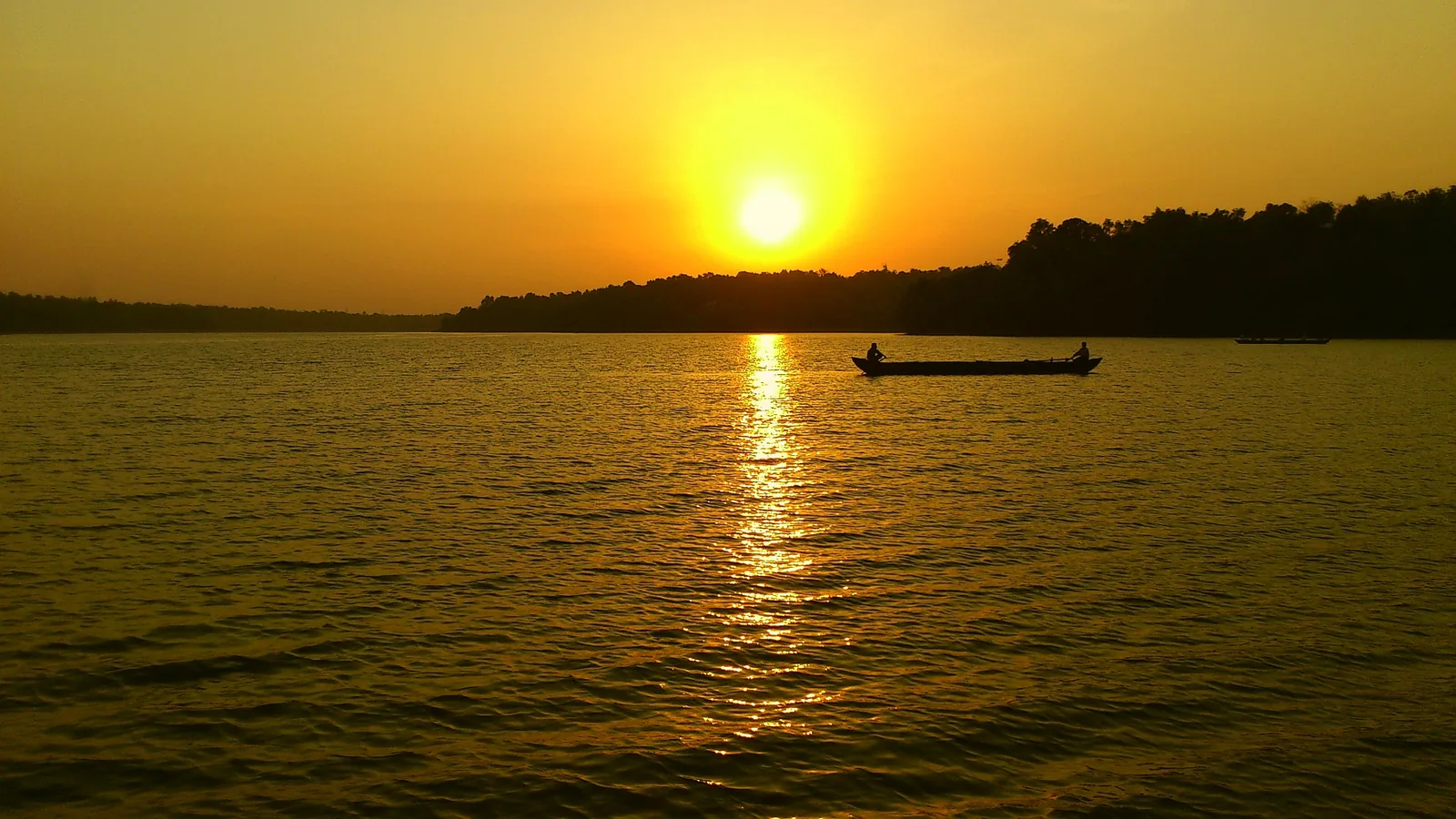
Kerala is a land defined by water — backwaters, rivers, lagoons open to the sea. But its single largest body of fresh water is something quieter and stranger: an inland lake ringed by green hills, watched over by an ancient temple and a troop of sacred monkeys, and kept miraculously clean by a creature almost too small to see. This is Sasthamcotta Lake.
The largest freshwater lake in Kerala
Spread across some 375 hectares in the Kollam countryside, Sasthamcotta is the biggest freshwater lake in the state — and not a decorative one. It is the drinking-water source for roughly half a million people in the Kollam district, and it supports fishing besides. In 2002 it was recognised as a wetland of international importance under the Ramsar Convention, one of only a handful of such sites in Kerala. It is, in short, a working wonder as much as a scenic one.
The larva that keeps it clean
And here is its quiet marvel — though not the one you will usually be told. Almost every account of Sasthamcotta credits the water’s purity to a larva called cavaborus, said to eat the bacteria. There is no such creature: the word is a long-lived misspelling of Chaoborus, the phantom midge, whose larvae prey on zooplankton rather than bacteria. The real explanation is duller and more useful. No river flows into this lake and none flows out, so no silt, sewage or fertiliser arrives from upstream; it is filled by rain and by groundwater seeping from the laterite hillocks around it, and it is soft, nutrient-poor and deep by Kerala standards. The clarity is a consequence of the lake’s plumbing, not of an insect.
The god and the demon
The lake takes its name from the Sastha — Dharmasastha, Lord Ayyappa — whose ancient temple stands on its bank; Sasthamcotta means, roughly, “the fort of the Sastha.” Legend holds that where the lake now lies there was once a thick and terrible forest, the lair of a dreadful demon named Bana. It was Ayyappa, the story goes, who came and slew the demon, and the great hollow of the lake was left behind by that cosmic struggle. The temple has stood guard over the water ever since.
The sacred monkeys
No visitor forgets the monkeys. Large troops of them live in the temple grove along the bank, and by local belief they are no ordinary animals: they are held to be the close aides and companions of the presiding deity, the Dharmasastha himself, and are treated as sacred. To watch them move through the trees above the still water, half-wild and half-worshipped, is to feel how completely nature and faith are braided together here.
Visiting Sasthamcotta
The lake lies in the countryside a short way from Kollam town, an easy and peaceful half-day trip, with boating on the water and the hilltop Sastha temple above. Treat the monkeys with respect and keep your food and belongings close. Details are on the Sasthamcotta place page; more of the district is on the Kollam hub.
Frequently asked questions
What is special about Sasthamcotta Lake?
It is the largest freshwater lake in Kerala (about 375 hectares), the drinking-water source for around half a million people in Kollam, and a Ramsar wetland of international importance since 2002. Its water runs clear because the basin is fed by rain and groundwater rather than by a silt-carrying river — not, as is very widely repeated, because of a bacteria-eating larva called cavaborus, which does not exist.
What is the legend of Sasthamcotta?
Legend holds the area was once a forest that was the lair of a demon named Bana, whom Lord Ayyappa (Dharmasastha) slew; the lake was left behind by that battle. The ancient Sastha temple on the bank gives the lake its name.
Why are there monkeys at Sasthamcotta?
Large troops of monkeys live in the temple grove on the lake’s bank. By local belief they are the sacred companions and aides of the presiding deity, the Dharmasastha, and are treated with reverence.