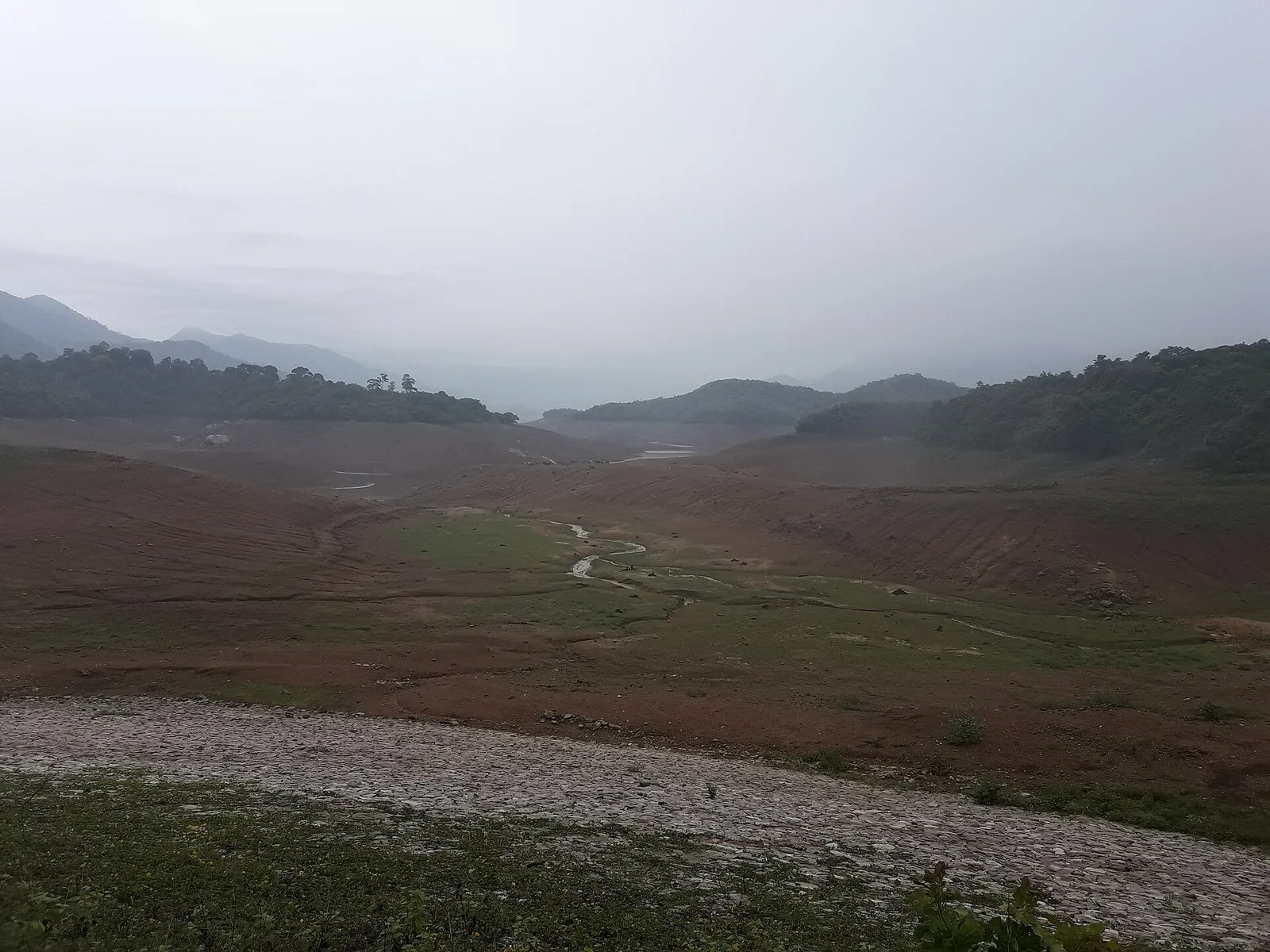
Roughly a ninth of this sanctuary is under water. That fact shapes the visitor experience more than any other single thing about the place — and it is not a fixed fact.
The photograph above was taken in late May. It is the same basin that appears on every listing as a lake ringed by rainforest. There is no lake in it. There is a red valley floor, a green flat where the drawdown has grassed over, and the river running through the middle of it as a stream you could step across in places.
It is a store, not a lake
The Parappar reservoir covers about 18.7 square kilometres inside the sanctuary boundary. It exists to irrigate Kollam and Pathanamthitta, and the protected area's boundary was drawn along the catchment that feeds it — the sanctuary and the water supply are the same decision, made once.
An irrigation store behaves in exactly the opposite way to a scenic lake. It fills through the monsoon and it is emptied through the dry season, because emptying it is what it is for. The lowest water of the year arrives in the weeks before the southwest monsoon breaks — which is also, inconveniently, the tail of the season most guidebooks recommend for visiting.
Which is why half the catalogue is wet
Of the twenty programmes the Forest Department sells here, seven happen on or across water. There are three price points for a motor boat — a thirty-minute Boat Safari at ₹1,770 for five, an hour at ₹2,950, and Idimuzhanganpara Boating at ₹5,900 for an hour and a half. Then the coracles: ₹354 for two or three people, ₹590 for four.
Those coracle prices look like an afterthought on a tariff sheet. They are not. A traditional round coracle needs a fraction of the draught a passenger launch does, and it can be carried to wherever the water has retreated to. When the level drops, the coracles keep running and the big boats do not. The cheapest line on the tariff is also the most weather-proof one.
What low water does to a booking
The camp at Idimuzhanganpara is the clearest case. It is reached by boat, and the boating and the camping are two separate purchases — ₹5,900 for the crossing programme, ₹7,875 for two people at the camp. It also carries the two tightest constraints in the entire system: a seventy-two-hour booking cut-off, three times the normal, and a daily allotment of five tickets.
When we read the operator's records in mid-August, Idimuzhanganpara Camping was the only Shendurney product carrying blackout dates at all — five of them, marked simply "not available". Every trekking, boating and safari slot was live. Whatever closes here, it is not the season and it is not the forest. It is one camp on the far side of a body of water.
Think about what that crossing means before you book it. The camp is described as about an hour out by boat, which puts you an hour of open water from the road with your kit, in the afternoon, on a launch the department itself records as ageing. There is nothing alarming in that — it is how a camp inside a protected forest ought to work — but it is a genuinely committed trip, and it is the one product here where the water level is not a matter of scenery. If the launches are not running, the camp is not reachable, and the seventy-two-hour cut-off means you will know well before you set out.
The boats themselves
Two findings from the sanctuary's own management documentation belong here, briefly, because they bear on what you should expect to be sold. The department records its passenger boats as nearing the end of their service life. And researchers working on this water have found that excessive boat noise directly harms bird breeding on it.
Neither is a reason not to go. Both are reasons to understand why the water programmes at Shendurney are capped, timed and comparatively expensive, and why a coracle at ₹354 may be a better hour than a launch at ₹2,950.
How to plan around it
When you ring to arrange a programme — and you will have to ring, because online booking for this centre is switched off — ask about the water level, not just about availability. The question the counter can answer is whether the launches are running, and that answer changes through the year in a way no published schedule captures.
If the reservoir is your reason for coming, come after the monsoon rather than before it. Roughly October onwards the basin is full, the reflections that appear in every photograph of this place are real, and the boats go where the photographs were taken.
If you are coming to walk, the water level barely matters — the trekking programmes run from the office and go into forest, not along a shoreline. But it is worth knowing what you are looking at when the trail opens out. A wide green flat with a stream through it is not a meadow. It is the bottom of a reservoir, and by December you would be looking at forty feet of water standing over the same ground.
One boundary worth drawing
Everything above is the sanctuary side of the water. The dam wall itself, the power station at its toe, the confluence below it and the coracles that work the river downstream are a different place with a different set of tickets, and they belong to the dam, not to the forest. This story stops at the waterline.
Frequently asked questions
Is there always water in the reservoir?
No. It is an irrigation store for Kollam and Pathanamthitta, filled by the monsoon and drawn down through the dry season. Photographs from late May show the basin bare to the red bed with the river running through it as a stream.
When is the best time for the boat safaris?
After the monsoon rather than before it — roughly October onwards, when the basin is full. The weeks immediately before the southwest monsoon are the lowest water of the year.
What happens to boating when the water is low?
The coracles keep running when the passenger launches cannot — they need a fraction of the draught. At ₹354 for two or three people they are also the cheapest programme on the tariff.
How do I get to the Idimuzhanganpara camp?
By boat, and the crossing is a separate purchase from the camp. It also has the longest booking cut-off in the system at seventy-two hours and the smallest allotment at five tickets a day, so it needs planning that the walking programmes do not.
Does low water affect the trekking?
Barely. The walking programmes start from the wildlife office and go into forest rather than along a shoreline. Water level changes what the boats can do, not what your feet can.
How big is the reservoir?
About 18.7 square kilometres inside the sanctuary — roughly a ninth of the protected area. The sanctuary boundary was drawn along the catchment that feeds it.