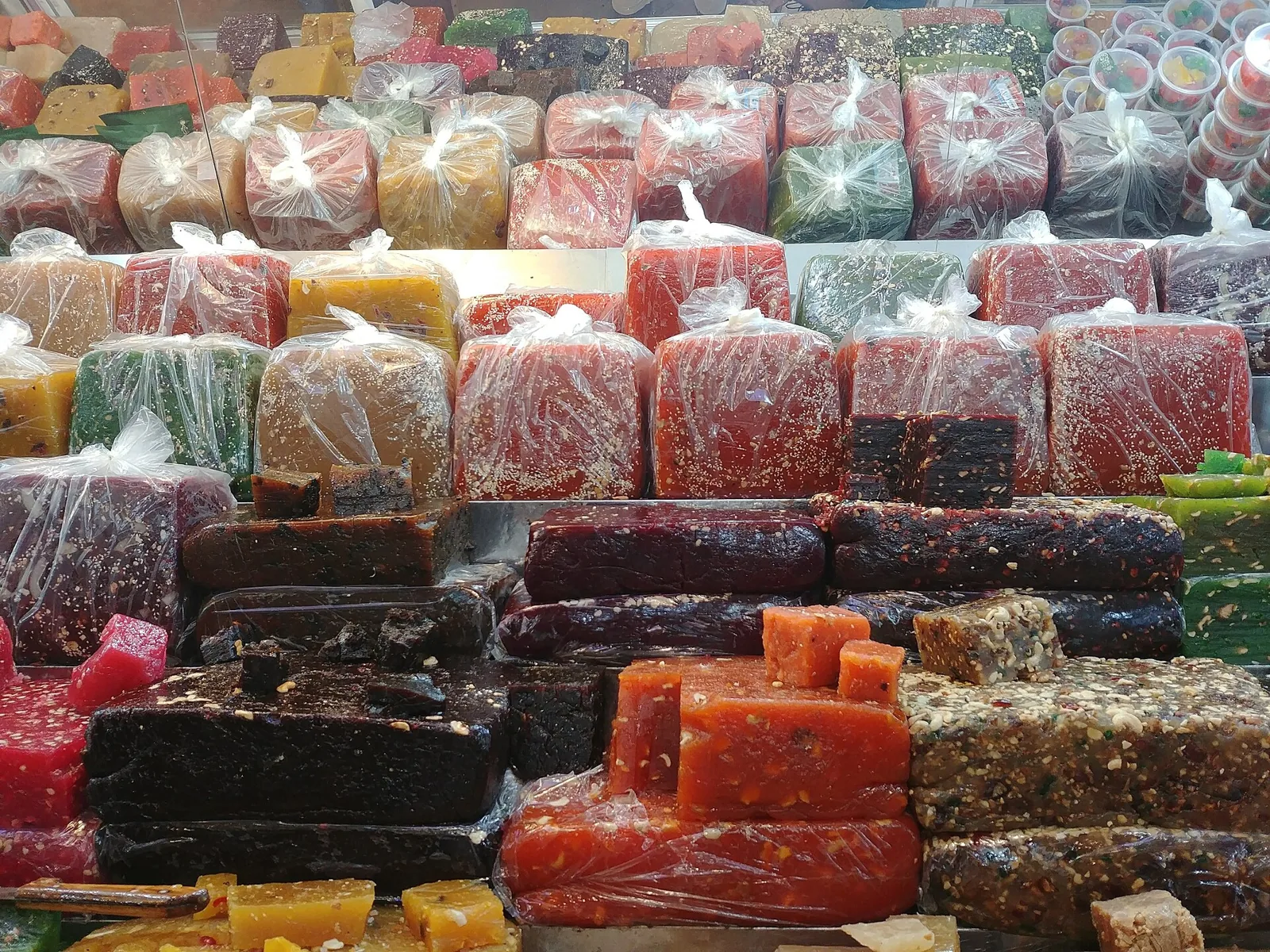
Kozhikodan halwa is the thing this city is known for, and SM Street is where you buy it. Most visitors do this badly — walking into the first shop, pointing at the reddest slab, paying, and leaving with a box that is fine. Ten minutes of method gets you something considerably better.
What it actually is
First, set aside what the word halwa means elsewhere. The semolina halwa served across much of north India, and the tahini-based halva of the eastern Mediterranean, are different products entirely. Kozhikodan halwa is made from maida or rice flour cooked down with sugar and a great deal of ghee, worked until it becomes a dense translucent mass, then poured, set and cut into slabs.
The result is chewy and slightly elastic rather than crumbly or grainy, closer in texture to a firm fruit jelly than to anything a European would call a sweet. It is extremely rich. A piece the size of a matchbox is a substantial thing to eat, and first-timers routinely overestimate how much they want.
The varieties are not decorative
The colours in the trays correspond to genuinely different products. Coconut halwa is the mellow, milky standard. Tender coconut is softer and lighter. Wheat halwa is denser and more caramelised. The dark, almost black variety is the most distinctive and the one aficionados argue about — deeper, slightly bitter, with a burnt-sugar edge that cuts the sweetness. Then there is a wide range of fruit versions, from pineapple to mango to banana, plus versions studded with cashew or sesame.
Ask what is in front of you rather than choosing on colour alone. The bright red that dominates the display is a classic, but it is not automatically the best thing in the shop, and it is often the least interesting to a palate encountering all of this for the first time.
Taste before you buy
This is the single piece of advice that changes the experience, and visitors are consistently too polite to act on it. The established shops on this street expect customers to taste. Slivers will be cut from several trays and handed across, and there is no obligation to buy from the tray you tried. This is normal commercial practice here, not a favour being extended to you.
Work through four or five before deciding. The variation between makers on the same street is real — in ghee content, in how far the sugar has been taken, in how firmly the slab is set — and you will develop a preference faster than you expect.
Buying properly
Halwa is sold by weight and cut from the block to order. If you are going to eat it within a few days, ask for it cut fresh rather than taking pre-packed boxes, which are made for travel and sit longer. Mixed boxes are the sensible purchase for taking home, and shops will assemble one to your specification rather than the standard selection.
It keeps and travels unusually well, which is the whole reason a regional sweet became a national souvenir — the ghee and sugar content make it stable at room temperature for a considerable period. This is why every Malayali returning from Kozhikode arrives carrying a box, and why buying more than you think you need is rarely a mistake.
The other thing to carry home
It is worth understanding what has gone into the block before you judge the price. Halwa of this kind is made by cooking flour, sugar and ghee together over sustained heat, stirred more or less continuously in large vessels for hours, until the mixture thickens and turns glossy and translucent. It is heavy, hot, skilled work, and the quality of the result depends almost entirely on judgement — how far the sugar is taken, how much ghee goes in and when, and the point at which the mass is deemed ready to pour. There is no shortcut and no way to automate the decision.
Ghee is the main cost and the main variable. Cheaper halwa is made with less of it, or with substitutes, and you can taste the difference immediately — the good stuff has a clean richness that coats the mouth and fades, while the economised version leaves a waxier finish. This is a large part of what you are comparing when you taste across several shops, and it is why the prices on the same street are not all the same.
Some shops let you see the cooking, and it is worth asking. Watching a batch being worked in the vessel is genuinely impressive and it recalibrates what you think you are buying: not a mass-produced confection but something closer to a craft product, made in batches, by people who have done it for a very long time.
On practicalities: bring cash in reasonable denominations, expect prices to be marked and fairly standard rather than negotiable at the established shops, and ask for your purchase to be wrapped properly if it is going in a suitcase — halwa is dense, it will take up less room than you expect, and it survives being sat on rather better than most souvenirs. Keep it cool and out of direct sun and it will comfortably outlast your trip.
Do not leave without banana chips. The Kerala version is fried in coconut oil and salted while still hot, and it bears very little relation to the packaged banana chips sold internationally — thinner, saltier, and with a distinct coconut note. Buy from shops frying on the premises and sold loose by weight from open tins rather than sealed bags, and eat them within a few days, because coconut oil does not stay fresh indefinitely.
Between the two, a box of mixed halwa and a bag of chips is the complete Kozhikode edible souvenir, it costs very little, and both are made a few metres from where you are standing. More of the city is on the Kozhikode hub.
Finally, resist the urge to buy everything on the first pass. Walk the length of the street once without purchasing, note which shops are busy with local customers rather than visitors, and buy on the way back. Crowds of residents are the most reliable quality signal available to a stranger in any food market anywhere, and on this particular street they are easy to read: the shops that Kozhikode buys its own halwa from are not the ones with the most aggressive signage.