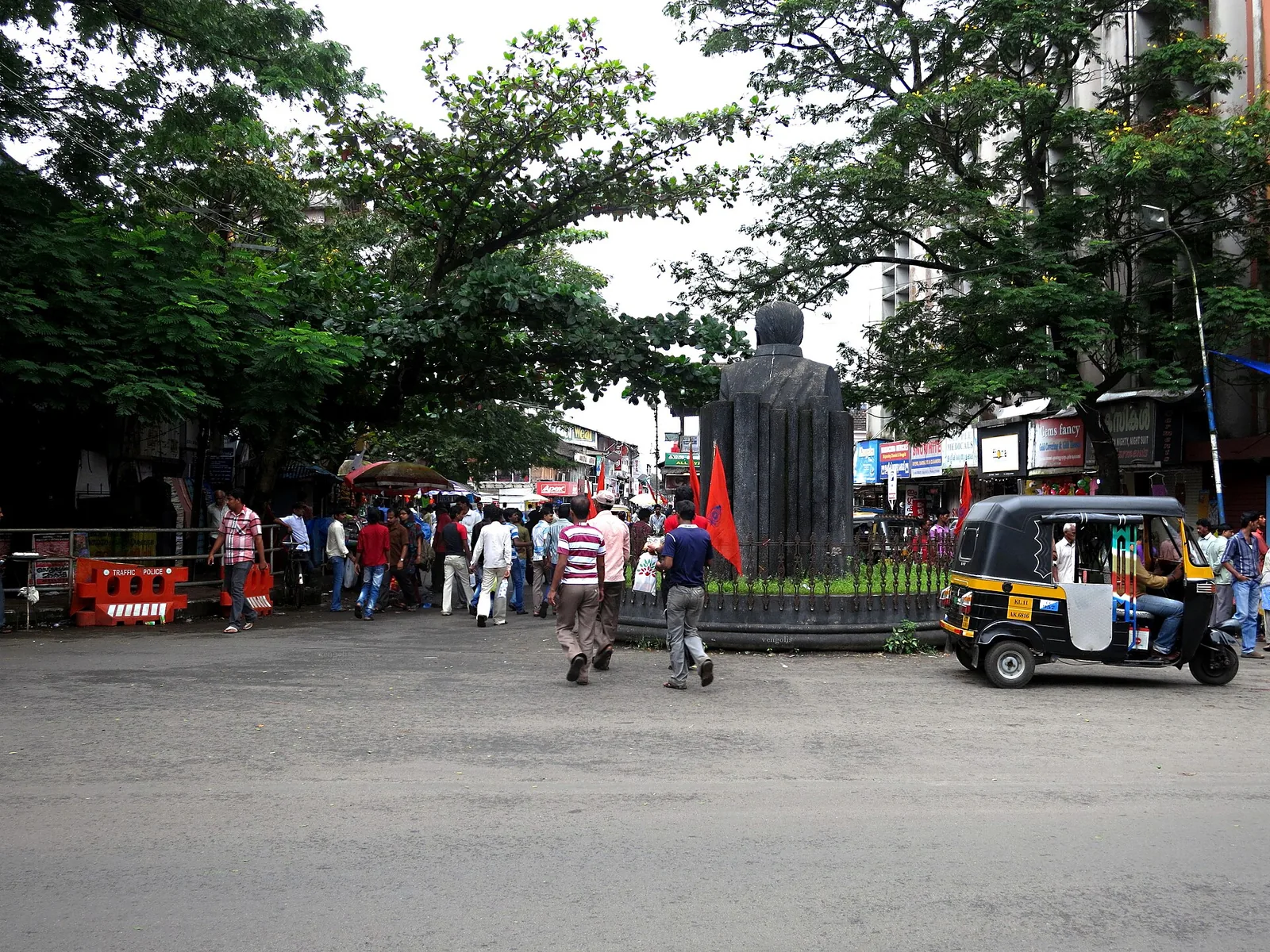
There is a bust at the head of SM Street, facing down the length of it. It is of S. K. Pottekkatt, and it is there because he wrote a novel about this street that is regarded as a classic of Malayalam literature. It is worth pausing at, because a shopping street that has produced canonical literature and then put up a monument to its author is a genuinely unusual thing.
Who he was
Pottekkatt was born in Calicut on 14 March 1913 and died in 1982, having spent his last years in the city where he began. He was one of the major Malayalam writers of the twentieth century, known both as a novelist and as one of the language’s great travel writers — he travelled extensively across Asia, Africa and Europe at a time when very few Indian writers were doing so, and the resulting books shaped how a generation of Malayali readers imagined the world beyond Kerala.
That biography matters for the street, because the man who wrote about this small stretch of Kozhikode was not a local writer with a local subject. He was someone who had seen a great deal of the world and chose to write a novel about the road he grew up beside.
The two books people confuse
His two most celebrated novels have similar titles and are regularly mixed up, so it is worth being precise. Oru Theruvinte Katha — The Story of a Street — was published in 1960 and received the Kerala Sahitya Akademi Award for Novel in 1961. That is the SM Street book.
Oru Desathinte Katha — The Story of a Land — came later, in 1971. It won the Sahitya Akademi Award in 1972 and then the Jnanpith Award, India’s highest literary honour, in 1980. It is generally treated as his masterpiece. The Jnanpith therefore belongs to the second book, not to the street novel, and sources that credit SM Street with a Jnanpith have run the two together.
What it means to write a street
The premise of Oru Theruvinte Katha is that a street is a legitimate subject for a novel in its own right — not a setting for a plot, but the thing being written about. The shops, the traders, the households, the arrivals and departures over time: the street is the protagonist, and the people move through it.
This is a natural fit for SM Street specifically, because the place really does work that way. It has been continuously traded on for roughly five hundred years by successive communities — Gujarati confectioners invited by the Zamorin, Parsi merchants, and generations of Malabar families since. Individual businesses come and go across decades while the street itself persists and accumulates. That is a novelistic structure before anyone writes a word of it.
Standing at the bust
The statue is a good place to begin a walk rather than end one, because it reframes what you are about to do. Approached as shopping, SM Street is a crowded bazaar with good sweets. Approached as the subject of a novel, it becomes a place where you notice the things a writer would notice: which shopfronts are clearly old and which are recent, where a family name recurs, how the trades cluster, where the street changes character along its two kilometres.
It also says something about Kozhikode that the monument here is to a writer rather than to a ruler or a general. The city holds a UNESCO City of Literature designation, and this bust is one of the more concrete pieces of evidence for why — a working commercial street that takes its literary reputation seriously enough to commemorate it at the entrance.
Reading it afterwards
The neighbourhood around the bust rewards the same attention. SM Street does not exist in isolation: it sits within a few minutes’ walk of Mananchira Square, the old civic centre built around the Zamorins’ tank, and of the Kuttichira quarter with its extraordinary timber mosques. The Parsi presence that preceded the Gujarati confectioners has left its own mark near the street. Walked as a single circuit, these are not separate attractions but one continuous piece of urban fabric, which is how Pottekkatt’s generation would have experienced them.
That continuity is the thing his novel is really about, and it is the thing a visitor is most likely to miss. Kozhikode presents itself to a hurried traveller as a list — a beach, a bazaar, a square, some mosques, a museum. It functioned, and to a large extent still functions, as a single trading town in which all of those were aspects of the same enterprise: the port brought the goods, the street sold them, the communities that handled them built their places of worship a few streets away, and the tank supplied all of it with water.
There is also a straightforward pleasure in the fact that the monument is where it is. Statues of writers are usually placed in gardens, on campuses, outside libraries — somewhere quiet and appropriately reverent. This one faces a working bazaar and is surrounded all day by people who are shopping and have no particular interest in literature. Pottekkatt spent his life writing about ordinary places and the people passing through them, and a bust that is permanently in the middle of a crowd is about as fitting a memorial as a writer of that kind could be given.
Oru Theruvinte Katha is available in Malayalam and has circulated in translation, and it is a reasonable thing to seek out after a visit rather than before — the street makes more sense as a subject once you have been jostled along it for an hour. Failing that, walk it slowly, twice, in opposite directions. The second pass is when a bazaar stops being a wall of shopfronts and starts being a place with a structure. The rest of the city is on the Kozhikode hub.
If you take only one thing from the bust, let it be a change of pace. Novels about places are always arguments for slowness — they work by accumulating detail that a person in a hurry cannot see. SM Street will give a visitor twenty brisk minutes and a box of sweets quite happily. It gives considerably more to anyone willing to stand still in it for a while, which is precisely what its novelist did, and what the statue at the end of the road is quietly recommending.