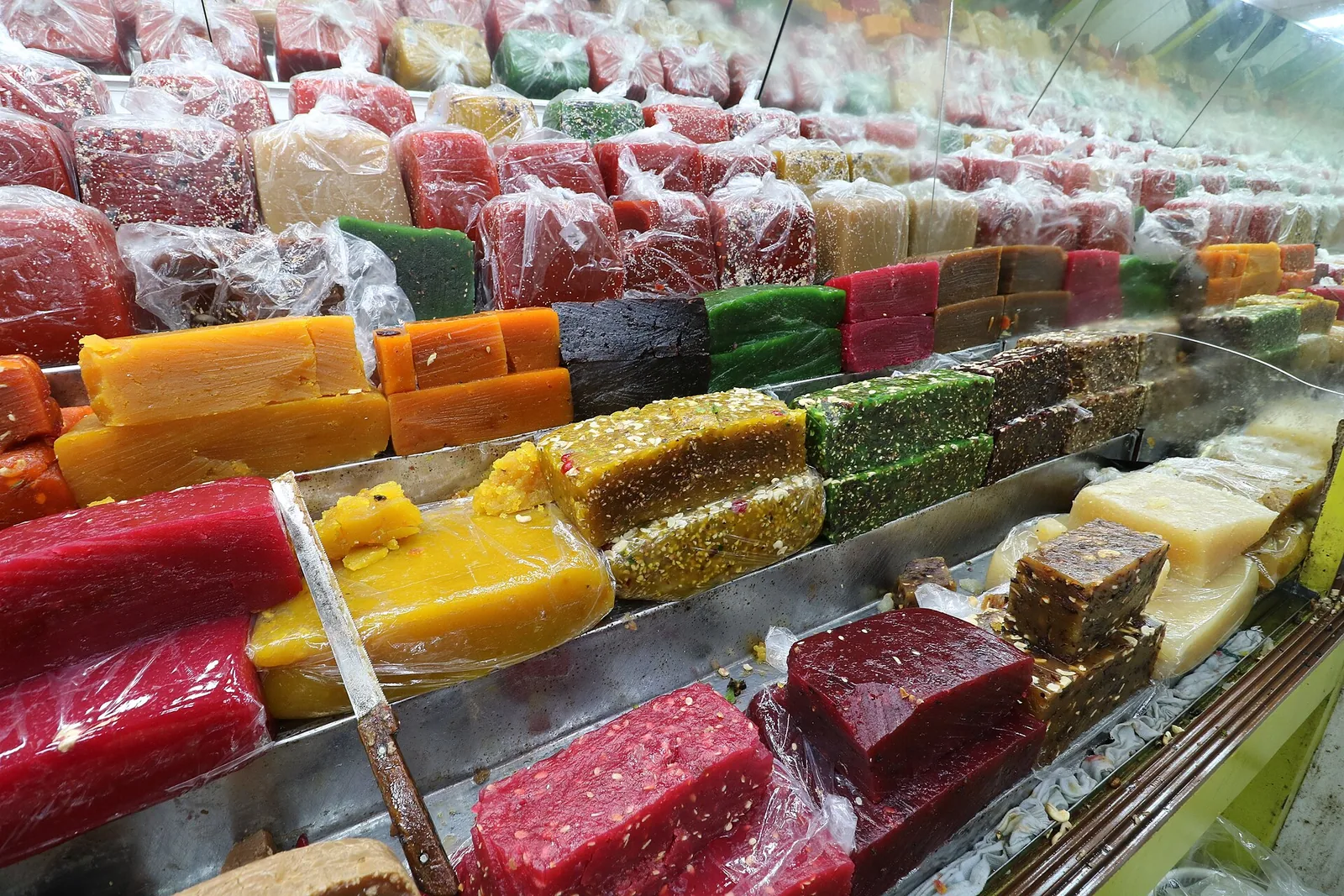
Walk down SM Street in Kozhikode and somebody will eventually tell you how it got its English name. The British, the story goes, saw slabs of dark red halwa glistening in the shopfronts, took them for cuts of meat, and called the place Sweet Meat Street — a colonial blunder set in stone and now worn by the city with a certain amused affection.
It is a very good story. It is repeated in guidebooks, on tourism pages and by people who have lived here all their lives. It is also, on the evidence, almost certainly wrong — and the way it went wrong is more interesting than the story itself.
Sweetmeat is just a word
Sweetmeat is an ordinary English noun. It has been in use for centuries and it means a confection: a candied fruit, a sugared almond, a preserved sweet, a piece of confectionery. It has never at any point meant meat, sweet or otherwise. Any English speaker of the eighteenth or nineteenth century would have used it without a flicker of ambiguity.
The reason it looks odd now is a shift inside the word. Meat once meant food in general, not flesh specifically — the narrowing to animal flesh happened gradually, and older senses survive fossilised in a few compounds. Mincemeat is the obvious parallel: the mincemeat in a Christmas pie contains dried fruit, sugar, spices and suet, and no meat whatsoever, for exactly the same reason.
So a street lined with confectioners was, to the people naming it, a sweetmeat street. Not a joke, not an error, not a mistranslation. A description, using the correct word, of what the shops sold.
Where the folk etymology comes from
The halwa-looks-like-meat story is what linguists call a folk etymology: an explanation invented after the fact to make sense of a word that has stopped being transparent. These are extremely common and they follow a predictable pattern. A name becomes puzzling because the language moves on; the puzzle demands an answer; somebody supplies a vivid one; and the vivid version, being far more memorable than the dull truth, spreads faster and further.
It helps that this particular invention is plausible on sight. Kozhikodan halwa really is sold in dense slabs, and the classic red variety really does have a wet, sliced-block appearance that a person primed for the suggestion can read as meat. Stand at a halwa counter and the story writes itself. That is precisely why it has travelled so well.
The Malayalam name settles it. Mittayi Theruvu means sweet street — mittayi is the sweet, theruvu the street. The two names have always said the same thing. The English one only appears to need explaining because English changed and Malayalam did not.
Why bother correcting it
Partly because the true version is better. A colonial-blunder story flatters a familiar narrative in which the outsider misunderstands and the locals quietly enjoy it. The plain version says something more accurate and less comfortable about this city: that a street of Gujarati confectioners, trading under a Malabar king, was described in ordinary English by administrators who knew exactly what they were looking at, and that all three of those facts sat together without friction for a very long time.
And partly because Kozhikode has enough real history that it does not need an invented anecdote. This street is around five hundred years old. It began, by tradition, when the Zamorin invited sweetmeat makers from Gujarat to set up shop outside his palace walls. That is a genuinely remarkable origin, and it is a good deal more interesting than a joke about the British and a tray of halwa.
What to do with the story
There is a further reason to be sceptical, which is that the anecdote has no obvious source. Folk etymologies of this kind are typically attributed vaguely — to the British, to an unnamed officer, to colonial times — without a document, a date or a name attached, and this one follows the pattern exactly. Genuine naming incidents usually leave a trace in a gazetteer, a survey record or a memoir, because the people doing the naming were administrators who wrote things down constantly. An event that supposedly gave a major street its official name and yet appears nowhere in the record is a story about the name rather than a record of it.
Compare it with the parallel cases and the pattern is unmistakable. A great many Indian place names carry invented origin stories in English, usually built around a misheard word or a comic misunderstanding between a European and a local, and the vast majority dissolve on inspection into ordinary descriptive names that stopped being transparent. The stories persist because they are charming and because nobody has any particular interest in checking.
None of which means the halwa is irrelevant to the name. It is the entire reason for it. The street was called Sweet Meat Street because it was full of confectioners, and it was full of confectioners because a Malabar king had invited a community of them to trade there. The connection between the sweets and the name is direct and real. What is invented is only the moment of confusion — the idea that somebody looked at a tray of halwa and got it wrong.
It is also worth noting how thoroughly the abbreviation has won. Almost nobody says Sweet Meat Street in full any more; it is SM Street in English and Mittayi Theruvu in Malayalam, and the awkward middle term has been quietly worn away by use. In another generation the full name may survive mainly in the folk etymology that purports to explain it, which would be a nicely circular ending — a story invented to explain a name, outliving the name itself.
Keep telling it, by all means — but tell it as what it is, which is a story about how names decay rather than a story about colonial ineptitude. Then buy the halwa. The etymology is settled but the confectionery is not, and the varieties on offer are a subject that genuinely rewards fieldwork. The rest of old Calicut is on the Kozhikode hub.
One last thought for anyone who finds the correction deflating. The invented story survives because it gives the street a moment — a scene you can picture, with characters in it. The true account has no scene, only a slow process: a word in ordinary use, a trade established by royal invitation, and a language quietly moving on over two centuries until the name it left behind looked like a puzzle. That is how most names actually happen, and it is worth getting used to, because the alternative is a world in which every place is explained by an anecdote and none of them are true.