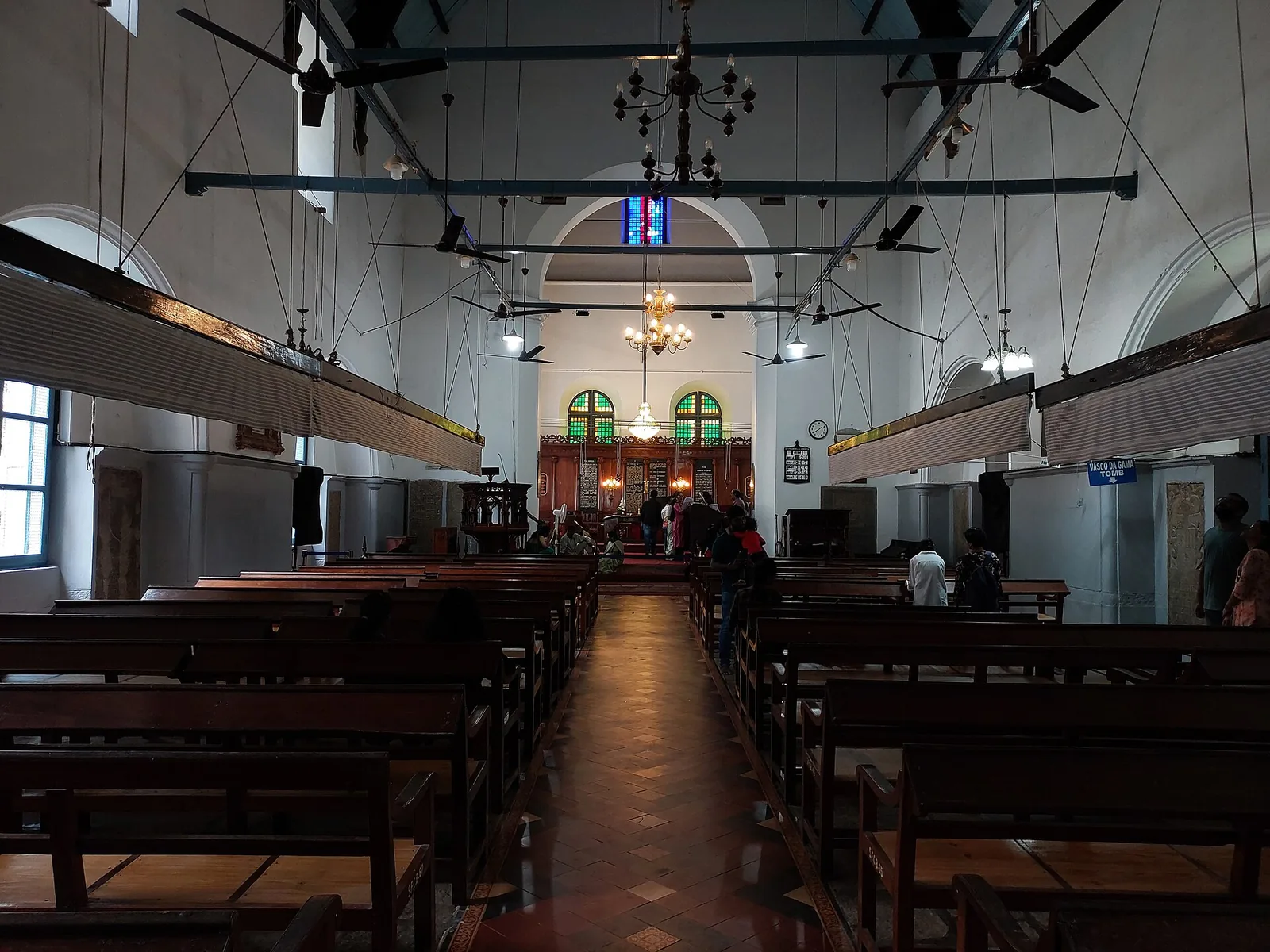
Everything written about St Francis Church treats the name as a fixed point — the oldest European church in India, called St Francis since the Portuguese raised it. It has not been. The dedication is the fourth identity this building has carried, and it is the most recent by a wide margin. It is also British.
1503: a wooden church called St Bartholomew
The first structure went up in 1503, built of timber and mud by Portuguese Franciscan friars inside Fort Emmanuel, with the permission of the Raja of Cochin. It is generally recorded as dedicated to St Bartholomew.
That permission is worth pausing on. The oldest European church in India stands where it does because a Kerala king allowed it — the Portuguese were not building on conquered ground in 1503, they were building on a concession. The whole later architecture of European power on this coast starts from a grant.
c. 1506–1516: rebuilt in stone, as Santo Antonio
In 1506 the viceroy Francisco de Almeida obtained permission to replace the fort’s wooden buildings with stone and masonry. The church was consecrated that year and the work ran on to about 1516, and the rebuilt church is widely given a new dedication: Santo Antonio.
The dedication history here is genuinely tangled across sources and we are not going to pretend it is clean — some accounts carry St Bartholomew forward, others have Santo Antonio from the stone rebuilding. What no account supports is the name being St Francis at this stage.
Which produces the anachronism nearly every guide repeats. Vasco da Gama died at Kochi on Christmas Eve 1524 and was buried inside this building; his remains were exhumed and shipped home to Portugal about fourteen years later. He was buried in a Portuguese Catholic church of a different dedication, under a Portuguese floor, inside a fort that no longer stands. “Vasco da Gama was buried in St Francis Church” is off by roughly two hundred and seventy years.
1663: the Dutch keep one church, and it is this one
When the Dutch took Kochi from the Portuguese in 1663 they demolished very nearly every church in the town. This one they kept, reconditioned, and made the government church of the settlement, under Dutch Reformed worship. A notable restoration is dated to 1779.
It is worth being clear about why it survived, because it was not reverence. Nobody in 1663 was protecting the oldest European church in India — that framing did not exist. A Protestant administration needed one serviceable building for official worship in a town it had just taken, and picked the best one standing. The single most important act of preservation in this church’s history was an administrative convenience.
- 1503 — wooden church inside Fort Emmanuel, dedicated to St Bartholomew.
- c. 1506–1516 — rebuilt in stone under Francisco de Almeida; widely given as Santo Antonio.
- 1663 — Dutch conquest; nearly all other churches demolished, this one kept as the government church.
- 1795 — British takeover; Anglican use; renamed St Francis.
- 1923 — declared a protected monument under the 1904 Act; today a Church of South India parish.
1795: the name it has now
The British took Kochi at the end of the eighteenth century, and in 1795 the church passed into Anglican use and acquired the dedication it still carries. Everything printed on the gate, the signboards and the tourism pages dates from that moment — three centuries after the first church stood on the spot.
In April 1923 it was declared a protected monument under the Ancient Monuments Preservation Act of 1904, and it remains under the care of the Archaeological Survey of India. With the reorganisation of Protestant churches in India it became part of the Church of South India, which is the congregation that worships here now.
Why the naming matters
Partly because it is simply true and nobody says it. But mostly because it changes what the building is. A church with one name for five hundred years is a monument to continuity. A church that has been St Bartholomew, then Santo Antonio, then an unnamed Dutch government church, then St Francis, is a monument to the opposite — to a piece of ground being taken and re-taken, and the roof over it being re-labelled each time by whoever held the fort that year.
The other claim on the signboard deserves the same care. “Oldest European church in India” is doing careful work with the word European: Kerala’s Saint Thomas Christian communities long predate the Portuguese, and their churches are not in the comparison at all. Treat it as the commonly repeated tradition it is, in its narrow form.
What to do with twenty minutes
Stand at the railed rectangle in the floor and register that it is a site, not a grave — the body left for Lisbon in the 1530s and the plaque says so. Look up at the punkahs, the rope-pulled cloth fans that servants outside once swung through humid services. Then look at the walls and notice which language a memorial is in, because the lettering changes with the regime.
And come at a time when a service is on, if you can. It is an active parish, not a ruin with a ticket, and the difference between a weekday morning here and a Sunday is the difference between a monument and a room in use.
Frequently asked questions
Was the church always called St Francis?
No. The dedication dates from 1795, when the British took Kochi and the building passed into Anglican use. The first wooden church of 1503 is generally recorded as dedicated to St Bartholomew, and the stone church completed around 1516 is widely given as Santo Antonio. Between 1663 and 1795 it served as the Dutch government church of the settlement.
So Vasco da Gama was not buried in “St Francis Church”?
He was buried in this building, but not under that name — the name was still two hundred and seventy years away. Da Gama died at Kochi on Christmas Eve 1524 and was interred here; his remains were exhumed about fourteen years later and taken back to Portugal, where he now lies in the Jerónimos Monastery in Lisbon.
Why did the Dutch spare this church?
Because they needed one. On taking Kochi in 1663 they demolished very nearly all the town’s churches, kept this one, reconditioned it, and used it as the government church of the settlement. It was an administrative decision by a Protestant regime, not an act of heritage preservation — that idea did not exist yet.
Who built the first church here, and on whose land?
Portuguese Franciscan friars, in 1503, inside Fort Emmanuel — and with the permission of the Raja of Cochin. The Portuguese were operating on a concession from a Kerala king at that point, not on conquered ground.
Is it really the oldest European church in India?
That is the standard claim and the qualifier matters: European-built. Kerala’s Saint Thomas Christian communities are far older than the Portuguese and their churches are not part of the comparison. We publish it as the widely repeated tradition it is rather than as a settled fact about Christian worship on this coast.
When did it become a protected monument?
In April 1923, under the Ancient Monuments Preservation Act of 1904. It is cared for by the Archaeological Survey of India and is at the same time an active Church of South India parish — which is why it behaves as both a monument and a working church depending on the hour you arrive.