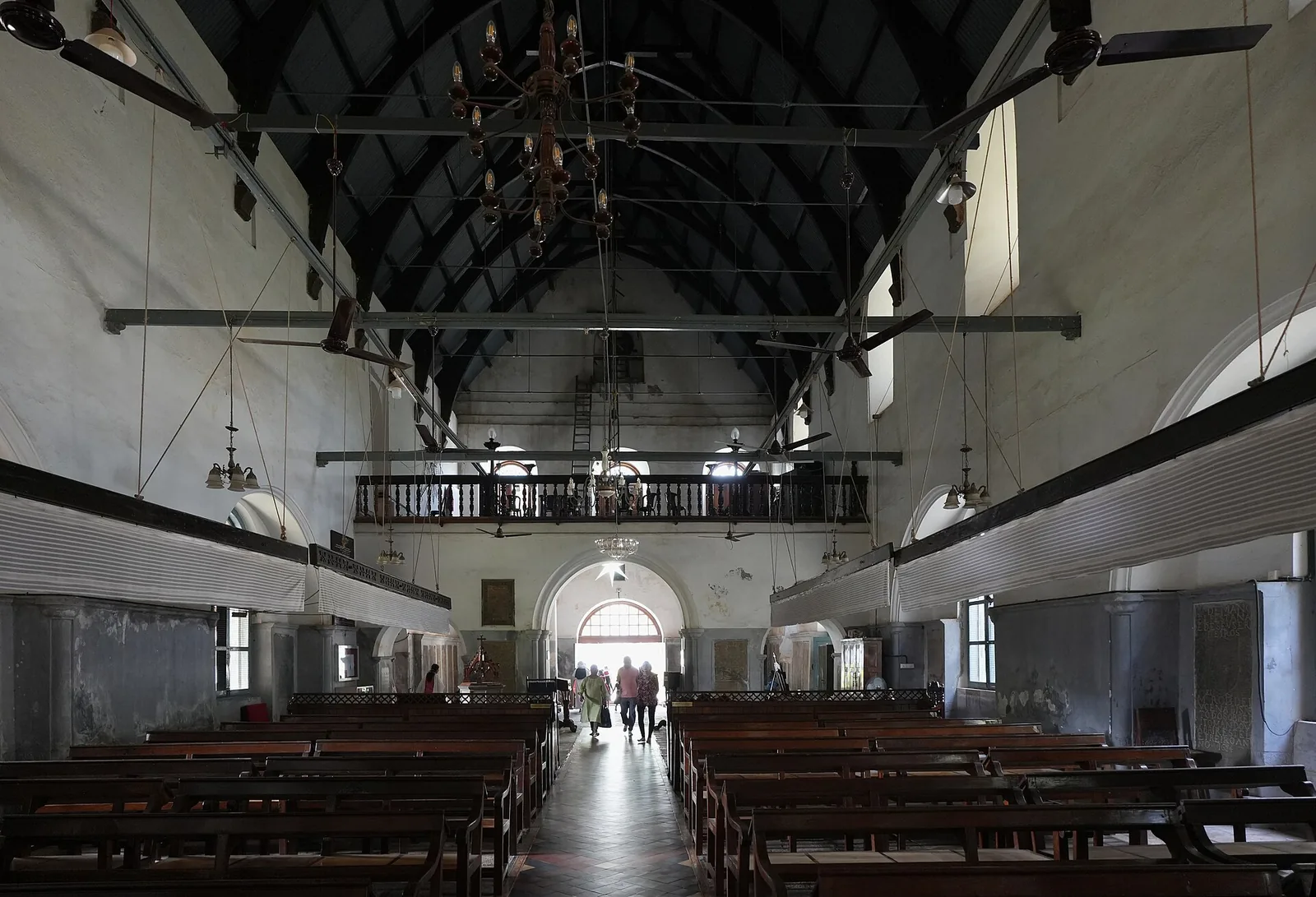
The average visit to St Francis Church runs about eight minutes: in from the glare, straight to the railed rectangle of stone in the floor where Vasco da Gama was buried, a photograph, out. The grave has been empty since the 1530s. The rest of the building has not.
Here is what to look at instead, in the order it is worth looking at it.
Look up: the punkahs
Slung above the pews on wooden frames are long horizontal cloth fans — punkahs. Before electricity, an attendant sat outside the church and pulled a rope, and the great flap swung back and forth over the congregation for the length of the service. Several survive here in place.
They are worth a proper minute because of what they encode. The congregation is inside, seated, cool. The man supplying the cool is outside, unseen, working. It is the single most efficient summary of colonial church-going in the building, and it is hanging over your head in cloth and wood.
Look down and sideways: the ledger stones
The walls carry a wall of the dead. Portuguese and Dutch tombstones, many lifted out of the floor and fixed upright along the interior, record merchants, officials and their families in worn Latin and Dutch. The earliest Portuguese epitaph is often cited from 1562 and the earliest Dutch from 1664.
That practice — burying under the floor of the nave, as close to the altar as rank and money allowed — is the reason the Dutch Cemetery down the road matters. When the Protestant Dutch consecrated separate ground in 1724, they were breaking with exactly this. You can see both halves of that argument within a five-minute walk, which is unusual anywhere.
- Portuguese Roman Catholic — built c.1503 in timber and mud, rebuilt in stone around 1516.
- Dutch Reformed — from 1663, when the Dutch took Cochin, demolished other churches and kept this one. A restoration is dated 1779.
- British Anglican — from the turn of the nineteenth century, with further reshaping through the 1800s.
- Church of South India — the active congregation today, after the reorganisation of Protestant churches in India.
- Protected monument since (commonly) 1923, under the Archaeological Survey of India.
The thing that is genuinely rare here
It is not the age, though the age is real. It is that four separate Christian establishments used the same room without pulling it down and starting again, and each left something in it. The plainness you are standing in is Dutch Reformed conviction. The dedication and the foundation are Portuguese Catholic. The nineteenth-century reshaping is British. The candle burning now is Church of South India.
Almost every other building in Fort Kochi records a rupture — something destroyed in 1663, something demolished in 1795, something burnt in 1889. This one records a handover, repeated four times.
How to use twenty minutes here
Go in, do the grave first so it stops nagging at you, then walk the perimeter slowly and read stones. Look up at least twice. Sit down for two minutes at the back — this is an active parish, and on a Sunday you will be sitting in a service rather than a monument, which is a different and better experience of the place.
Then walk out onto the green, past the cenotaph, and go and look at the Dutch Cemetery wall. The two together make sense of each other in a way neither does alone.
Frequently asked questions
What are the fans hanging inside St Francis Church?
Punkahs — large horizontal cloth fans on wooden frames, swung by ropes pulled by an attendant sitting outside the church, to cool the congregation before electric fans existed. Several survive in place above the seating.
What are the tombstones on the walls?
Portuguese and Dutch ledger stones, many lifted from the floor of the nave and fixed upright along the interior. They record merchants, officials and their families in Latin and Dutch. The earliest Portuguese epitaph is often cited from 1562 and the earliest Dutch from 1664.
How many denominations has the church belonged to?
Four. Portuguese Roman Catholic from its founding around 1503, Dutch Reformed from 1663, British Anglican from around the turn of the nineteenth century, and the Church of South India today. It is an active CSI congregation.
Why does the church look so plain inside?
Largely because of the Dutch Reformed century. Protestant practice stripped out Catholic imagery, and the barn-simple nave you see is that conviction made visible. The Portuguese founding and the British nineteenth-century reshaping are both in the building too, but the plainness is Dutch.
Is there an entry fee?
Entry is generally free, with a donation box available. It is an active church, so visitors are asked to be respectful, particularly during services.
How long should I allow?
Twenty minutes if you look properly rather than the eight most people spend. Do the grave first, then walk the perimeter reading stones, look up at the punkahs, and sit at the back for a moment. Then walk to the Dutch Cemetery — the two explain each other.