St Mary’s parish church in Bharananganam is easiest to understand by changing viewing distance. From below, the white facade dominates. In the forecourt, the stone cross and entrance stair become individual objects. Near the porch, timber doors and the depth of the nave replace the skyline as the focus. Each position explains something different about the same building.
Start with the space before the church
The forecourt is more than the empty foreground of a photograph. A freestanding stone cross occupies it, with a substantial base and broad arms. Against the white church its darker surface is particularly clear. It creates a devotional focus outside the nave and establishes an axis towards the doors. The roof cross is a different object high above it; both can appear in one frontal view.
The broad stair makes the change of level explicit. The church does not sit on a continuous flat pavement at the edge of the road. Its raised entrance provides a ceremonial approach, while also shaping how a congregation enters and leaves. During a busy service changeover, the stair is a circulation route. The best place for studying the facade is one that leaves people room to use it.
The tower stands apart
The bell tower is separate from the principal white front. Its open stages let the sky appear through the structure, giving it a lighter profile than the church wall. In a wider view, the tower, cross and gable form three different vertical elements. Cropping the scene down to the front doors removes much of that composition.
No precise construction date follows from this arrangement alone. Separate towers and forecourt crosses occur in more than one Kerala church tradition. Here their interest lies in their visible relationship to this parish building: the cross at ground level, the open tower beside it, and the decorated frontage enclosing the worship room beyond.
Follow the front into the nave
Pointed arches recur in the facade’s openings and niches. Small pinnacles extend the rising outline, while horizontal bands divide the white surface into levels. Circular openings interrupt the pointed shapes. The result is a front that reads strongly from a distance, with details becoming clearer as one climbs towards the porch.
An oblique view adds something a straight-on photograph conceals. Behind the tall frontage stretches a long nave beneath a pitched roof, with repeated windows along the wall. That depth is the space occupied by the congregation. The projecting entrance porch mediates between the broad outdoor approach and the more intimate scale of the wooden doors.
The sanctuary has a Marian focus
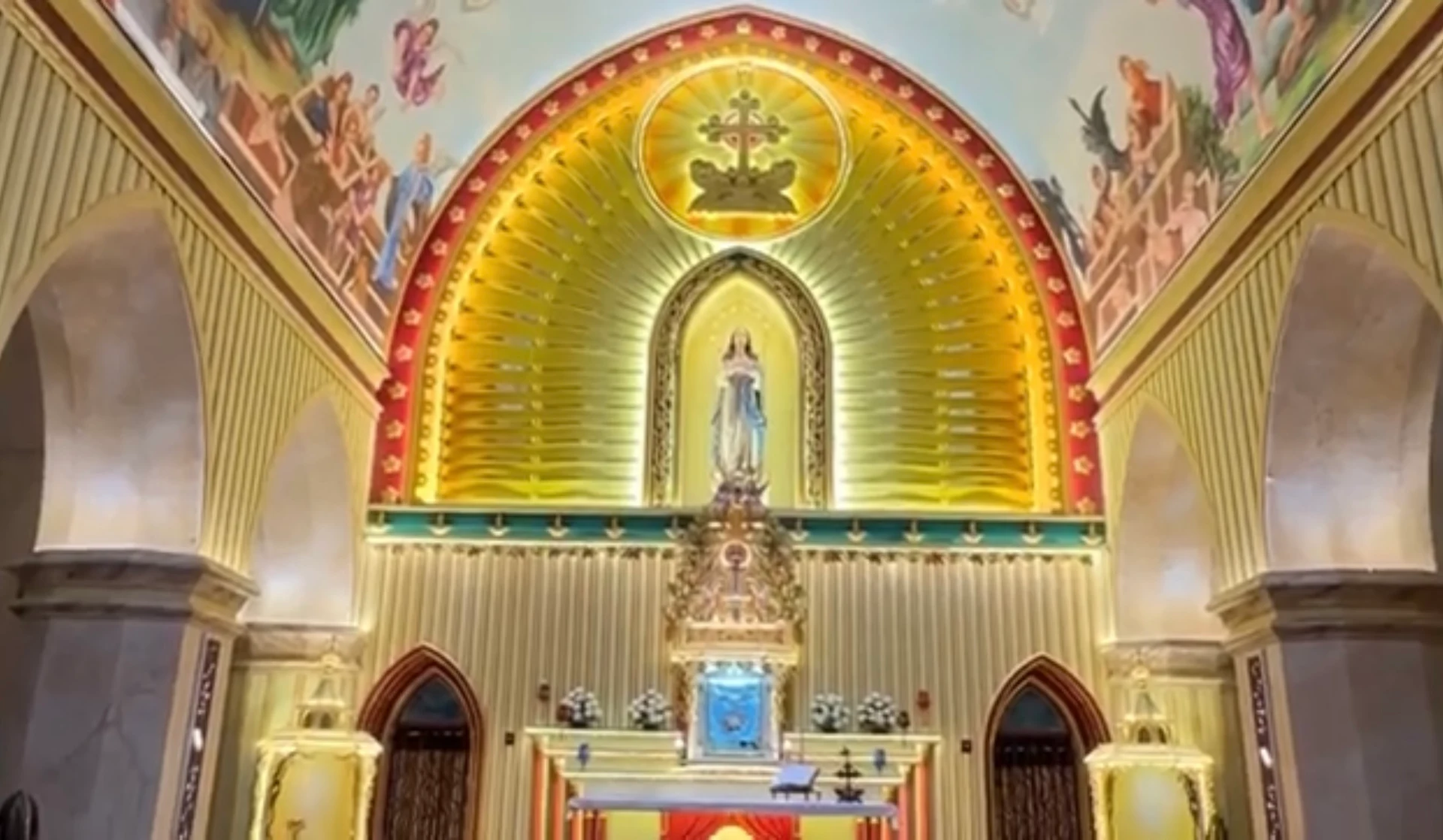
The diocese’s published altar photograph shows a Marian figure in a pointed central niche, a radiating gold background and an arched painted surround. These details fit the dedication of St Mary’s parish. They should not be confused with photographs of Alphonsa’s tomb, which belong to the separate shrine north of the church.
Institutional photographs from different dates show changes in the sanctuary’s presentation, including an older red-curtain arrangement. An architectural visit is therefore a chance to look at the room as it is being used today. It is not a search for an exact recreation of one archive photograph. Stay within the part of the nave open to visitors and let the sanctuary remain the focus of worship.
Let the service determine the route
If Qurbana is underway, the central aisle is active liturgical space. Sitting quietly at the rear or returning between services gives a better encounter with the building than moving repeatedly through the congregation. Exterior inspection can remain worthwhile when the interior is unavailable: the cross, stair, tower, porch and side elevation already tell a coherent architectural story.
For a visitor who cannot use the main stair, the crucial question is the continuous route from drop-off to an appropriate door. Paving beside the church is visible in official photographs, but a side pavement alone does not prove a step-free entrance. Arrange that practical detail before the visit so that the church’s raised setting does not become an avoidable obstacle.