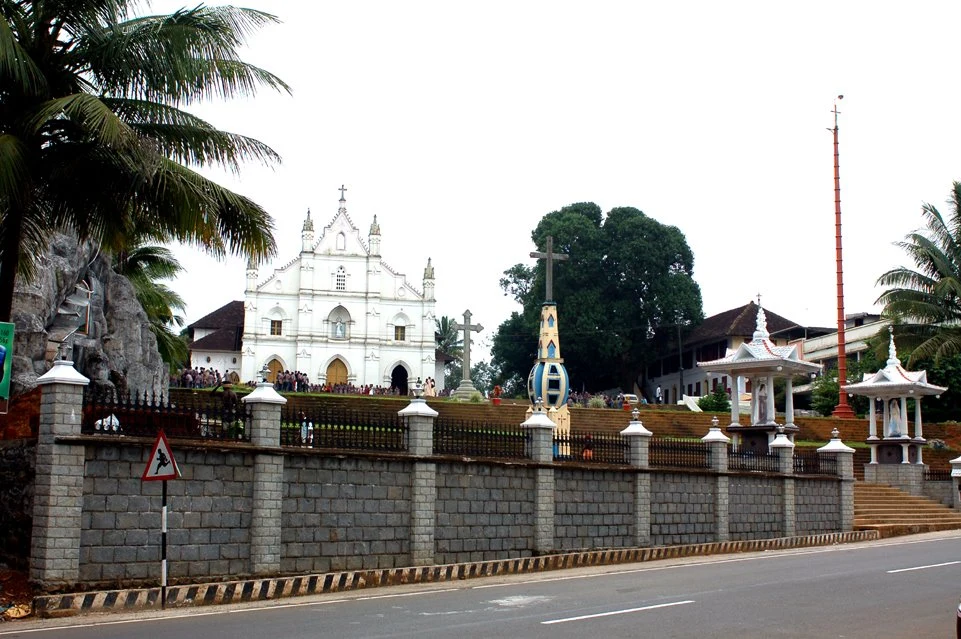
The date 1004 is striking when attached to a white church with pointed arches and a broad entrance stair. At St Mary’s in Bharananganam, it needs to be read as the foundation of a parish. The large building seen today belongs to a much later chapter. Holding those two dates apart makes the history more interesting: this is a congregation that has continued through changing buildings and institutions, rather than a claim that one facade has survived untouched for a millennium.
A congregation before the present facade
The Diocese of Palai’s parish profile records establishment in 1004. The official Alphonsa pilgrimage centre’s account adds the name Parelpally to that early foundation and places the construction of the present large church in the early decades of the twentieth century. Neither account supplies a complete building-by-building sequence across the intervening centuries. A visitor can appreciate the duration of the parish without filling that gap with an invented medieval architectural history.
Look at the building accordingly. The white front, repeated pointed openings, porch and long pitched-roof nave belong to the church one can inspect. The stone cross and separate bell tower are parts of the ensemble, but their apparent age is not an inscription. A darkened stone surface cannot, by itself, connect an object to the year 1004. Institutional continuity and the date of an individual fitting are separate historical questions.
The parish and a public school
Bharananganam Grama Panchayat’s local history records an English school opening in 1897. It says the church took the initiative in constructing a building and handing it over to the government. That small civic detail changes the way the parish can be understood. The church was involved in a town institution used for education, not only in the worship room above the forecourt.
The record does not identify every surviving school wall as an 1897 structure. What it establishes is a relationship between a congregation and the development of schooling in Bharananganam. When passing the educational and administrative spaces around a working parish, remember that these are used by a present community. They are not automatically open heritage exhibits merely because their institutional story is old.
A convent arrives in the twentieth century
The Franciscan Clarist congregation’s Bharananganam province dates Sacred Heart Convent’s foundation here to 27 October 1910. That gives a second firm institutional marker close to the period when the present church was built. A parish and a convent have different functions, but their proximity shaped the small world in which Alphonsa later studied, taught and lived as a religious sister.
The parish church is associated with her religious vows in the pilgrimage centre’s own account. Her burial belongs to the separate cemetery-chapel site. A biography can connect two places without making them one building. Preserving that distinction allows a visitor to follow both a life lived within a community and the later place where pilgrims came to her tomb.
Why the church is called a forane
The Diocese of Palai was established in 1950. Its historical milestones include Bharananganam, under the name Anakallu, among the original forane centres. The parish was therefore already many centuries old when it entered that newer diocesan structure. “Forane” describes its ecclesiastical role; it does not identify the church as the diocesan cathedral.
This layered chronology gives a useful order for the visit: a parish foundation recorded in 1004, a documented school initiative in 1897, a convent founded in 1910, the present large church from the early twentieth century, and a diocesan reorganisation in 1950. The dates describe different kinds of change. They need not be compressed into one claim about how old the church looks.
Sources and further reading
Diocese of Palai: parish profile