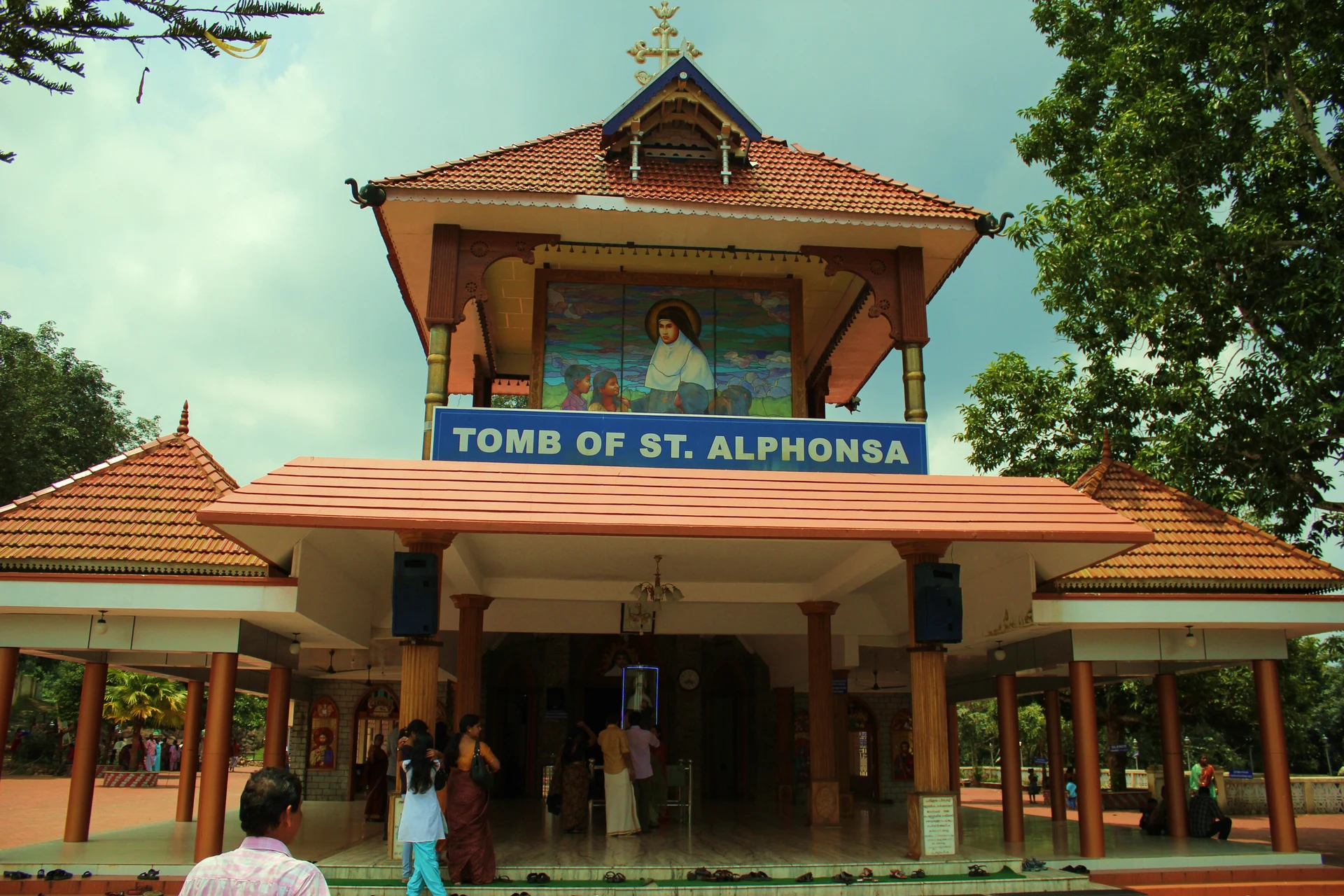
A driver asked only for “the church at Bharananganam” may reasonably think of the Alphonsa pilgrimage centre. A visitor searching for St Mary’s may expect the tomb to be inside its white facade. Both shortcuts obscure a simple fact: the parish church and the tomb shrine are separate buildings with connected histories. Knowing which visit you mean improves the whole stop.
Recognise the parish first
St Mary’s is the Syro-Malabar parish in the Diocese of Palai, also known locally as Anakkallu Palli. The building has a tall white pointed facade, a broad stair and a stone cross in its forecourt. The official parish profile gives its dedication and service calendar. It is an active congregation with a much longer history than the modern Alphonsa pilgrimage.
The parish account associates Alphonsa’s religious vows with this church. That is a connection to an event in her life, rather than to her burial. The distinction is useful for anyone following her biography: places of study, profession, community life and burial can lie close together while representing different chapters.
Locate the tomb separately
The official pilgrimage centre places the cemetery-chapel shrine about 200 metres north of the parish. Its entrance is visibly different, with a tiled roof and a sign naming the tomb of St Alphonsa. Photographs of the tomb, the devotional interior and the shrine’s entrance should be read as images of that second destination.
A cemetery chapel and a parish nave also have different spatial purposes. A parish congregation gathers around its liturgy; a tomb visit has a particular devotional focus and may involve waiting close to a small area. Arriving at the shrine does not establish that you have seen St Mary’s interior, and an exterior photograph of the parish does not document a visit to the tomb.
The calendars are not interchangeable
The parish profile lists Mother Mary Immaculate and St Sebastian in its feast calendar. Bharananganam’s widely known July pilgrimage commemoration is associated with Alphonsa’s death anniversary. During that season the wider neighbourhood may be busy, but it remains helpful to ask which institution is holding a particular service or programme.
That distinction matters especially when an itinerary is built around a liturgy. A service time published by the parish is not automatically a shrine service time. A group intending to attend worship should choose the institution first, then use its programme. Visitors interested mainly in architecture can plan their parish inspection between services and treat the shrine visit as a separate part of the day.
Plan one clear meeting point
The short separation makes combining the two possible, but it does not make them one continuous indoor complex. Before splitting up, agree whether the meeting point is the parish approach or the shrine entrance. A message saying only “back at the church” recreates the original ambiguity when different people have spent time in different places.
For someone with limited mobility, consider the actual entrances and level changes. The parish’s principal stair is substantial. The route to the shrine has its own surface and traffic conditions. A short distance on a map is not the same thing as a verified accessible connection, so a suitable drop-off for each visit may be more useful than insisting that everyone walk together.
Keep facilities attached to their institution
The pilgrimage centre advertises services including a canteen, rooms, a religious-articles centre, museum and parking. These support the shrine visit; they should not be assumed to sit inside the parish campus or to share its opening arrangements. Likewise, nearby school and convent spaces remain working institutions rather than extensions of a sightseeing route.
The reward for getting these names right is a richer visit. St Mary’s gives the parish setting of Bharananganam and part of Alphonsa’s lived religious world. The shrine gives the tomb and the later pilgrimage focus. Seeing both as distinct places allows their connection to emerge without erasing the character of either one.
Sources and further reading
Official account of the parish and shrine separation