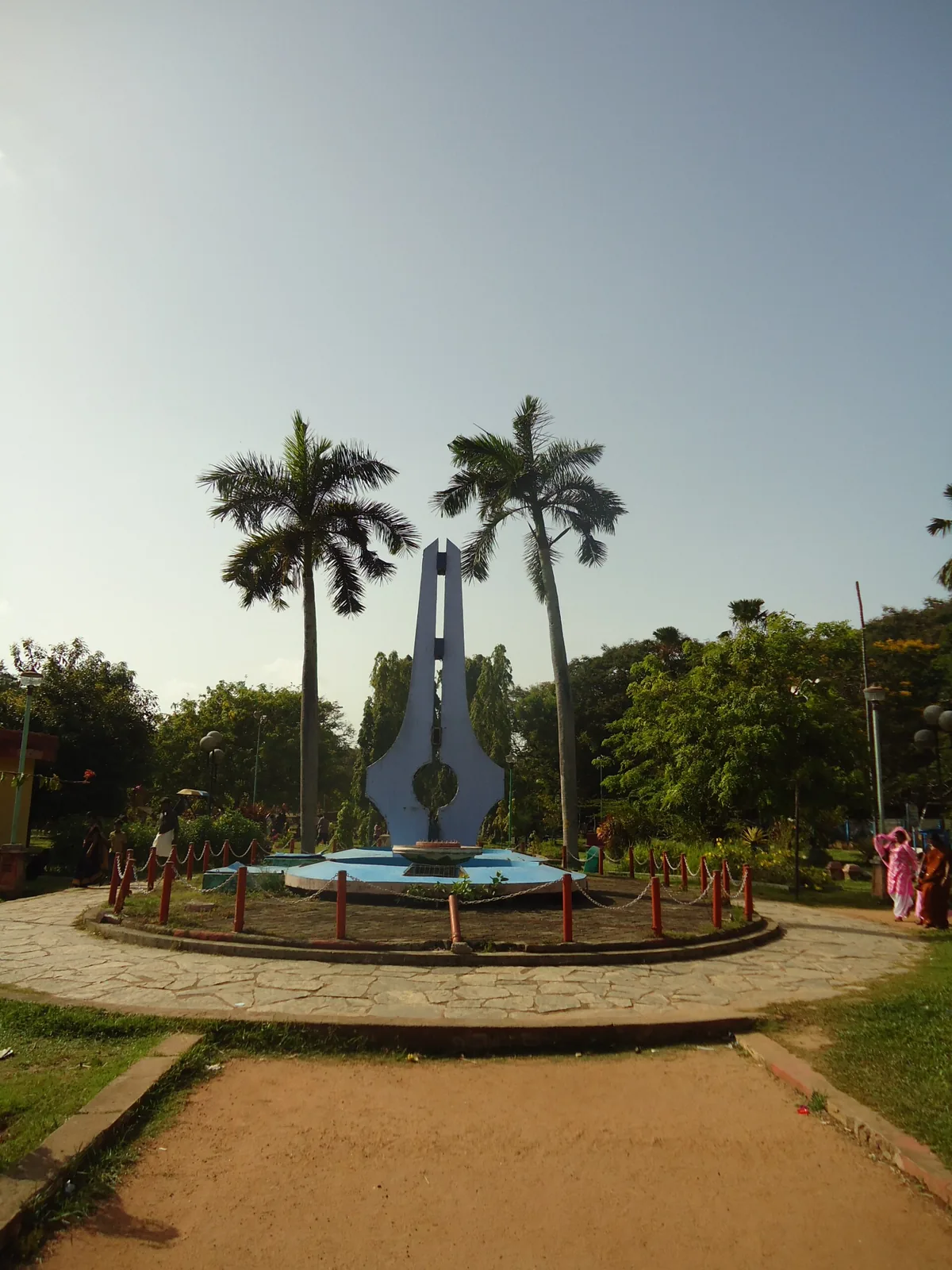
Subhash Park on the Ernakulam waterfront is listed everywhere as a pleasant green break beside the boat jetty, and almost nowhere as what it also is: a permanent open-air sculpture collection produced by an international artists’ camp. The works are in the southern part of the grounds. Most people walk past them.
What happened in 1990
In 1990 the park hosted the first International Symposium of Sculptors held here — a sculptors’ camp organised jointly by Kerala Kalapeedom and the Kochi Municipal Corporation, coordinated by the Japanese sculptor Hiroshi Mikami together with Kalapeedom’s director. Fourteen artists took part, seven from abroad and seven Indian.
The important detail is that this was a camp rather than an exhibition. The artists did not ship finished pieces in; they worked on site, in the park, over the course of the symposium, and the results were installed permanently across the southern quarter. Whatever you are looking at was made here, by hand, in this place, in that year.
The part that is missing
We cannot tell you who the fourteen were. No published source we have been able to find lists them; the works carry no labels in the park; and a sculptural handbook prepared during the 2018 restoration does not appear to be available online. A city commissioned an international sculpture collection and then mislaid the names attached to it.
This is worth stating rather than smoothing over, because it explains the thing visitors actually experience. Unlabelled sculpture in a municipal park reads as municipal decoration. The absence of a plaque is not a small oversight — it is the reason a genuine cultural asset is invisible to the people standing in front of it.
- Kanayi Kunhiraman’s Mukkola Perumal is sometimes said to be in Subhash Park. It is not.
- That work stands at the GCDA complex in Kadavanthra, on the other side of the city, and dates from 1973.
- Kunhiraman’s best-known pieces — the Malampuzha Yakshi, Sagarakanyaka at Shanghumukham — are elsewhere in Kerala.
Rescued, briefly, in 2018
By the 2010s many of the works were weathered and damaged. Between 23 January and 4 February 2018 a restoration camp ran on site, with artists repairing the sculptures in the open where the public could watch and ask questions — which is a good way to do it, and a rare one. A handbook was produced to document what was there, and the restored works were formally rededicated to the city on 6 February 2018.
Day-to-day care of the park sits with the Centre for Heritage, Environment and Development on the Kochi Municipal Corporation’s behalf, which is why maintenance here has a heritage flavour that most corporation parks do not. What it still does not have is signage.
How to actually see them
Go to the southern part of the grounds rather than the waterfront edge, where most people head for the harbour view. Give it fifteen minutes and treat it as a small sculpture park rather than a lawn with objects on it. Late afternoon is best — the light is better and the park fills with families after about six.
The wider setting rewards the same attention. This is a park that was named for a British viceroy and renamed for Subhash Chandra Bose; that has a statue of Sir Sri Rama Varma XV of Cochin standing in it; and where, in 1930, students from Maharaja’s College across the road were violently put down for demonstrating against their own state. None of that is signposted either.
Frequently asked questions
Are there sculptures in Subhash Park, Kochi?
Yes. The southern part of the grounds holds a permanent collection of works made during an International Symposium of Sculptors held in the park in 1990. They are unlabelled, which is why most visitors take them for ordinary municipal ornament.
Who made the sculptures in Subhash Park?
Fourteen artists — seven international and seven Indian — took part in the 1990 camp, coordinated by the Japanese sculptor Hiroshi Mikami with the director of Kerala Kalapeedom, and organised jointly by Kalapeedom and the Kochi Municipal Corporation. We have not found any published source that names all fourteen, and there are no labels in the park.
When were the Subhash Park sculptures restored?
In an on-site camp that ran from 23 January to 4 February 2018, with artists working in the open where the public could watch. A documentation handbook was prepared and the restored works were rededicated to the city on 6 February 2018.
Is Kanayi Kunhiraman’s Mukkola Perumal in Subhash Park?
No. Mukkola Perumal dates from 1973 and stands at the GCDA complex in Kadavanthra, elsewhere in Kochi. It is occasionally misattributed to Subhash Park.
Whose statue is in Subhash Park?
Sir Sri Rama Varma XV of Cochin, the maharaja who is reported to have started the park in 1903. There is also an information board about him in the grounds.
Is Subhash Park worth visiting?
Not across the harbour on a short trip, but yes if you are staying in Ernakulam or waiting for a ferry — and it is a better hour than its reputation suggests once you know the sculptures are there. It is free and it is immediately beside the Ernakulam boat jetty.