Most visitors to Thali Temple give it twenty minutes, and twenty minutes is enough to register that it is handsome and to leave. The building rewards considerably more than that, but only if you know where to point your eyes. Here is what to look at, and in what order.
Start with the shape of the sanctum
The sanctum is two-storeyed, and its profile is traditionally likened to a chariot — a comparison that sounds like guidebook language until you stand square on to it and see the thing actually gather into a form that looks poised to move. The roofing is copper and brass, and it behaves completely differently depending on when you come. In flat midday light it reads as dull metal. In the last hour before sunset it goes molten, and the whole upper storey lifts away from the courtyard. If you have any choice about timing, come late.
Then the band of carving under the eaves
Walk slowly around the sanctum and keep your eyes at the level where the roof meets the wall. That band — brackets, struts, the run of figures beneath the overhang — is where Kerala temple carpentry does its most concentrated work. The deep eaves that make this architecture waterproof also create a permanently shaded strip, and craftsmen filled it, knowing it would be protected from six hundred monsoons. Much of what survives best on any Kerala temple survives because it was built underneath something.
The struts are the part to slow down for. Structurally they are doing an unglamorous job — bracing the projecting rafters that carry the eaves out past the wall — and carvers across Kerala treated them as the licence to show off. Expect figures, animals, and forms that twist out of the timber at angles no flat surface would allow. They are best seen from a few steps back rather than directly beneath, and a long lens or a patient zoom will show you detail that is genuinely invisible from the courtyard floor.
The murals, which are the reason to come
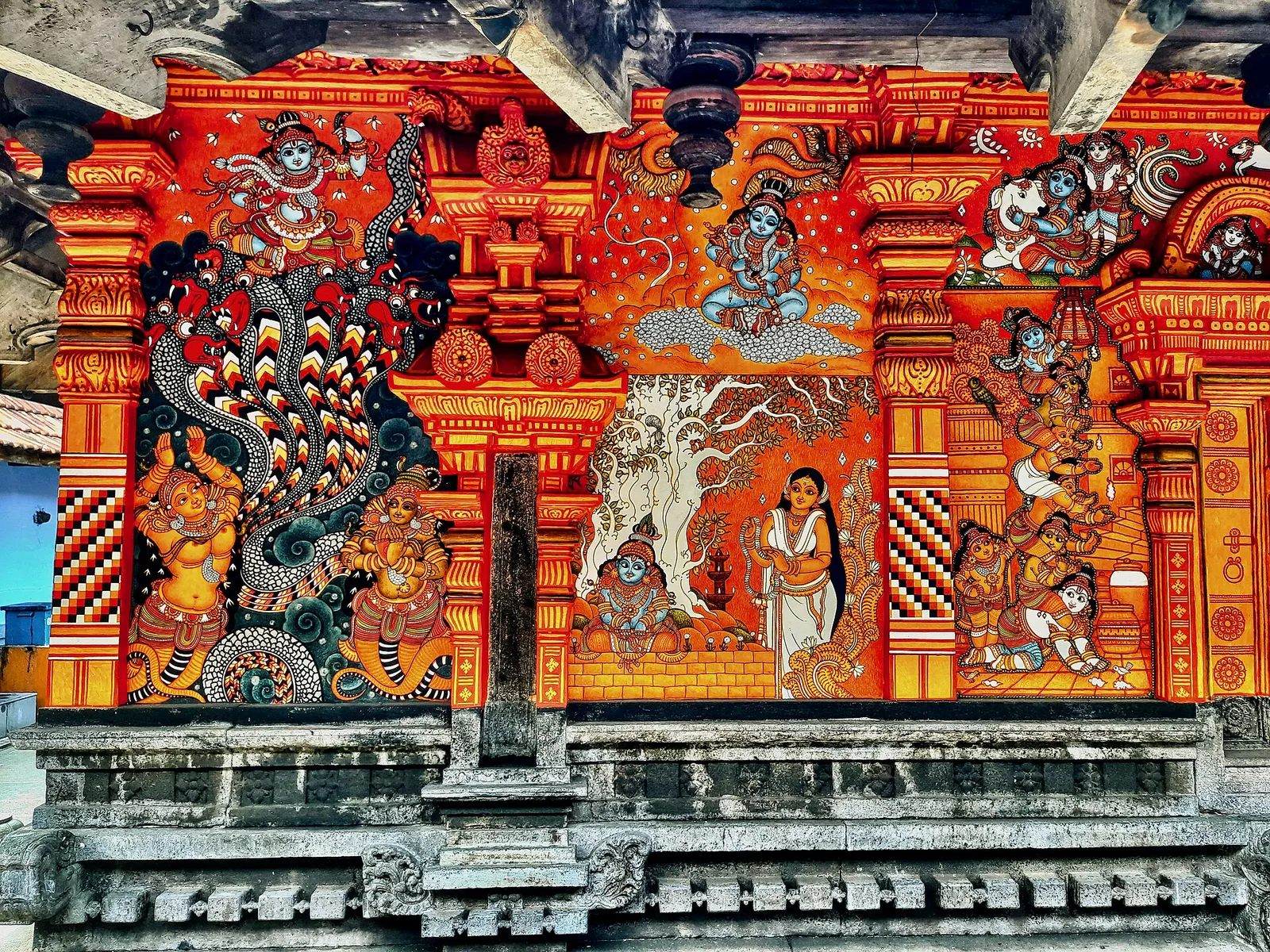
The mural panels are the finest thing at Thali and the most likely to be walked past, because they sit in the mandapams rather than facing you as you enter. Kerala mural painting works in a deliberately restricted palette — reds and ochres, a saturated orange ground, black outline, white and green used sparingly — and the effect at first glance is of overwhelming pattern. Give it two minutes and the pattern resolves into narrative.
The episodes are Puranic. You will find Krishna, serpent forms drawn with astonishing rhythmic energy, figures seated under trees, attendants stacked in registers up the composition. The convention is that scale indicates importance rather than distance, so the large figure is the significant one, not the near one, and the small figures crowding the edges are not background — they are the rest of the story, told simultaneously. Once you see that a single panel is holding several moments at once, the paintings stop being decoration and start being readable.
The colours themselves are worth knowing about. Traditional Kerala mural pigment is mineral and vegetable — ochres and laterite reds from the ground the temple stands on, black from lamp soot, white from lime, green worked up from leaves — bound and laid over a prepared lime plaster ground. The palette is narrow because the local earth is what supplied it. That is why murals from opposite ends of the state look like relatives, and why the red that dominates these panels is the same red as the soil in the road outside.
Light is the practical problem. The mandapams are shaded by design, the panels are high, and phone cameras handle the combination badly — they will flatten the reds into a single orange smear. If you want photographs worth keeping, come when the sun is low enough to bounce indirect light in off the courtyard, avoid the flash entirely, and accept that some of it is simply better looked at than photographed.
Granite below, timber above
Look down and the logic of the whole building becomes obvious. The base is granite, laid in heavy courses and carrying the sculpture that has to survive standing water. Everything above it is timber and tile. This is not a stylistic preference; it is a response to a coast that receives extraordinary rainfall. Stone where the water sits, wood where the air moves, tile where the rain lands. Every Kerala temple you subsequently visit will be built on the same reasoning, and Thali is an unusually clear place to learn it.
The courtyard, and the fact that it is in use
One more thing to catch on the way round: the copper. Sheet copper on a temple roof is not a decorative choice but a practical one — it is light enough for a timber frame to carry, it will not rot, and left alone it develops a patina that protects the metal underneath. It also has to be renewed periodically, which historically was an act of major patronage, the kind of gift a ruler or a wealthy family made once in a generation and expected to be remembered for. When the low sun catches the sanctum, you are looking at a maintenance programme that has been kept up, on and off, for six hundred years.
And look properly at the granite base while you are down there. Kerala temple stonework is generally low, heavy and deeply undercut, designed to throw hard shadows in the vertical light of the tropics rather than to be read frontally as a European frieze would be. Photographed at noon it looks flat and dull. Seen in person in the late afternoon, when the light rakes across it, the same carving reads as though it has been switched on.
The temple sits walled off from a genuinely busy part of Kozhikode, and the sudden drop in noise as you come through the entrance is part of the experience. Inside, this is a working shrine with a full daily cycle of worship, not a monument with an audioguide. People are there to pray. Move around the edges, keep clear of the ritual paths, and do not photograph worshippers.
Before you go
Many active Kerala temples restrict the inner shrine to Hindus and enforce a traditional dress code — for men that usually means removing the shirt and wearing a mundu, and for everyone it means covering the legs. Thali is a functioning place of worship and these norms can change, so check the current rules at the temple rather than relying on anything written in advance. If you can manage it, come in the Malayalam month of Thulam, in October or November, when the Revathi Pattathanam fills the courtyard with scholars. The rest of old Calicut is on the Kozhikode hub.