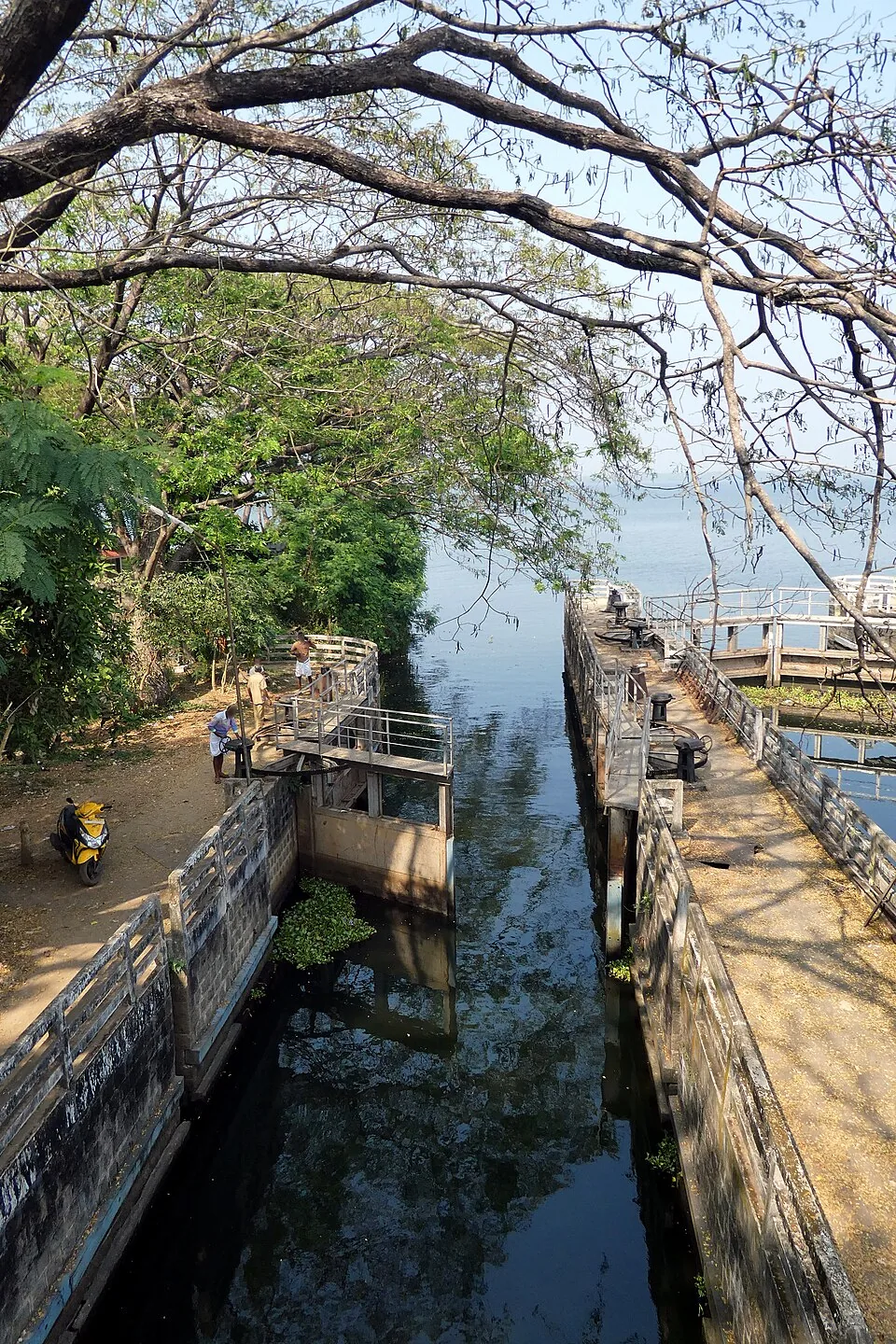
Almost everything written about the Thanneermukkom barrage describes it as a barrier, which it is. It was built to stop salt water pushing south up Vembanad into the below-sea-level paddy land of Kuttanad, and for a good part of every year its shutters are closed and the lake is, functionally, two lakes.
But Vembanad is a working waterway. Country canoes, cargo boats, fishing craft and ferries move up and down it, and they were not going to stop moving because an irrigation department put a wall across the middle. So the wall was built with doors.
Four locks
The barrage carries navigation locks — two on the Vechoor side, completed in 1965 alongside that half of the shutters; one on the Thanneermukkom side, completed in 1975; and a fourth in the central stage that opened much later. Four in total when the structure is complete, alongside ninety shutters.
A lock is a very old idea and an almost embarrassingly simple one. It is a chamber with a gate at each end. A boat comes in through the open gate; that gate closes behind it; water is let in or out until the level inside the chamber matches the level on the other side; then the far gate opens and the boat carries on. The boat has effectively been lifted or lowered over the wall by nothing more than water finding its own level.
What makes the Thanneermukkom locks worth looking at is how unglamorous the machinery is. Stand on the walkway and look down into a chamber and you see stone and concrete walls streaked with algae, heavy timber gates, and — set into the parapet — the gear that opens them: wheels turned by hand. No hydraulics, no control room. Somebody walks out, winds a wheel, and a gate the size of a house front swings.
Why it matters more than it sounds
For the boats of Kuttanad this is not a curiosity, it is infrastructure. During the months the shutters are shut, the locks are the only way through, and every canoe going between the northern and southern halves of the lake has to be locked through. Watch for a while and it becomes clear this is a routine with its own rhythm and its own etiquette — craft queuing at the approach, gathering in the chamber, going through together rather than one at a time, because a lock cycle costs the same amount of water whether it passes one boat or six.
It also quietly complicates the usual story about the barrage. The structure is generally narrated as a blunt instrument: a wall that solved an agricultural problem and created an ecological one. That is fair as far as it goes. But a wall with four locks in it was not designed by people who had forgotten the lake was used. Whatever else the barrage got wrong, somebody sat down and worked out that boats would need to keep crossing, and built the means for them to do it.
What you can actually see
This is a public structure with a road across it, so you can walk out and look. The eastern end has a viewpoint, and there is a boat jetty a few hundred metres west of it on the Thanneermukkom side. From the road deck you can see down into the lock chambers on either side, and if you have any luck at all you will catch a lock cycle in progress — the gates moving, the water boiling as levels equalise, canoes sliding through.
Bear in mind that whether the shutters are open or shut depends on the season, and we cannot tell you the dates with confidence. The closure runs through the dry months and is usually described as lasting about six months, often quoted as mid-December to mid-June, but the Irrigation Department publishes no fixed calendar that we could find, so treat any date you are given — including that one — as approximate and ask locally.
A note on what you are standing on
One last thing, because it changes how the crossing feels. The barrage was built in two halves, in 1965 and 1975, and the four hundred and twenty-eight metres in the middle could not be built at the time. For forty-three years the two ends were joined by an earthen cofferdam — a bank of packed mud — and that is what traffic crossed. The bridge over the centre opened only on 31 July 2018. If you drove this road before then, you drove across a temporary earthwork in the middle of the longest lake in India.
Frequently asked questions
How many navigation locks does the bund have?
Four when the structure is complete: two on the Vechoor (Kottayam) side finished in 1965, one on the Thanneermukkom (Alappuzha) side finished in 1975, and one in the central stage that opened later. They sit alongside ninety shutters.
Can boats cross when the shutters are closed?
Yes — that is precisely what the locks are for. A boat enters the lock chamber, the gate closes behind it, the water level is equalised with the far side, and the second gate opens. The gate gear at Thanneermukkom is wound by hand.
Can visitors watch the locks working?
Yes. The barrage carries a public road with a viewpoint at the eastern end, and you can look down into the chambers from the deck. Whether you see a cycle depends on traffic and on whether the shutters are currently shut.