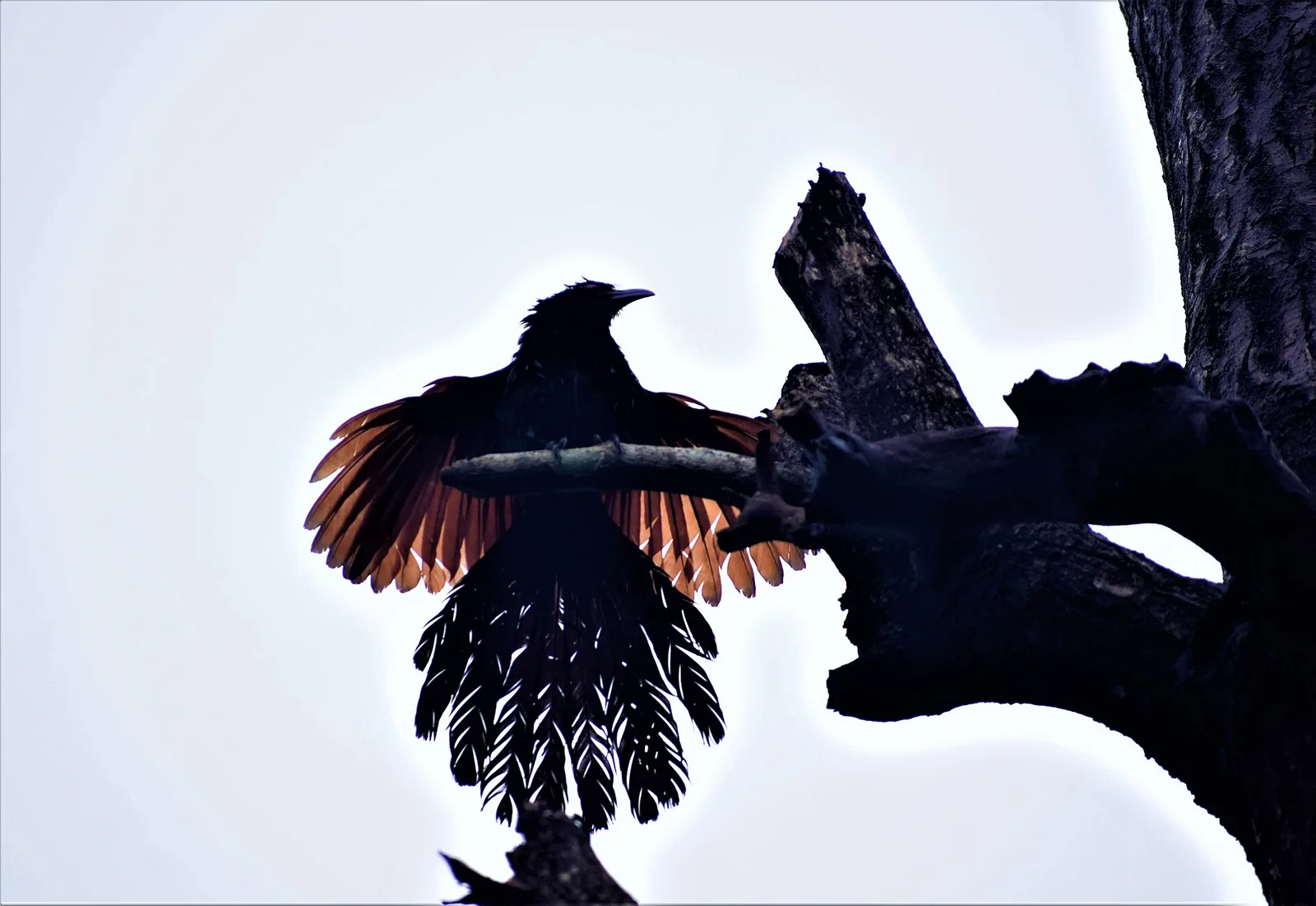
Walk the trails at the Thattekkad Bird Sanctuary and a guide will point out things you would never have found — a frogmouth pretending to be a snapped branch, a pitta ticking in the leaf litter, a trogon sitting so still it might be painted on. And then, at some point, a big glossy black bird with rich chestnut wings will crash out of a bush at knee height, fly badly for ten metres and drop into the next bush. Nobody will lift their binoculars.
That is the chembothu. It is the least rare bird in the forest and the only one at Thattekkad that Kerala has actually built a legend around.
Uppan, chembothu, crow pheasant
In English it is the greater coucal, sometimes the crow pheasant, and it is neither a crow nor a pheasant — it is a cuckoo, one that gave up the family habit of laying eggs in other birds’ nests and raises its own young. In Malayalam it is the uppan or the chembothu, and in most of Kerala the sighting of one is straightforwardly auspicious: a good omen to meet on your way out of the house, the kind of thing an older relative will still remark on.
The deep, hollow, descending call — a slow coop-coop-coop that carries a long way through thick forest — is part of why. Across its whole range from India to Southeast Asia, this bird’s voice has been read as an omen, and in Kerala it lands on the lucky side of the ledger.
The root that cures everything, and the root that eats iron
Here is the part worth carrying into the forest with you. Kerala folklore holds that the chembothu alone knows where to find a root that will cure any illness — and that it knows the whereabouts of a second, more alarming root, one that will disintegrate iron by mere contact.
It is a wonderfully specific piece of folk belief. Not a bird that brings luck in the vague way birds usually do, but a bird with privileged access to two particular items of forest pharmacology, one merciful and one faintly menacing. Nobody has ever produced either root. Nobody, so far as we can tell, has ever seriously tried.
Where the belief probably comes from is visible if you watch the bird for five minutes. The chembothu forages low and slow in dense undergrowth, turning over leaves, poking into root tangles, and frequently emerging with something long and stringy in its beak — a caterpillar, a small snake, a stem. A large, unmistakable, faintly ominous-looking bird that spends its life pulling things out of the ground is exactly the bird a forest culture would decide knows something about roots.
- Look low, not up. Coucals feed on the ground and in thick scrub, rarely in the canopy.
- Listen for the deep, resonant, descending coop-coop-coop — it carries further than the bird flies.
- Adults are glossy black with chestnut wings and a long, heavy, graduated tail. Juveniles are barred and much duller.
- They are poor fliers. A short, laboured flap from one bush to the next is characteristic.
- This is a cuckoo that raises its own chicks — one of the few in its family that does.
Cuckoo Paradise
The chembothu is not an outlier here. One part of the sanctuary is known locally as Cuckoo Paradise for the number of cuckoo species that turn up in it, and the wider family — the coucals, the drongo-cuckoos, the hawk-cuckoos, the koels — is one of the reasons serious birders keep coming back to a forest of barely twenty-five square kilometres.
Which is a good argument for slowing down. Thattekkad’s reputation rests on its scarcities: the Sri Lanka Frogmouth, the Western Ghats endemics, the long list that makes it the richest bird habitat in peninsular India. But the sanctuary is also full of birds that ordinary Kerala households have opinions about — birds that turn up in proverbs, in songs, in what your grandmother said about leaving the house. Those are worth a minute too.
How to use this
Ask your guide. The guides at Thattekkad are local, most of them grew up in these villages, and they bird by ear. If you ask what a bird is called in Malayalam and whether anyone says anything about it, you will generally get an answer — and quite often a better story than the one in the field guide. It costs nothing and it turns a species list into a place.
Frequently asked questions
What is a chembothu?
The Malayalam name for the greater coucal, also called uppan, and in English the crow pheasant. It is a large glossy-black bird with chestnut wings and a long heavy tail, and despite the English name it is neither crow nor pheasant but a member of the cuckoo family — one of the few that raises its own young rather than parasitising other nests.
Why is the chembothu considered lucky in Kerala?
Seeing one, especially on setting out, is widely held to be a good omen. The belief is tied up with folklore that credits the bird with knowledge of powerful roots, and with its deep resonant call, which is read as an omen across much of the bird’s range from India to Southeast Asia.
What is the legend about the root?
Kerala folklore holds that the chembothu alone knows where to find a root that cures all ailments, and also knows of a second root that will disintegrate iron on contact. It is a belief, not a botanical claim — no such root has ever been produced — and it probably grew out of the bird’s habit of foraging in undergrowth and pulling long, stringy things out of the leaf litter.
Is the greater coucal easy to see at Thattekkad?
Yes — it is one of the commonest birds you will encounter, and one of the easiest to identify. Look low in scrub and along trail edges rather than in the canopy, and listen for the slow descending coop-coop-coop. It flies badly and briefly, so you usually see it crossing a gap between bushes.
What is Cuckoo Paradise at Thattekkad?
A part of the sanctuary known locally for the number of cuckoo-family species recorded in it. Along with the greater coucal, the family includes drongo-cuckoos, hawk-cuckoos and koels, and it is one of the reasons a sanctuary of only about 25 square kilometres holds a bird list this long.
Should I ask guides about local bird names and beliefs?
Yes, and it is one of the best things you can do at Thattekkad. The guides are local, they bird by ear, and Malayalam bird names and the folklore attached to them are part of what makes this forest a place rather than a species list. Most guides enjoy the question.