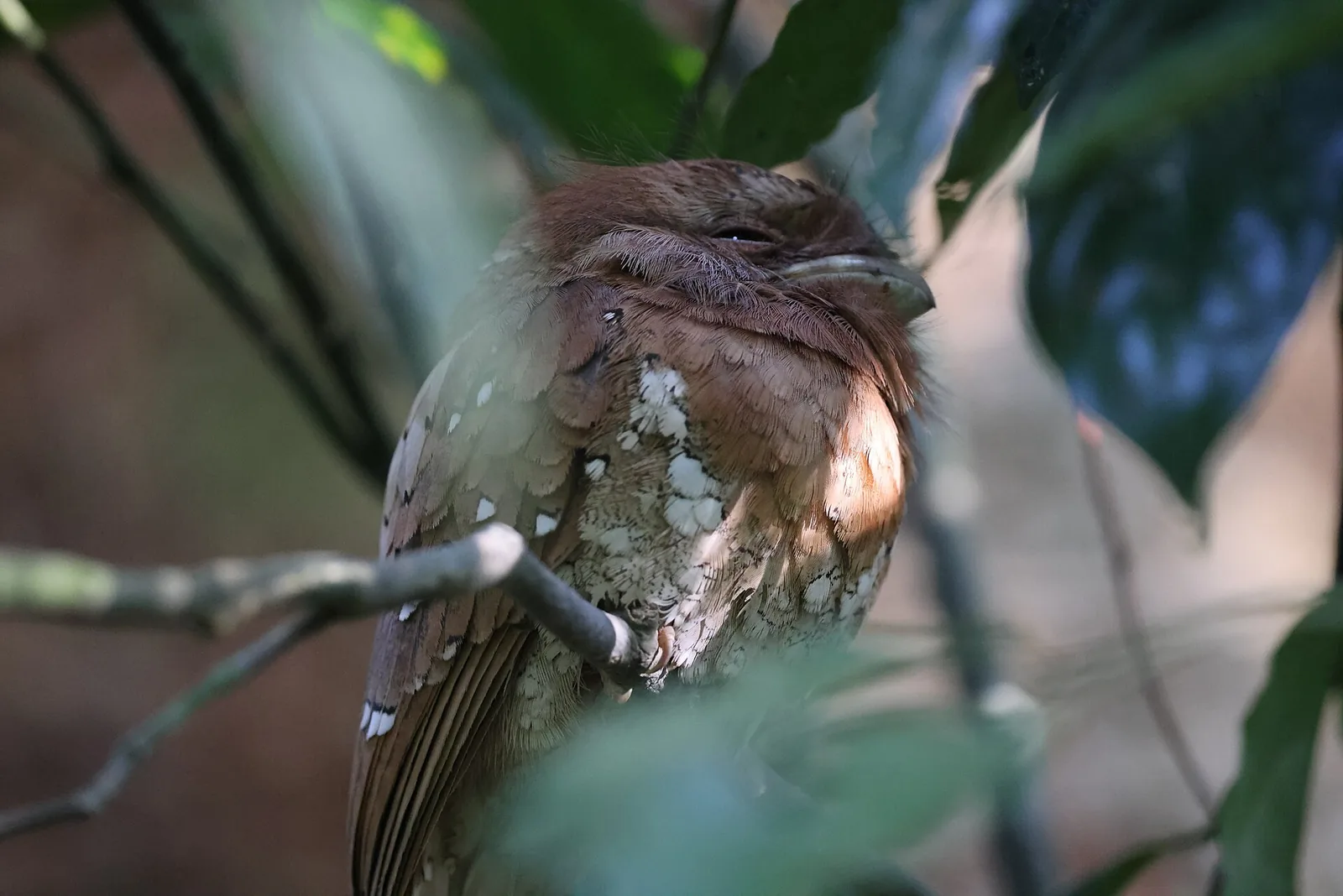
The guide stops on the trail, turns, points into a tangle of branches about four metres away and waits. You look. There is nothing there. He keeps pointing. You look harder. There is still nothing there — some leaves, a fork, a short broken stub of branch angled up at forty-five degrees. Then the stub opens one eye.
That is the Sri Lanka Frogmouth, and the Thattekkad Bird Sanctuary is one of the best places on earth to have it happen to you.
What the bird actually is
It is a small nocturnal bird, roughly the size of a fist, with an enormous flattened hooked bill that gives it the frog-mouthed look and the name. It is not an owl, though it does an owl’s job — it hunts insects at night, low and quietly. And its entire daytime survival strategy is not to be a bird at all.
It roosts on a branch in plain sight, sits bolt upright, closes its eyes to slits, and points its bill upward so that its outline becomes a broken stub of wood. The plumage does the rest: the female is a rich rufous, the male a mottled grey-brown, and both are patterned like bark. It will hold that pose while you stand and stare at it. It will hold that pose while a group of eight people take photographs. It has no other plan, and it does not need one.
Its range is narrow — the Western Ghats of southern India and Sri Lanka, and effectively nowhere else. That restricted range is why birders fly in for it, and why Thattekkad, where the species has been studied and where local guides track individual roosts, sits on a great many life lists.
Why you cannot do this alone
There is no technique for finding a frogmouth by wandering. The bird does not move, does not call in daylight and does not look like a bird. What works instead is knowledge that accumulates: a guide who has watched a pair use the same stretch of forest for years, who knows the four or five branches they rotate between, and who checks them.
This is the single strongest argument for hiring an authorised guide at Thattekkad, and the reason the guiding tradition here is unusually good. Many of the guides grew up in these villages, bird almost entirely by ear, and can put you on thirty species in a morning that would have given you five on your own. The frogmouth is simply the most dramatic demonstration of the gap.
- Engage an authorised guide at the sanctuary office. The frogmouth is a guide-knowledge bird, not a luck bird.
- Go at first light. The sanctuary opens around 6:00am and the birds go quiet by mid-morning.
- Keep back and keep quiet at a roost. A disturbed bird abandons the site, and roosts are a shared resource that the next visitors depend on.
- No flash, no playback at the roost, and no pulling branches aside for a clearer shot.
- November to February is the comfortable peak season, though the bird is resident year-round.
The etiquette matters more than usual here
A roost is a fixed address. The bird returns to it, sometimes for years, and it is known to the guides because it is stable. That stability is exactly what a crowd destroys: press too close, use flash, or pull the vegetation about, and the pair simply move somewhere nobody has found yet.
So the frogmouth is a good test of how you travel. Look at it, take one photograph from where the guide put you, and go. The reward is that when you come back in five years it will still be possible.
What else the same walk gives you
The frogmouth is the headline, but the walk around it is the real value. Thattekkad’s roughly twenty-five square kilometres of low-elevation moist forest hold a long list of Western Ghats endemics along with Malabar grey hornbills, Indian pittas, trogons, woodpeckers and owls — the kind of density that made Salim Ali call it the richest bird habitat in peninsular India after his 1933 survey. The frogmouth is what gets people onto the plane; the forest is what they talk about afterwards.
Frequently asked questions
What is the Sri Lanka Frogmouth?
A small nocturnal bird of the Western Ghats and Sri Lanka, with a huge flattened hooked bill. It is not an owl. By day it roosts motionless on a branch with its bill pointed upward, imitating a broken stub of wood — which is its entire defence.
Can I find a frogmouth at Thattekkad without a guide?
Realistically, no. The bird does not move or call in daylight and does not look like a bird. Guides find them because they know individual roosts and check them. Engage an authorised guide at the sanctuary office — this is the clearest case anywhere in Kerala for doing so.
Why is Thattekkad famous for the frogmouth?
It is one of the species’ last strongholds, it has been studied here, and the local guiding tradition tracks known roosts. Between the restricted range and the reliable access, Thattekkad has become one of the best places in the world to see one.
What time of day should I go?
First light. The sanctuary opens around 6:00am and guided trail sessions run from about 7:00am. Bird activity drops off sharply by mid-morning, so a late start largely wastes the trip — though the roosting frogmouth itself is, by definition, a daytime sighting.
How should I behave at a frogmouth roost?
Stay where the guide places you, stay quiet, do not use flash or call playback, and do not move branches for a better photograph. Roosts are used for years and are known to the guides because they are stable; a disturbed pair simply moves somewhere nobody has found.
What else will I see on the same walk?
Malabar grey hornbills, Indian pittas, trogons, woodpeckers, owls and a strong cast of Western Ghats endemics, from a list of several hundred species recorded across the sanctuary. A guided dawn walk commonly turns up thirty or more species.